Peru governor touts Chinese interest in deep-water port pitched as Chancay alternative
A planned US$844 million port in southern Peru has drawn interest from several foreign investors, including Chinese companies, a regional governor said on Monday, as the government began promoting the project abroad.
“Several companies have approached us. We have investors from the US, China and India who are very interested,” Rohel Sanchez, the governor of Arequipa, told reporters after signing an agreement with the state investment agency Proinversion.
He said firms from Turkey and the Netherlands had also been in touch, as had South Korean investors interested in technology for a logistics park to be built alongside the terminal.
Proinversion president Luis del Carpio said Corio would likely handle general cargo and containers but could also be used to export copper from the region to Asia.
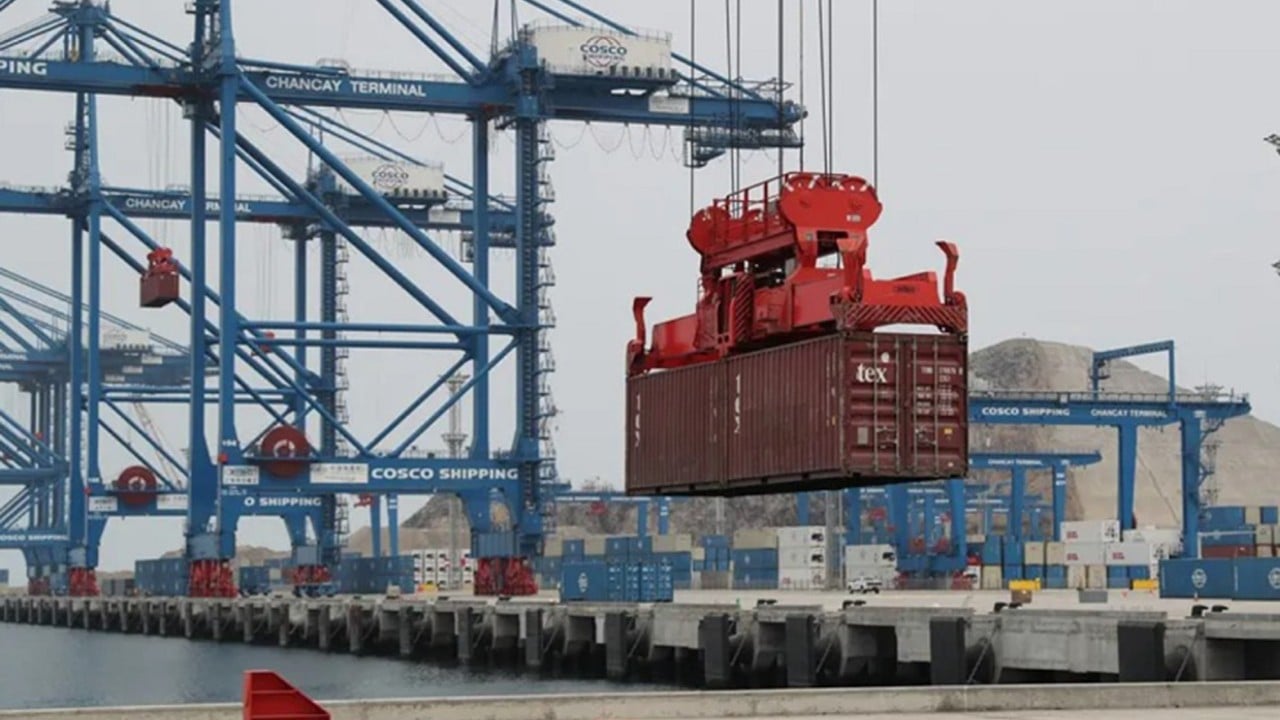
Regional officials have long promoted the deep water off Punta de Bombon, in Islay province, which they put at between 20 and 28 metres (66 to 92 feet). Chancay, the port north of Lima that China’s Cosco Shipping Ports has run since November 2024, has a maximum depth of about 18 metres.
08:02
Uncertainty surrounds Peru’s new Chinese-built Chancay megaport
Smaller master plan
For years, Arequipa’s government described Corio as a US$7 billion hub with room for 100 million tonnes of cargo a year, more than Peru’s public ports currently handle in total.
The master plan approved by the National Port Authority in September is far more modest: a multipurpose terminal of around US$800 million developed in three phases.
Its capacity would be close to 2 million tonnes a year, industry sources told the news site Infobae.
Proinversion now has to draw up tender rules and find an operator willing to finance, build and run the terminal, the Lima-based magazine Revista Economia reported in September.
A demand study commissioned by the port authority had not been finished, and specialists quoted by the magazine estimated that operations could begin in five or six years at the earliest.
Chinese interest
Sanchez, who leaves office in December, has also spoken of Chinese suitors before. In September 2024, he said business delegations from China, South Korea, Portugal and the US had visited Arequipa to look at the project.
Julio Caceres, president of the Arequipa chamber of commerce, went further during the Asia-Pacific Economic Cooperation summit in Lima two months later, telling the broadcaster RPP he had “confidential information” that four Chinese companies had approached the regional government. No names have emerged since.
A report on Peru’s port sector published in August by Shanghai Maritime University, on a Shanghai government platform that advises companies investing overseas, did not discuss Corio.
It recommended that Chinese firms enter the Peruvian market through equipment, engineering and logistics contracts and warned against port investments justified only by cargo forecasts or memorandums of understanding.
Two Chinese-backed port projects are already under way in Peru. In September the government said Jinzhao, a mining company owned by China’s Zhongrong Xinda Group, would start construction in 2027 of a US$405 million port at Marcona, in the Ica region, once a land agreement with Shougang Hierro Peru had removed the last major obstacle.
Transport minister Jose Tangherlini said the first phase would take about two years and cost US$200 million. Most of the cargo will come from Jinzhao’s own Pampa de Pongo iron ore mine, a US$1.78 billion project.
Cosco, meanwhile, has spent most of this year fighting Peru’s transport regulator Ositran over its power to supervise Chancay.
The US State Department called the port’s Chinese owners “predatory” in February, after a lower court ruled in Cosco’s favour. An appeal court sided with Ositran in July, and Cosco said last month it would keep up its challenge.
Las Bambas, the largest Chinese-controlled copper mine in southern Peru, already exports through Matarani, a port in the same province as Corio. The mine, run by MMG with partners Guoxin and Citic, moves its concentrate there by truck and rail and has its own berth and storage shed at the terminal.
The idea of a port at Corio dates back to 2000. The port authority rejected a private proposal in 2019, and a consortium led by a retired navy admiral, Cesar Zelada, has continued to pursue its own plans for the site, saying a US company is among its investors.
KioskNews shows a cleaned-up reading view extracted from the publisher’s page — the original always lives on their site, not ours.