We wanted to let Max Dowman bloom in the shadows but he has become hard to ignore | Barney Ronay

The poet Jorge Luis Borges wrote a famous short story about a society that had become so good at making maps, so obsessed with capturing every detail, that its rulers decided the only way to do the job right was to make a lifesize map of its entire empire, which could then be laid out across the actual land from coast to coast. Imagine a map of Britain the exact same size as Britain, showing every branch of Greggs, every nail bar, every Vape shop in perfect detail. Only then can we really see what Britain looks like, by standing on a fake Britain laid over the top of actual Britain.
Borges was writing in the 1940s, at a time when people were fascinated by the mechanised future, with its new forms of measuring out the world: the wireless, the 30mph motorcar, the rise of Big Tape Measure. And to be fair, the mega-map is a pretty accurate vision of our own fully networked present, a place where you can snoop around a village in Mozambique from your laptop in Egham, where no one ever stops committing acts of minute self-surveillance, even if they think they’re just searching “what is beetroot?” on the internet.
Borges also hated football. “Soccer is popular because stupidity is popular,” he wrote, which probably seemed a bold statement at the time. But then Borges also didn’t live to see an episode of Wow Sports Premier League Breakfast at Breakfast with Roger McRoger and a puzzled Lee Trundle. After which, perhaps less of a surprise. But the process he describes is also a good description of what football is doing to itself. Endless data, endless analysis, no spaces or free air, matches that are just schematised movement. At times it can feel like football is out there laying a lifesize real-time map on top of itself.
In Borges’s story the land soon begins to decay beneath the massive map – which is reassessed by later generations as insane, pointless and stupid – and left to rot in the desert. We haven’t reached this point. Nobody is de-mapping football. But it does perhaps explain why everyone gets so excited when a talent emerges that seems to be playful and human, to exist outside the grid. And also why it has felt wrong to gush too soon about Max Dowman, to fear placing the hex on him. We know how this works. Here is a fluffy new thing. Let us break him. Let us heap pressure on his shoulders. Don’t talk about Max Dowman. Let Max Dowman exist, breathe, bloom in the shadows.
So, Max Dowman then. It has become quite hard to ignore him. He was brilliant against Ipswich in midweek, and brilliant in a way that seems solid and real and comfortable with itself. Most obviously there were the two goals, both a perfect snapshot of why Dowman seems equipped to survive, more state-of-the-art than some other young players we’ve burdened with expectation.
The second goal is particularly good, five perfect little actions packed into six seconds of football. Arsenal have the ball on the edge of the Ipswich box. Dowman shows for a pass, sees it’s going elsewhere, changes his mind, and makes a three-yard sprint to create space. Finally he has the physical capacity to control a bouncing ball in that sliver of space, to move his feet so much quicker than the nearest defender it looks like a glitch in the machine, and to finish in a way that involves sifting the options and timing the shot, all without breaking stride.

The first goal is on his other side, and involves a more classical piece of one-on-one deception. This is the same defender: Cédric Kipré, 29 years old, came through Paris Saint-Germain’s youth system. Dowman walks through him with a micro-feint and a switch of feet, then reels off another hilariously understated finish, doing it all while a second defender is still gathering himself to lunge, like a man operating in a different time signature to everyone around him. This is the key point of difference, the ability to make everything stop, the fly-vision that means he sees what’s about to happen while everyone else is whirling about trying to read the charts, in the same way Lionel Messi (yes, sorry, sorry) always seems to have time to pass the ball into the net, like this is all a kickabout in a pair of sliders.
Our way of understanding young creative players has often seemed to lag behind where the game actually is, to be driven by nostalgia for what this thing used to look like. I remember the excitement over the 18-year-old Jack Rodwell’s physicality at the exact moment physicality was no longer going to be a thing, like proudly unveiling the latest horse-drawn train just as the Ford Model T rolls off the production line.
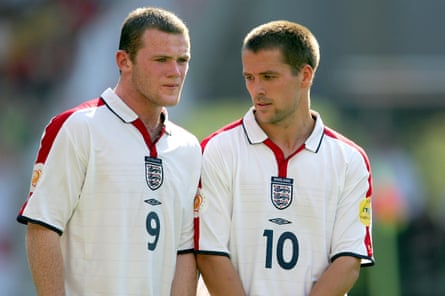
Michael Owen was brilliant at 17, but he was mainly brilliant at running very fast in a straight line and smashing the ball into the net. Plus of course there was Wayne Rooney, who emerged a pale, unformed teenager composed entirely from energy drinks and white bread, out there making the game up on the fly, as though some urban foundling had come barreling over the advert boards with a string of sausages still dangling from his mouth.
The narrative around Rooney is that he lost this vital native quality. But Rooney adapted and survived, and clearly understood what he had to be a lot better than those of us watching. And even now creative players have to exist against this. Cole Palmer is exciting because he does surprising things that seem to be striking a blow for freedom, beauty and older people who struggle to make their email work. But his real challenge is to retain just enough of this while fitting the world around him.
Dowman is a bit different. The things that make him stand out seem to speak very easily to how football is now. Being a modern creative footballer is not jinking runs, rasping drives or dribbling across a cabbage field in a pair of cowboy boots. It’s targeted energy, high-intensity semi-freedom. Lamine Yamal and Désiré Doué have the same fast-twitch foot and brain speed, the ability to operate in micro-moments, to see patterns just ahead of time. Dowman is 6ft tall and getting stronger. He won’t be kicked to pieces. He can repeat this without taking bites out of himself.
There is still the issue of his youth. But maybe this doesn’t matter so much either. The world has changed. In the age of Rooney and Owen there was no care, no data, no softness. This is where the structures of modern football are an advantage. Dowman will be GPS’d to the last decimal point. Endless physical scientists will have a say on his output and stress levels.
The money is too big. The talent is too valuable. It also comes ready to plug and play. You don’t get to this level unless you can ingest systems and briefings. You’ve already been pressure-cooked and stress-tested. What you’re being asked to do in the orderly spaces of professional football is the same thing you were asked to do in the orderly spaces of academy football, just five levels up and with more people watching.
Borges was anti-football because he saw it as inauthentic, the players no longer sports people but “actors in jerseys before the TV cameras”. And this is also fine, further evidence that boomer-dad nostalgia is one of the key archetypes of human behaviour.
Life is also different now; not harder or easier, but more instant, a series of moments, the creation of rapid-fire energy. Dowman has grown up inside this. He can parcel his time out, disappear for a bit, maybe make a show of things in the spring.
And yes this is another way of fitting him to a model, laying a lifesize map of future Max Dowman across the present. But I strongly suspect he will be fine, and that unlike so many other things out there he’s pretty well adapted to whatever the future is supposed to look like.
KioskNews shows a cleaned-up reading view extracted from the publisher’s page — the original always lives on their site, not ours.