Sidney Nolan looms large over this exhibition of his early work, but his voice can’t always be trusted
In a literal sense, an exhibition is just an array of objects. When that exhibition is devoted to a single artist, it’s their life, ambition and achievements that imbue those objects with cultural aura.
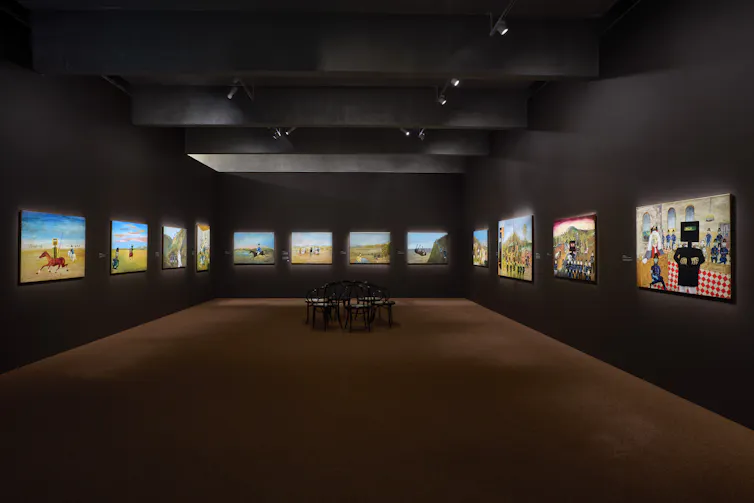
Sidney Nolan (1917–92) looms large in Nolan: Origins, the Art Gallery of NSW’s exploration of the Australian artist’s formative decades, spanning from the late 1930s until his departure for the United Kingdom in 1953.
In a wall-sized projection of filmed interviews, Nolan speaks of life, art and Australia in his characteristic manner: thoughtful, direct, quietly egocentric.
The way artists talk about their work has its own distinctive history. In my research, I’ve listened to hundreds of oral history interviews with Australian artists, tracing a long transition from the humble studio talk of last century’s veterans to the media savvy artists of today.
Always a good talker, Nolan became a seasoned interviewee in his maturity. As my ANU colleague Kate Warren recently demonstrated in her exhibition Public Impressions: Sidney Nolan in Popular Media, Nolan eagerly advocated modern art to a mass audience in the 1960s and 70s.
He delivered assertive takes on his interests, the direction Australian art should take and the happy coincidence of both in his paintings.
Bluffer or prophet?
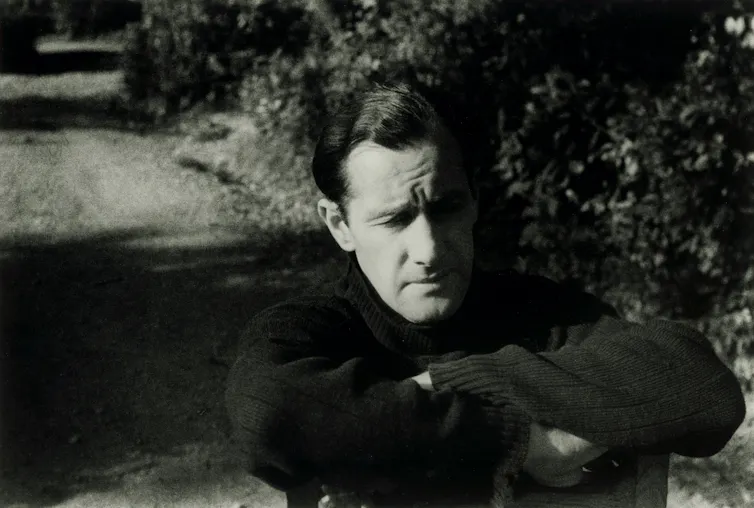
Nolan’s voice is seductive and engaging, but we shouldn’t necessarily take his statements at face value. His most recent biographer, Nancy Underhill, cites a description of Nolan as “the biggest bluffer on earth” and paints a picture of a trickster and fabulist.
A performative speaker, Nolan saw the benefits of explaining his art but was strategic in his revelations. He favoured enigmatic pronouncements, laden with tantalising but inconclusive promise.
Speaking of his iconic Ned Kelly series (the original 27 paintings of which are presented here) in the exhibition video, he hints that events in his personal life made him feel an affinity with the bushranger.
So what happened to this young artist in the mid-1940s that aligned him with the notorious 19th-century outlaw? It’s too “complicated” to go into, Nolan says softly, before moving on to his next talking point. But the seed has been effectively planted; who better to recount the legend of a bush rebel than a charismatic romantic like Nolan?
Nolan often played this teasing game, dangling then withdrawing the promise of intimate revelation.
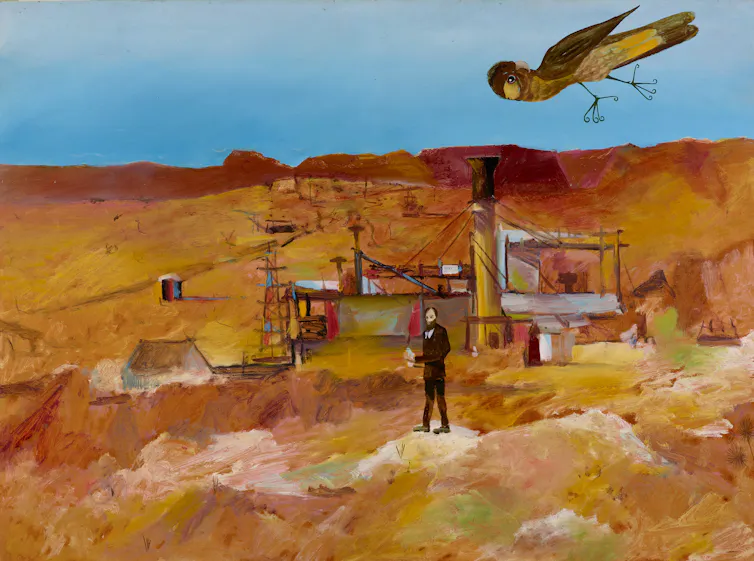
Sometimes he laid his cards on the table; when he speaks of his fascination with “crystalline” sunlight and shimmering mother-of-pearl colours, we can see it in the intensity of the paintings. In Pretty Polly Mine (1948) and Bathers (1943) the high key of the blue sky (painted in Ripolin, an enamel house paint) makes for a magic realist version of the outback and the beach.
But often, he was coyly evasive. In a 1961 interview in the Art Gallery of NSW archive, Nolan says of Tent (1940) – a remarkable early abstraction displayed in Origins – “[the shapes were] something to do with beaches and tents and girls”.
Perhaps his childhood in St Kilda was not all innocence. Maybe an enigmatic abstract painting could contain a complex psycho-sexual narrative. But Nolan says no more.
Painter vs poet
Off camera, and especially in his letters, Nolan was particularly concerned with what a painting could say, and how.
There are certainly works in Origins that are consciously coded. As curator Denise Mimmocchi explains in wall text, Cyclist (1945) depicts Nolan’s father embracing his white-clad wife at the end of an endurance race: the happy couple; the warrior and his bride.
But there’s also an undeclared meaning. A few years earlier, when Nolan’s own marriage imploded, he took a cycling tour of Tasmania while his patron John Reed cleaned up the mess.
Elsewhere, Nolan seemed exasperated by the whole business of symbols and meanings. Writing to arts patron Sunday Reed about Flour Lumper, Dimboola (1943), which features a vibrant tiger on a flour sack, he insisted that was it just something he’d seen. There were tigers on the Luna Park carousel, on jam tins and billboards, he wrote. “No symbols. A tiger is just a tiger wherever he happens to be.”
The images were there to be found, and Nolan would spot the opportunity wherever he happened to be.
That’s the painter’s dilemma, at the heart of Origins. Working in a country obsessed with a national art, Nolan knew that paintings had to mean, and mean big.
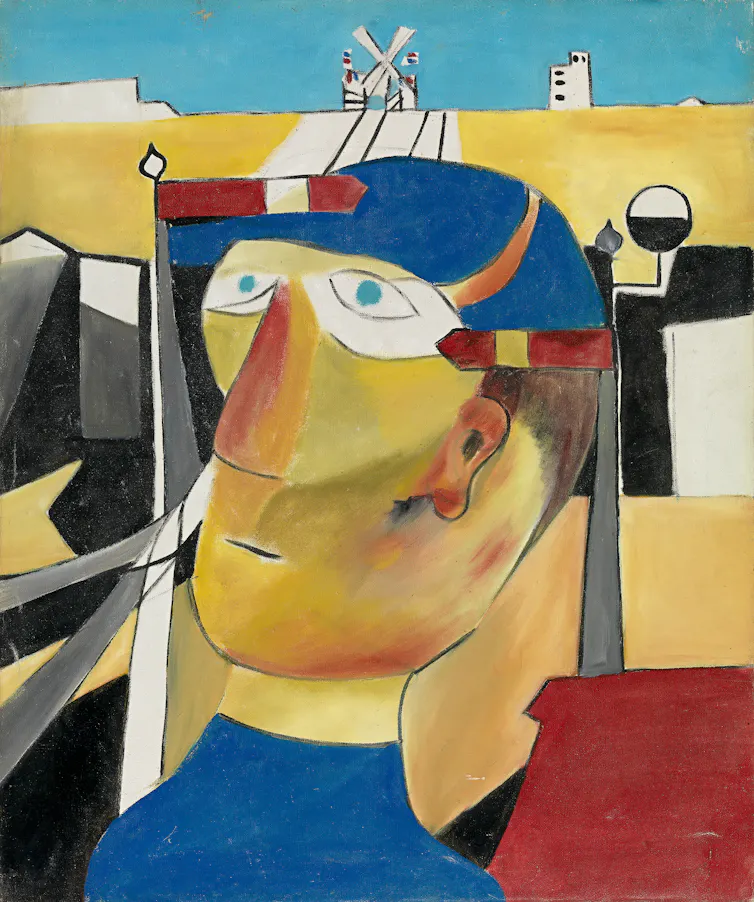
But his raw talent lay in his intuitive, responsive art. The Dimboola paintings Railway Yards and Railway Guard (both 1943) are a case in point. At first glance they seem all out of whack. Space compresses, structures warp, even time itself seems to stall. But seeing them in Origins, I understood how Nolan has captured the spare, patched-together feel of a country town.
When what he saw morphed into enigmatic symbol, when Australia’s crystalline light conjured a world shaped by psycho-sexual myth, Nolan probably felt he was closest to being a poet – which, after all, had been his original goal. Until Sunday Reed very sensibly suggested that he stick to painting.
Nolan: Origins is showing at the Art Gallery of NSW, Sydney, until February 7 2027.
KioskNews shows a cleaned-up reading view extracted from the publisher’s page — the original always lives on their site, not ours.