We want you! ADF recruitment rates are growing, even as the odds of conflict rise. Why are people signing up?

We’re herded into a sterile elevator by a woman in navy camouflage fatigues and carried up to the 11th floor, overlooking Parramatta’s central business district on a dreary afternoon in Sydney’s west.
At the front of the room, dressed in a khaki green uniform behind a lectern, stands army corporal Joel Kellner. In the corner, a portrait of King Charles III rests on a wooden easel.
“We’ll start with a rabble rouser,” Kellner says in a raspy drawl, clicking the projector into gear. A fighter jet roars over the ocean. Keyboards rattle in a neon-lit situation room. Soldiers blast their way through a doorway with explosives. Cue pulsing soundtrack and energetic voiceover:
Do more than send emails. Send critical intelligence.
When you travel for work. Travel undetected.
And if you work late. Work to defend what matters.
The slick advertisement is a pitch to the room, an audience of mostly young men, a handful of young women, and their parents and carers – a crowd reflecting the ethnic diversity of western Sydney. It’s a small turnout of about 30 people. But this Australian defence force recruitment session, open to all and one of hundreds held across the country each month, forms the frontline of a much larger effort.
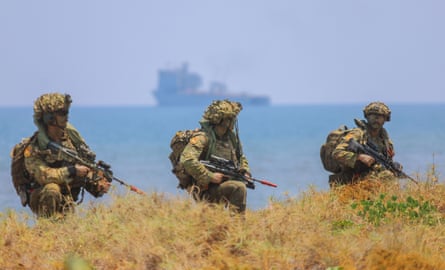
Facing what the government describes as the “most complex and threatening strategic circumstances” since the end of the second world war, Australia is investing billions to strengthen its maritime firepower in response to an increasingly contested Indo-Pacific region. The build-up includes long-range missile systems, army landing craft and the nuclear-powered submarines planned under the Aukus pact. To operate and maintain this equipment, the military now needs thousands more people. Will any of the young people in this room answer the call of duty?
“Serving your country, it gives you a sense of importance,” says Angad Sahi. The 16-year-old’s family migrated from northern India to Australia three decades ago and now live in Penrith in western Sydney. He’s in year 12 studying business, finance, law and advanced maths and, at 6ft 1 tall, is a keen basketball player.
He listens as Kellner outlines the more than 300 jobs on offer across the navy, army and air force. “My parents saw a lot of ads on social media about it … they looked into it and saw the benefits,” Sahi says.
With more than 8,100 new recruits , the number of full-time personnel across navy, army and air force grew to more than 64,000 this year. It’s the largest military in 25 years, though still a fraction of the scale of the mass mobilisations during world wars. The growth reverses years of recruitment and retention failures but still falls short of the government’s annual recruitment targets. Even so, Defence says it’s on track to grow to 69,000 full-time personnel by the early 2030s.
A 2025 study by University of Tasmania’s Prof Robert Hoffman, commissioned by the ADF to examine declining sign-ups, concluded that a range of measures – including targeted advertising aimed at 16 to 25-year-olds on TikTok and video games, improved pay and conditions, and tweaking eligibility criteria, all seem to be contributing to the recruitment uptick. The surge in sign-ups is mirrored across the US, Germany and the United Kingdom (where there was a 19% rise in people joining the armed forces last year). And Canada’s defence forces have seen a 10-year high in recruitment, up by 55%.
And while Sahi does seem attracted to the concept of duty, it’s ultimately pragmatic reasons that makes the proposition appealing. “You get paid to finish the degree. No study debt. It puts you in a good position in the future, even once you leave.”
Sahi is talking about the Australian Defence Force Academy (ADFA), where cadets earn a salary while completing a university degree and officer training, in exchange for a commitment to serve in the military for a minimum of about nine years after graduating. In the first year of study the pay is about $55,000. Once you graduate, you can easily earn more than $100,000 as a commissioned officer.
‘The army feels irreplaceable’
For the more non-committal types, the army gap year program offers a 12-month trial of military life. It appeals to year 12 student Eli Holt, 17, from the Sutherland shire. His favourite subject is sports science and, outside of school, he takes martial arts classes. “I like the idea of the discipline, the fitness, the money,” Holt says. “I’d be getting a taste for it and really seeing if I want to turn it into a career.
“And the army feels irreplaceable. Like there’s things that need to be done that AI just can’t do. That’s a comforting idea.”

Prof Ben Edwards of the ANU’s Centre for Social Policy Research says: “As the labour market gets tighter … [more young people] might see the ADF as an attractive option post-school.” Cost-of-living pressures and housing unaffordability may also influence their decisions.
But even signing up on the spot won’t fast-track a quick pathway to enlistment for any of the young people here this afternoon. In October 2026, the average time from lodging an application to enlistment was 259 days.
Jennifer Parker, adjunct professor at UWA’s Security Institute and former navy officer, says a cumbersome recruitment process involving exams, security screenings, medical examinations and interviews is a major bottleneck to the ADF’s growth.
“People coming out of school or university don’t want to wait around for a year to know if they can join or not,” Parker says.
The head of military personnel, Rear Admiral Letitia Van Stralen, told the Guardian that “significant reforms” are under way to reduce the application-to-enlistment period to 100 days on average.
As part of their current recruitment drive, Defence has also widened the pool of potential recruits. In 2024, it changed the standards so medical conditions such as acne or a childhood broken bone that had previously disqualified applicants could be assessed on a case-by-case basis, and eligibility has since been expanded to permanent residents from New Zealand, the UK, the US, Canada. And, from next month, Australia will open recruitment to Papua New Guinea university students as part of a new military alliance between the two countries. The first cohort of the $65m pilot program will be enlisted by next year.
‘I had a very positive career’
The ADF have undergone significant attempts at reputation rehabilitation over the last few years amid scrutiny over its culture, including the Brereton inquiry into alleged war crimes in Afghanistan and the royal commission into defence and veteran suicide. And last week the ADF launched its first women veterans’ strategy, aimed at improving recognition, safety and economic security for women during and after service, and has adopted a target of 25% female workforce participation by 2030. Currently just over 20% of the workforce is female.
When Parker joined the navy back in 2002, women had only been at sea for 10 years. “Now the fleet commander is a woman. That just goes to show how much the ADF has evolved in its treatment of women,” she says.
Female participation in the navy, like the air force, is much higher than the army, which lags at 15% participation. “I had a very positive career,” Parker says. “As a country we have struggled with equality for women, and the harassment of women. The ADF is drawn from wider society and therefore reflects that. That’s not in any way to excuse bad behaviour but it’s important to understand.”
Efforts have been made to stem the flow of departures from the military too. The military separation rate has fallen to its lowest level in 15 years, which Defence attributes to retention bonuses, improved housing and better working conditions.
Parker says these benefits, combined with one of the most significant modernisations in military history, make it a “fairly exciting time” to join the military. But, she warns, “anyone who joins the ADF should expect to serve on operations and, if necessary, be called upon to fight for their country – the chances of doing that is increasing”.
‘If there is a conflict, it’s probably going to be major’
Eli Holt’s mother, Tara, and father, James, are seated beside him for the information session. They have some reservations. “We’re learning with him,” Tara says.
James says: “At first we weren’t a fan of the idea but we know we’re going to have to support him either way.
“The way we came to grips with it was, if there is a conflict, it’s probably going to be major and they’ll probably end up conscripting anyway … We’d rather he have proper training than be suddenly conscripted.”
Parental attitudes are the strongest predictor of a young person’s interest in serving. According to a Defence-funded report co-authored by Edwards, if a young person thinks their parents want them to enlist they are 30 times more likely to want to join themselves.
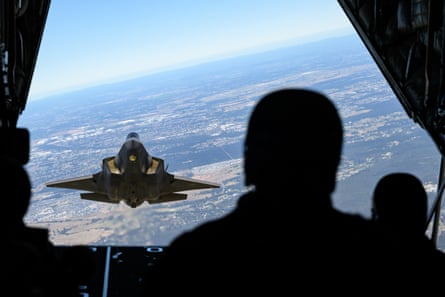
Parker says it’s unhelpful to speculate about exactly how Australia might enter a conflict. But Albert Palazzo, a military historian and adjunct professor at UNSW Canberra is more explicit. He says a potential US-China war over Taiwan is the most likely scenario to draw Australia into conflict. Because the US has access to or controls most of Australia’s military bases, Palazzo argues Australia would have little choice but to join the war.
“Australia has a long history of inviting itself to American wars. We’re now inviting ourselves to war with China,” Palazzo says. “It would be really ugly, violent. A lot of our people will die, young people. That’s the nature of war.”
At the recruitment session in Parramatta, the prospect of conflict feels distant. Glossy recruitment ads promise free health and dental care, subsidised housing and lifelong friends.
When the presentation ends, Kellner informs the group that they can apply online and offers an opportunity to come up the front and ask questions before leaving. The military’s policy of “unrestricted service”, which legally obliges personnel to be available at all times to deploy in Australia or overseas, is not discussed. That will come later in the recruitment process.
Mahmood Dakkak, 18, is in his first year of a university degree, studying to be high school history teacher, but is now considering a career in the navy.
“I kind of feel unfulfilled in life. I was looking online and saw jobs to work on nuclear submarines. Sounds pretty interesting,” Dakkak says.
But, worried about the increasing likelihood of war, he says he wants to avoid enlisting in a frontline role.
Holt admits it’s a consideration for him, too. “My dad believes that world war three might be sooner than later, even if I get out [after the gap year] I’d be on the roll [for 10 years] and drafted before any of my mates, that’s scary to think about,” he says.
The last person to file out of the room is 21-year-old Keriyacous Magar, who works in waste management in Sydney’s south-west. He’s attracted to the military by a good salary and the idea of a fulfilling career but admits: “I’m a bit confused.
“I’m just a young man trying to figure out where he wants to go in the world.”
KioskNews shows a cleaned-up reading view extracted from the publisher’s page — the original always lives on their site, not ours.