Thais want Israelis held to the law, NIDA poll finds
Thailand’s public patience with alleged bad behaviour by Israeli visitors appears to be running out — and most people in NIDA’s latest poll want the law enforced strictly.
The National Institute of Development Administration’s polling centre questioned 1,410 eligible voters aged 18 and over across six provinces — Bangkok, Chachoengsao, Chonburi, Surat Thani, Phuket and Mae Hong Son — from 8–10 September.
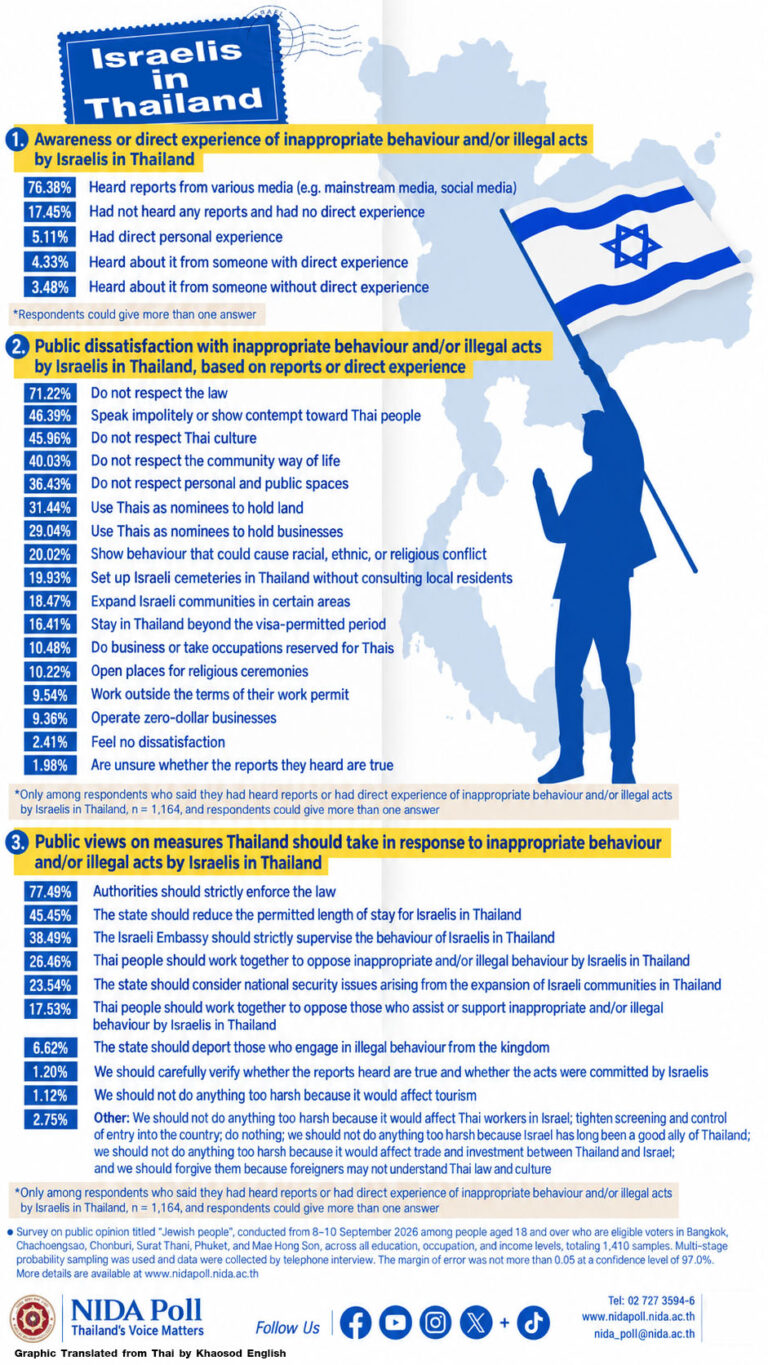
The numbers suggest this isn’t a fringe concern. More than three-quarters of respondents, 76.38%, said they’d heard reports through the media about alleged inappropriate or illegal behaviour by Israelis in Thailand. Only 5.11%, however, had direct personal experience with bad Israeli behaviour — and 17.45% reported not having any bad experience or even reading reports of it.
What’s fuelling the frustration
NIDA followed up with the 1,164 respondents who’d heard about or experienced the alleged misconduct, asking what specifically bothered them. The answers paint a clear picture: this is less about any single incident than a broader sense of disrespect. The following statistics are only among the 1164 respondents who said they had heard reports or had direct personal experience of inappropriate behaviour/illegal acts by Israelis in Thailand:
Top of the list, at 71.22%, was a perceived disregard for Thai law. Close behind: impolite speech or behaviour seen as contemptuous towards Thai people (46.39%) and a lack of respect for Thai culture (45.96%). Around four in ten cited disrespect for local communities’ way of life (40.03%) and personal or public spaces (36.43%).
Money and land featured prominently too — 31.44% pointed to the alleged use of Thai nominees to hold land, and 29.04% cited nominees used to hold businesses. Roughly a fifth of respondents raised the spectre of racial, ethnic or religious conflict (20.02%) and unease over Israeli cemeteries established without consulting local residents (19.93%).
Further down the list: the expansion of Israeli communities in certain areas (18.47%), visa overstays (16.41%), competition with Thais for reserved occupations (10.48%), religious ceremony venues (10.22%), work permit violations (9.54%) and so-called zero-dollar businesses (9.36%).
A small minority — 2.41% — said none of it bothered them, and 1.98% weren’t sure the reports were even true.
Note: NIDA measured perceptions and reported experiences. It did not verify whether the conduct actually happened.
The public’s prescription: enforce the law
Ask people what Thailand should actually do about it, and the answer is blunt. 77.49% of the same 1,164 respondents said authorities should strictly enforce the law — by far the most popular response.
Nearly half, 45.45%, want the government to shorten how long Israelis can stay in the country. Another 38.49% think the Israeli Embassy itself should more closely supervise its nationals’ behaviour.
Beyond government action, a chunk of respondents want Thais to take matters into their own hands, in a manner of speaking: 26.46% said Thais should actively oppose the alleged misconduct, and 17.53% extended that to anyone assisting or supporting it. Nearly a quarter, 23.54%, framed the issue as a national security concern tied to expanding Israeli communities.
Only 6.62% called for deporting offenders. And a small, more cautious minority pushed back on the premise entirely: 1.20% said reports should be verified before any action is taken, and 1.12% warned against measures so severe they’d hurt tourism. Another 2.75% fell into a miscellaneous “other” bucket — think tighter border screening, calls to do nothing, or worries about blowback for Thai workers in Israel and bilateral trade.
Read with caution
A caveat NIDA itself would want on the record: with the sample drawn only from six provinces, this isn’t a nationally representative snapshot of Thai opinion. NIDA used multi-stage probability sampling from its Master Sample database, conducting the survey by phone, with a stated margin of error of no more than 0.05 at a 97% confidence level.
There’s also a wrinkle in the poll’s framing worth noting: it was titled “Jewish people” (“ชาวยิว”) in Thai, even though every question specifically asked about Israelis. Israeli nationality and Jewish identity aren’t the same thing — a distinction the poll’s own title blurs.
The backdrop
The poll lands amid a fast-escalating public backlash. Hundreds of demonstrators gathered outside the Israeli Embassy in Bangkok on Thursday, after activist Sondhi Limthongkul called for a protest over Israeli nationals’ conduct in the country.
The embassy, for its part, says it is paying attention. In a Thai-language video message, Deputy Chief of Mission Rami Teplitskiy said the embassy was tracking the rising negative sentiment towards Israeli tourists and was preparing travel guidance urging visitors to obey Thai law, cooperate politely with authorities, avoid conflict, and respect local culture.
KioskNews shows a cleaned-up reading view extracted from the publisher’s page — the original always lives on their site, not ours.