Hotesur/Los Sauces: Fernández de Kirchner in dock for new corruption trial alongside son
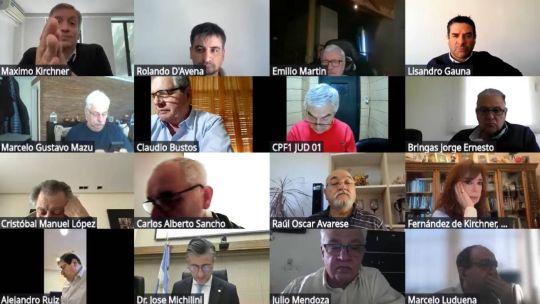
Former president Cristina Fernández de Kirchner, who is serving a six-year sentence under house arrest for corruption, faced a new corruption trial Friday alongside her lawmaker and son over alleged money-laundering through their family’s hotel and property businesses.
Fernández de Kirchner, 73, followed the hearing by videoconference from her Buenos Aires apartment, where she is serving her sentence.
The official broadcast of the trial showed her reviewing documents. Her son, a 49-year-old national deputy, watched on, smoking a cigarette.
The trial, which is combining two cases known as 'Hotesur' and 'Los Sauces,' involves 19 defendants in total.
It is the first corruption trial for Máximo Kirchner and the third for his mother.
The proceedings are being overseen by Federal Oral Court No. 5, comprising judges José Michilini, Fernando Machado Pelloni and Adriana Palliotti, following the merger of the two cases ordered by a criminal cassation court earlier this week.
Friday's hearing lasted almost three hours and was mostly devoted to reading part of the indictment. The proceedings are due to resume on Monday, October 26, when that will continue.
One defence lawyer objected that the recent merger had left insufficient time to prepare the case, arguing that the defence was entitled to 10 working days in the Hotesur proceedings, which had originally been scheduled to begin in March 2027.
Judge Michilini said the court would read the charges in the Los Sauces case first and continue in the coming days to allow the required period to elapse.
Prosecutor Diego Velasco is expected to present a summary of the allegations in the Hotesur case in the coming days.
Alleged money-laundering scheme
Prosecutors allege that the scheme was organised at the highest levels of the Executive branch during the administrations of the late Néstor Kirchner (one term, 2003-2007) and his widow Fernández de Kirchner (two terms, spanning 2007-2015), with the involvement of officials and businesspeople, to divert and appropriate public funds.
The alleged criminal scheme is said to have channelled part of the money siphoned from the state through public road-building contracts back to the former presidents and their family through payments from businessmen who had benefited from state contracts, according to the indictment.
Prosecutors say it operated from May 2003 to December 2016, with clear roles for its members both inside and outside the state apparatus.
The scheme allegedly extended beyond the awarding of lucrative public contracts to favoured businessmen, including allies Lázaro Báez, Cristóbal López and Fabián De Sousa, to transferring and concealing part of the proceeds through loans, property purchases, hotel rentals and improvements to the family's hotel establishments.
The indictment alleges that Fernández de Kirchner designed, executed and directed a scheme to recycle funds of illicit origin. Prosecutors say properties were acquired and made available to receive money from companies belonging to Báez and Grupo Indalo, the business conglomerate of López and De Sousa, through hotel and property transactions.
Fernández de Kirchner established the family property company Los Sauces SA, alongside Néstor and Máximo Kirchner.
The company acquired several properties, including the apartment at San José 1111 in Buenos Aires where the former president is currently serving her house-arrest sentence in the separate 'Vialidad' public-works corruption case.
Máximo Kirchner, who became president of the family company, is accused of organising the alleged unlawful association.
Báez, López and De Sousa are also accused of acting as organisers.
'Deep remorse'
Prosecutors identify Fernández de Kirchner as the alleged ring-leader of the association and Máximo as an organiser. Both could face prison sentences of up to 10 years.
Among the defendants present at Friday's hearing was Víctor Manzanares, the family's former accountant, who told journalists outside court: "I feel deep remorse."
"I have come to receive my sentence when the time comes. I need to close this chapter of my life," he added.
The defendants were allowed to attend remotely for the reading of the charges, although the court's president stressed that this was an exceptional arrangement. They must appear in person when summoned for questioning.
Lawyers for both Kirchners reject the allegations, arguing that the commercial transactions were legal, conducted through the banking system and declared to the tax authorities.
Cristina and Máximo were acquitted in 2021, but a higher court overturned that decision in 2023.
Florencia Kirchner, the former president's youngest daughter who was initially part of the trial, was later definitively excluded from the proceedings.
Another cloud for Cristina
Fernández de Kirchner is currently serving a six-year sentence since June 2025 for fraudulent administration in the awarding of public works contracts. The conviction also bars her for life from holding public office.
In July, the former president took her case to the United Nations Human Rights Committee, arguing that she had been the victim of arbitrary judicial proceedings intended to exclude her from politics.
KioskNews shows a cleaned-up reading view extracted from the publisher’s page — the original always lives on their site, not ours.