Stratospheric airship flew from US to Japan to test sky cell tower concept
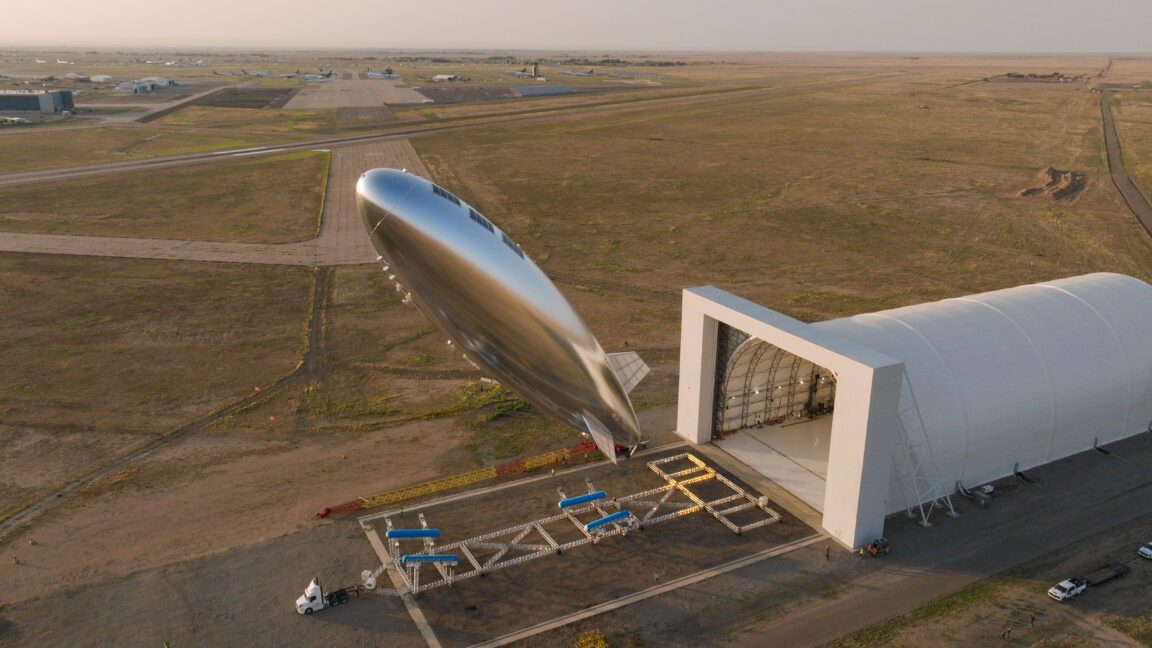
Nearly 100 years after the dirigible Graf Zeppelin made the first nonstop airship journey across the Pacific Ocean, another airship has successfully completed a round-trip flight from New Mexico to Japan and back. But the significance of this modern feat was less about the journey’s length and more about its purpose: demonstrating how a lighter-than-air platform can act as a cell phone tower in the sky.
The trans-Pacific flight that took place over a month between August and September 2026 was the most notable milestone yet for Sceye, a US aerospace company based near Albuquerque, New Mexico. Sceye has developed an uncrewed platform filled with helium for buoyancy and equipped with an electric-powered propeller for active propulsion, allowing it to resist most strong winds and keep hovering over the same location for long periods. The platform also uses top-mounted solar panels and onboard batteries to stay powered for stratospheric operations around the clock.
“We can stay over an area of operation, and we do that in the stratosphere right around 60,000 feet, so we’re twice as high as air traffic and we’re above the jet stream, and yet 30 times closer than low-Earth orbit satellites,” Mikkel Frandsen, founder and CEO of Sceye, told Ars. “We can fly through day and night until the sun comes up the next morning and recharges the batteries, at which point we’re still at the same altitude and still over the same area of operation.”
Flying higher
There have been many past technology demonstrations and attempts to make stratospheric platforms commercially viable since the late 1990s, Frandsen said. In Sceye’s case, the company began testing a series of smaller prototypes in 2016 before eventually reaching the stratosphere with a 215-foot (65-meter) length version in 2021. The latest version extends to 270 feet (83 meters).
The lighter-than-air platform has also benefited from advances in material sciences that “were either not discovered or not understood back in the late 1990s,” Frandsen said. He highlighted the example of the discovery of graphene in 2004, which “greatly helped us optimize strength relative to weight on our hull, the energy density of our batteries, and performance relative to the area and weight of our solar panels.”
The design could eventually scale up to a high altitude platform system (HAPS) capable of lifting payloads as heavy as 551 pounds (250 kilograms). That would be between 25 and 50 times more payload capacity than competing stratospheric platforms such as high-flying drones, according to Helena, a US nonprofit organization with a for-profit investment arm that has invested in Sceye.
Sceye’s current platform has already done multiple flight demonstrations with payloads exceeding 220 pounds (100 kilograms) and can provide up to 1 kilowatt of onboard power capability for any devices that it may be carrying.
A heavier payload and higher power capacity opens the door to bigger mission possibilities, such as someday using a single Sceye platform hovering in the stratosphere to provide mobile broadband coverage equivalent to 500 ground-based cell towers. That may prove useful for both enhancing commercial telecommunications services and providing emergency coverage during disaster scenarios.
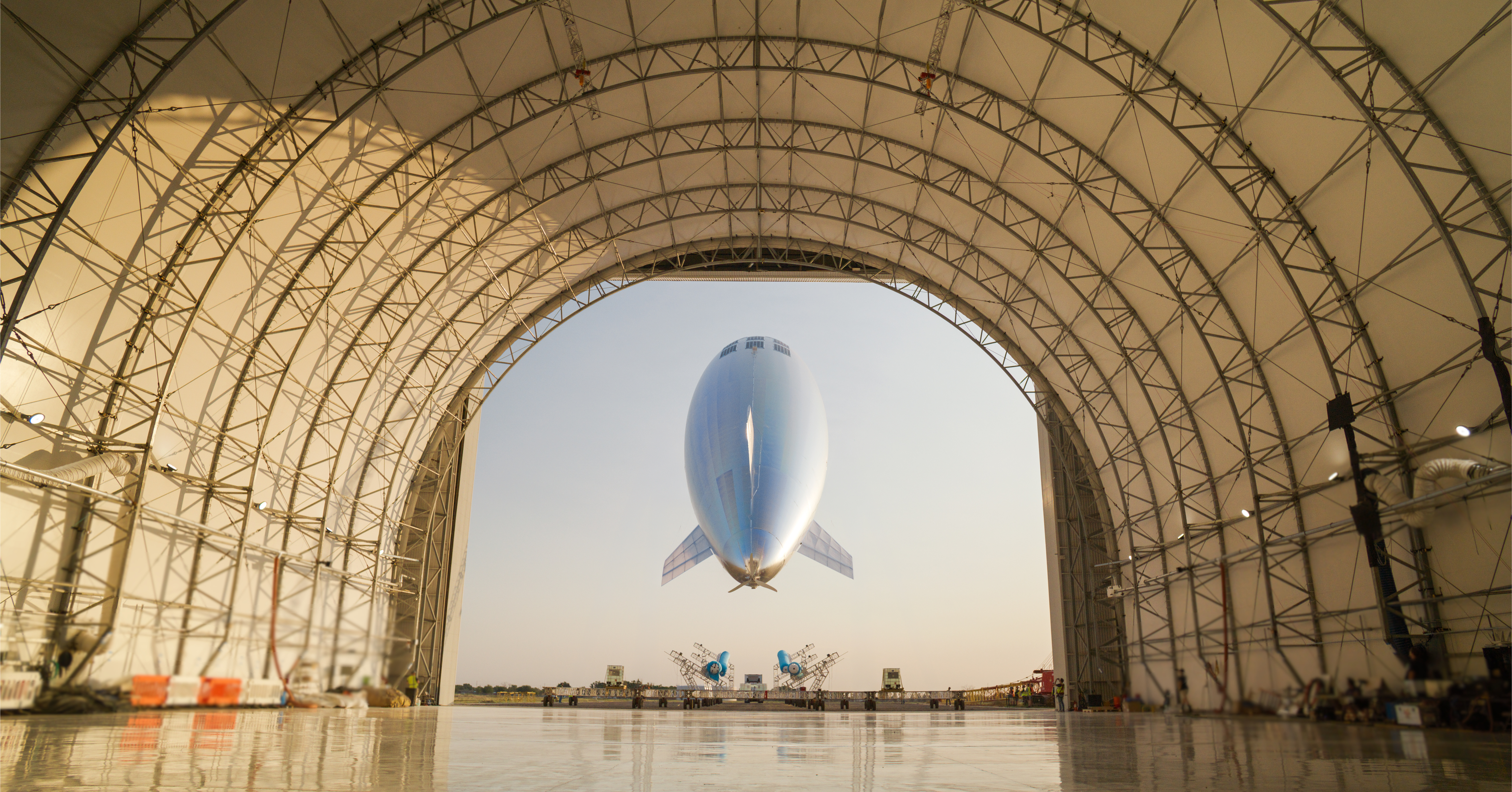
Sceye’s high-altitude platform system (HAPS) seen from inside its hangar after launching from New Mexico on August 9, 2026.
Credit: Sceye
Sceye’s high-altitude platform system (HAPS) seen from inside its hangar after launching from New Mexico on August 9, 2026. Credit: Sceye
Crossing the Pacific
The concept was put to the test after Sceye’s platform launched from its New Mexico base on August 9, 2026, and traveled more than 9,320 miles (15,000 kilometers) across the Pacific to reach Japan. That 13-day journey required the airship to navigate through strong winds and avoid potential bad weather “during a window of typhoon season,” said Johnny Truong, chief technology officer of Sceye.
The stratospheric platform has an auto-navigation system that allows the airship to fly on its own between point A and point B while accounting for factors such as local wind conditions, Truong explained. That frees up human operators to focus on big-picture decisions such as monitoring weather forecasts, running flight simulations for possible paths, and then chaining together a series of navigational waypoints for the smoothest possible journey.
The capability was first used during a previous 12-day flight from New Mexico to Brazil. But the monthlong mission to Japan and back—dubbed Service Test 1 (ST1)—was the longest test flight and deployment yet for Sceye’s platform.
“There were times when our actual plan trajectory and flight path was disrupted by a change in the weather,” Truong told Ars. “So what it would do was actually just park itself at a safe, quiet place in the weather and just station-keep a while until it moved on.”
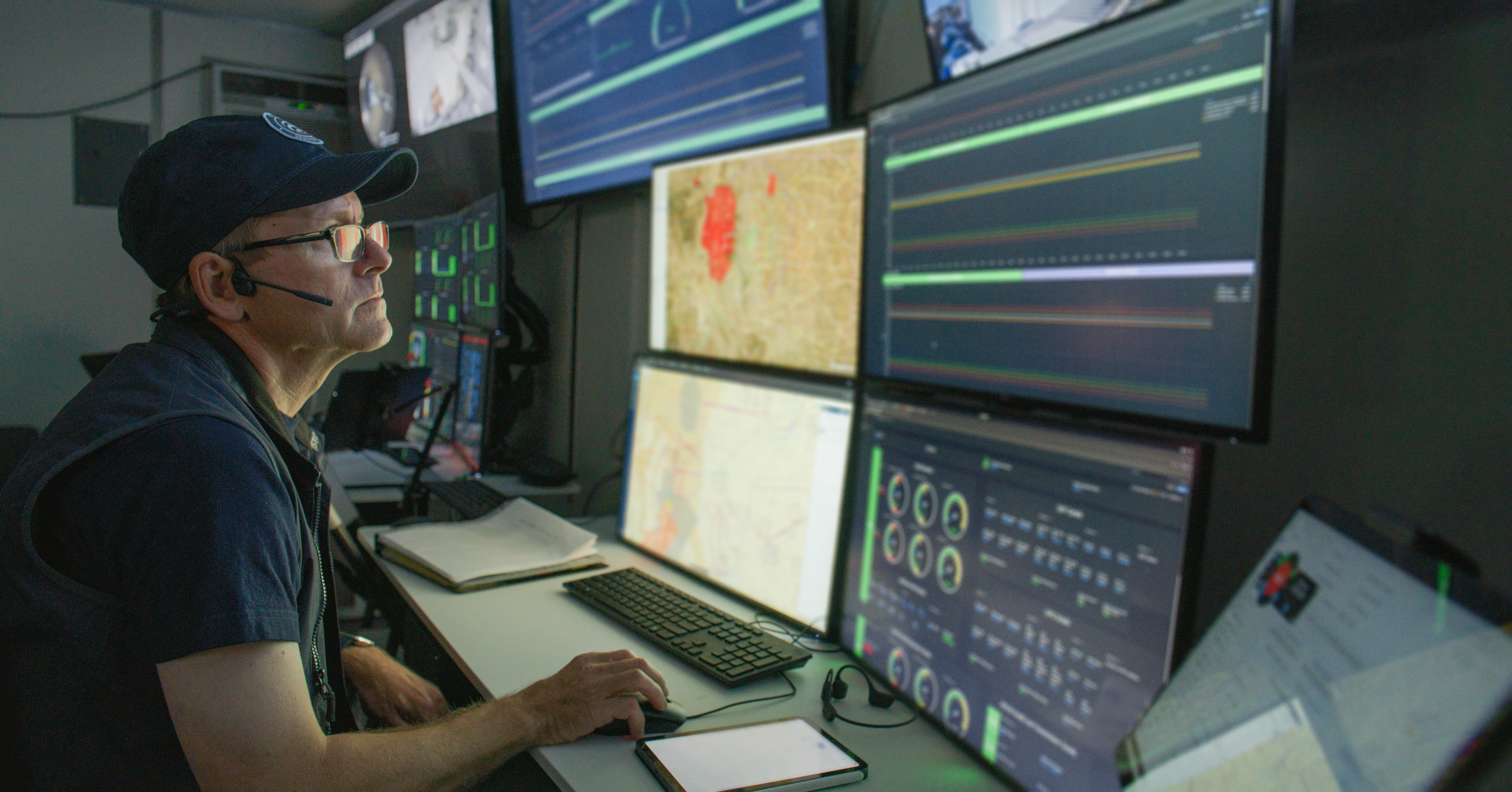
The Sceye team monitors the performance of a high-altitude platform system (HAPS) during its roundtrip flight from New Mexico to Japan.
Credit: Sceye
The Sceye team monitors the performance of a high-altitude platform system (HAPS) during its roundtrip flight from New Mexico to Japan. Credit: Sceye
Cell tower in the sky
The arrival over Shikoku—the smallest of Japan’s four main islands—allowed Sceye’s uncrewed airship to show how it could provide mobile broadband service from an operational altitude of about 54,000 feet (16.5 kilometers) to smartphones, laptops, and even drones. That demonstration was performed in partnership with the Japanese telecommunications firm SoftBank Corp, which has also invested directly in Sceye.
Sceye’s platform carried the equivalent of a 4G LTE base station for the demonstration that simulated providing backup coverage in the case of an earthquake or similar large-scale disaster.
”It’s not the first time we flew a telco payload, but this is the first time where we actually flew into an area where we provide a live service,” Truong said. “What SoftBank did was they disabled the cellular coverage area, and then we came in and we basically backfilled it.”
SoftBank’s team ran tests involving voice calls, text messaging and Internet web browsing, along with streaming YouTube videos and making video calls. They also verified that Sceye’s platform could support emergency alert messaging systems for earthquakes and tsunamis, along with supporting calls to a maritime emergency number.
The Japanese company even equipped drones with LTE cards to remotely control them using the Sceye-supported connectivity, along with receiving video transmissions from the drones. SoftBank also ran data throughput tests in several environments, including an open beach, a forest area with tree cover, and an indoor test inside a building.
The Sceye-supported connectivity passed testing in all three scenarios, although Truong acknowledged initially being unsure about whether the indoor test would succeed. Sceye’s team had decided not to run Sceye’s communications antenna at full power to minimize potential interference and to play it safe with local regulators.
For a separate edge computing experiment, a server aboard Sceye’s platform let SoftBank demonstrate an average roundtrip data-processing response time of 68 milliseconds. That supposedly represents a 40 percent reduction in latency compared to standard Internet-based cloud processing times.
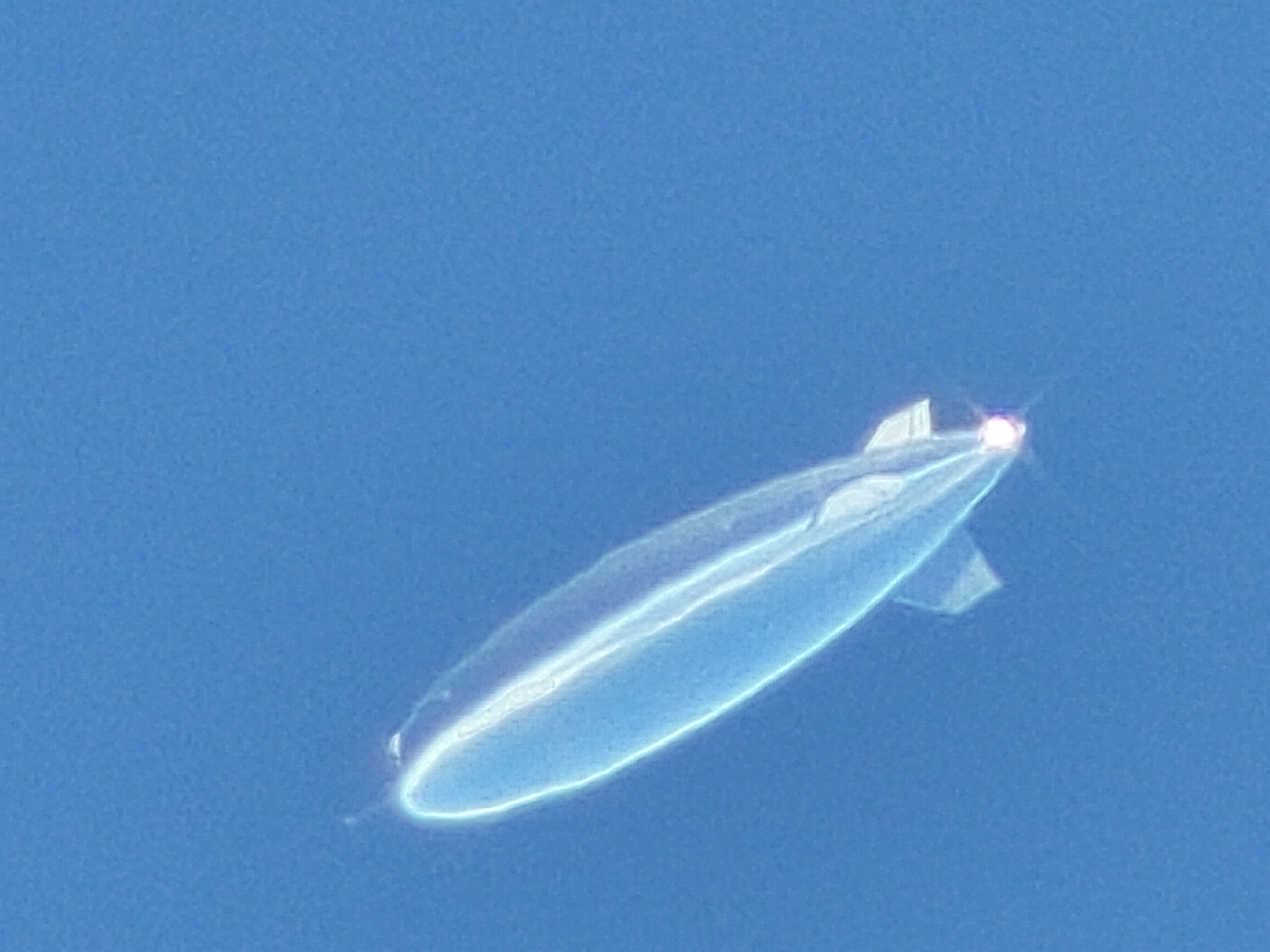
Sceye’s high-altitude platform system (HAPS) seen above Japan during testing as a cell tower in the sky.
Credit: Sceye
Sceye’s high-altitude platform system (HAPS) seen above Japan during testing as a cell tower in the sky. Credit: Sceye
Lasers in the stratosphere
The companies also tested setting up optical wireless communications using lasers to transmit data between Sceye’s platform in the stratosphere and towers or stations on the ground. A ground-based laser ranging system sent laser pulses toward Sceye’s moving platform, which carried a corner cube reflector that reflected laser signals back down to the ground-based system.
In the future, Sceye’s platform might act as a stratospheric relay station that links communications satellites in low-Earth orbit with ground infrastructure. That would help reduce the loss of optical signal involved in transmitting directly between satellites and ground stations through the Earth’s atmosphere, because there is much less signal attenuation when transmitting between space and the stratosphere.
Sceye’s HAPS could then act as a “reenergizer” to boost an optical signal received from space for retransmission down to the ground, or even switch over to radio frequency communication modes that can travel more cleanly through cloud cover down to the ground, Truong said.
Broader deployments of optical wireless communication could help handle the increased data rates expected of sixth generation (6G) mobile communications services, along with providing faster Internet and mobile connectivity to more remote regions of the world that are not connected to ground-based fiber-optic networks.
“You need those three layers to work together to make sure that nobody’s left behind, but also to make sure that you can get to the real-time services that are the promised land of 6G,” said Frandsen.
This could also provide additional resiliency for global communications at a time when the Internet’s undersea backbone of fiber-optic cables linking continents and islands faces greater threats from deliberate sabotage—not to mention accidental cable cuts from weighted fishing boat nets and ship anchors.
“You’ve seen stories where there’s a dispute and a boat for some reason forgets to raise their anchor and they suddenly take out that ocean cable,” Truong said. “Now you don’t have to worry about that because everything’s wireless… that leads to resiliency from an operational perspective.”
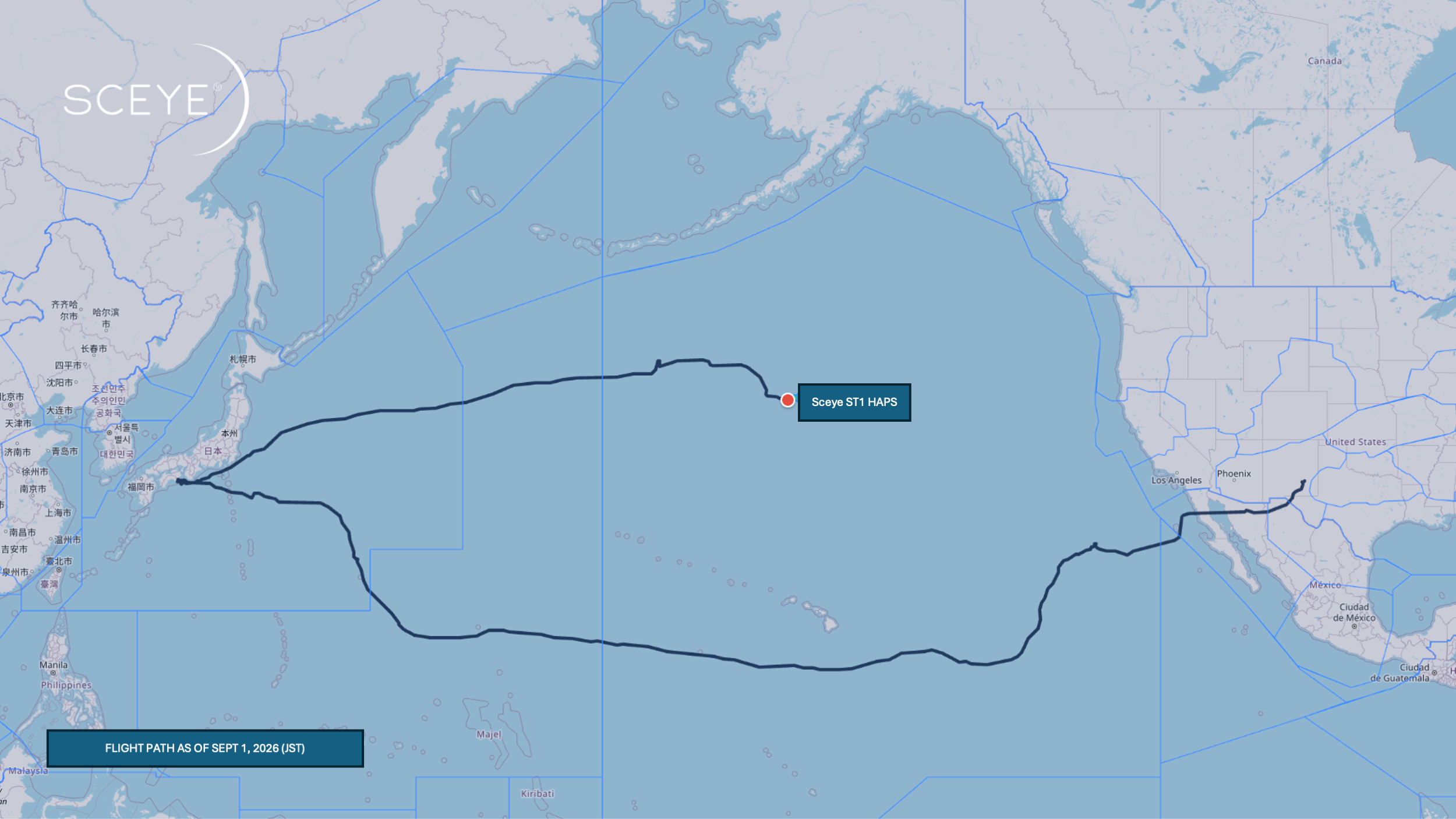
The trans-Pacific flight route of Sceye’s helium-filled platform as seen on September 1, 2026.
Credit: Sceye
The trans-Pacific flight route of Sceye’s helium-filled platform as seen on September 1, 2026. Credit: Sceye
There and back again
By the time Sceye’s platform returned to New Mexico on September 5, it had traveled nearly 18,641 miles (30,000 kilometers) during its 30-day roundtrip to Japan and back.
The company and its partners are already looking ahead to future tests. SoftBank wants to perform additional testing around using the airship to quickly restore communications in disaster scenarios, along with potentially placing cameras and other sensors aboard to help with search-and-rescue operations, Truong explained.
“We can come in and basically place instant infrastructure and provide that service,” Truong said. “So from that perspective, it’s about being ready throughout the year and providing that service during those critical few days while you’re trying to restore service.”
But Sceye is also aiming to help provide regular cellular coverage to underserved areas where installing fiber-optic cables to provide Internet access is more economically prohibitive.
“A lot of our missions going forward are not a week-long mission—they’re like multi-month to a year-long mission,” Truong said. “We have one that we’re going to do earlier next year which is going to be anywhere from three to six months, with a plan to be a year-round kind of operation.”

Jeremy Hsu is a reporter exploring a wide range of topics across deep tech and AI. He has previously written for New Scientist, Scientific American, IEEE Spectrum, Wired, Undark Magazine and MIT Tech Review, among many other publications, about topics such as deepfakes, data centers, drones, battery tech, robotics, and GPS jamming. He also has a Master of Arts in Journalism from NYU, and a bachelor's degree from University of Pennsylvania in History and Sociology of Science, with a minor in English.
KioskNews shows a cleaned-up reading view extracted from the publisher’s page — the original always lives on their site, not ours.