If turbocharged petrol prices are driving up inflation, then why are Australia’s unemployed on the line? | Greg Jericho
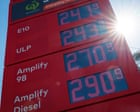
And here we are again. Hello darkness my old friend. Interest rates up again and talk of a recession if needed.
The Reserve Bank’s enacting legislation gives it a dual mandate – “price stability [ie stable inflation] and the maintenance of full employment in Australia.” But in reality the RBA seems to ignore the “full employment” aspect overall, and we now need to worry about a recession.
It’s not just me who noticed this. After the RBA governor Michele Bullock held a press conference where she announced the cash rate was being raised to 4.6%, the ABC’s Alan Kohler (enjoy your retirement, Alan!) told Afternoon Briefing, “she defines ‘full employment’ in terms of inflation. There’s really only one mandate that means – the mandate is inflation. That’s it.”
The market also understands this.
After the RBA’s July meeting, the markets predicted no rate rise this month and maybe no more to come. Now a rise to 4.85% is priced in before March next year:
If the graph does not display click here
They predict this even though without the increase in petrol prices driven by the war on Iran, inflation in August would have fallen (which is why core inflation remained steady at 3.6%):
If the graph does not display click here
When thinking about petrol prices, recall that Ampol’s interim profit this year rose 376%, and its share price has risen so much since the war on Iran began that Woodside and Santos seem like the poor cousins:
If the graph does not display click here
Apparently, companies are not to blame for raising prices.
Never mind that household spending in August fell once you took away the increase due to petrol prices:
If the graph does not display click here
No, forget all that, the RBA is devoted to getting inflation under 3% regardless of what is causing that inflation.
Bullock said the RBA was not failing to deliver full employment because “the full employment target is the unemployment rate, if you like, or the level of employment which is consistent with low and stable inflation. And what we’re saying at the moment is that the rate of unemployment or the employment, is actually a bit tight, and it’s not consistent, we don’t think, with low and stable inflation
Truly Humpty Dumpty language territory.
If you are not angry now, you should be.
But just wait.
With inflation at 4.0% mainly driven by petrol prices due to a war in Iran and a massive boom in datacentres (which are not delivering any productivity benefits yet), the RBA is worried we might think this clearly abnormal period is normal and that inflation will always be above 3%.
God spare us.
after newsletter promotion
The governor was asked if she could see a situation “where you do actually need to put the economy into recession in order to get what you desperately hope for which is basically the mid-point of 2.5%? Can you see a scenario where that would be needed?”
Now for me that is a pretty easy question to answer; something along the lines of “No! Are you crazy? There is no way lowering core inflation from 3.6% to under 3% would justify a recession.”
Instead, Bullock replied, “Well, I hope it’s not needed. Are there scenarios in which it might have to happen that way? I guess possibly. And the scenario that I’m thinking of there is if inflation expectations get away from us. If inflation expectations start – if people start saying, ‘You know what, three point something is fine or four is fine’, and you do hear some of that, if that gets away, then that is a circumstance in which I think you might need to have quite a dramatic slowdown in the economy to – and that’s our worry.” [My italics]
Just think on that – the central bank thinking if people would start considering that inflation between 3% and 4% is OK, then a recession could be on the table, even if it wasn’t their “central base case at this moment”.
Bullock once again on Tuesday told journalists that rising unemployment “doesn’t mean job losses. What it often means is that people might be taking longer to find a job.”
She’s technically right, but for her to say that “we’ll do what we have to do to get inflation down because we need to”, shows the skewed priorities. Sure, she went on to say, “but if we can avoid massive job losses and a massive increase in the unemployment rate, that is a really important thing to be able to try and do.” Avoiding massive increases in unemployment is important, but, for the RBA, apparently not a dealbreaker.
Recessions are horrible things and many a central bank has come a gutser thinking they can just lower rates and get things going again.
During Covid the percentage of adults with a job fell by as much as during the 1990s recession, but it was due to lockdowns, not economic conditions, so the recovery was very quick. The GFC was almost a recession, but the percentage of adults with a job fell much less than in the 1990s recession.
In the 1990s recession, not only was there a massive loss of jobs, it took a decade to recover:
If the graph does not display click here
Recessions over the past 55 years have seen the level of men in full-time work fall and never recover. Never:
If the graph does not display click here
But that, it seems, might be the price we have to pay to lower inflationary expectations from 3.5% to 2.5%.
KioskNews shows a cleaned-up reading view extracted from the publisher’s page — the original always lives on their site, not ours.