Shocks, alchemy and John Howard’s ‘long shadow’ have shaped 21st century Australian politics
It says something not too flattering about Australian politics that respected academic Paul Strangio’s new book The Alchemy of Leadership only discusses 21st century prime ministers, but still needs to cover seven of them. Or eight, if you count Kevin Rudd twice.
A possible reason for this volatility, according to the latest book by award-winning political journalist George Megalogenis, is three poorly handled “shocks”.
Three Shocks: Who We are Becoming in the 21st Century – George Megalogenis (Penguin)
The Alchemy of Leadership: Seven Australian Prime Ministers in a Turbulent 21st Century – Paul Strangio (Melbourne University Press)
Coincidentally, both authors describe their books as the conclusion of a trilogy. Megalogenis is building on The Australian Moment (2012) and Australia’s Second Chance (2015). Strangio is following Settling the Office (2016) and The Pivot of Power (2017), both co-written with Paul ’t Hart and James Walter.
Cosmopolitan Australia
There is an interesting contrast in the way the two authors tell the story of recent Australian politics. Strangio focuses on prime ministers. Megalogenis puts more weight on external trends. He draws on his interviews with the four most recent prime ministers, but makes extensive, at times excessive, use of demographic and electoral data. His eponymous “three shocks” are:
for the first time since federation, we have a population that’s majority migrants and their children;
professional women are now the largest segment of the workforce, replacing blue-collar men; and
on the world stage, both our allies and our key trade partners have proven unreliable.
Megalogenis argues the traditional parties of government have been slow to come to terms with the implications of these shocks. Labor has adapted better than the coalition parties and the crossbench better still.
Megalogenis comments that, when these shocks occurred in the new millenium, the federal parliament was largely “suspended in a white-bloke past”.

This did not change until the 2022 and 2025 elections. Australians with Chinese ancestry had formed key voting blocs in marginal Liberal seats. Scott Morrison’s rhetoric as prime minister alienated them, contributing to the Coalition’s 2022 defeat.
Yet no lessons were learned. The Liberals’ review of their thrashing at the 2025 election noted what it termed the party’s “multicultural problem”.
Megalogenis deploys the metaphor of Australia as “a family tree, with First Australian roots, an Old Australian trunk and New Australian branches”. The first shock, he argues, was when the branches became larger than the trunk.
He introduces what he calls the “Tendulkar Line”. Not to be confused with a measure of poverty used in India, Megalogenis’ line is named after the Indian cricketer. He describes it as separating “Melbourne’s cricket-loving Indian suburbs from footy-obsessed Geelong and Sydney’s melting pot from the rugby league heartlands of Penrith and Newcastle”.
Megalogenis observes that, while Liberal prime ministers Tony Abbott, Malcolm Turnbull and Morrison all grew up in and represented electorates in Sydney, they were all from the least Eurasian parts of it.
Strangio notes that Anthony Albanese is the first Australian prime minister without an Anglo-Celtic family name. As he did not grow up with his father, however, Albanese absorbed no Italian culture.
Professional women
For much of Australia’s history, the conservative parties were more popular with women than with men. By the time of the Morrison government, this had reversed.
Here, too, the Coalition had not moved with the times. Abbott and Morrison, in particular, had problems dealing with women. Abbott only appointed one women to his first cabinet. Or two, if you count his influential chief of staff Peta Credlin as a de facto cabinet member. Or none, given that Julie Bishop was there because she was deputy leader, not because Abbott wanted her.
After Morrison lost the 2022 election and Dutton lost in 2025, the Liberals finally chose Sussan Ley as their first female leader. But she was only tolerated for nine months.

Albanese has performed much better. After the 2025 election, the majority of his party room were women. They hold senior positions in the cabinet.
His government has also appointed the first women to head some key government departments and agencies, such as the Reserve Bank and the Productivity Commission.
This could reflect differences in family backgrounds. Abbott was the oldest child and his sisters accepted he was the star. He attended all-boy schools and an all-male college at university. Morrison came from a family of two boys. In both cases, the fathers seemed the dominant parent. Albanese, by contrast, was an only child raised by a single mother and grandmother.
Strangio, a biographer of Gough Whitlam’s treasurer Jim Cairns, notes some some interesting parallels. He suggests growing up without fathers in female households may have been a factor in Cairns and Albanese developing a “group leadership” rather than “strong leader” style. Albanese also worked for Labor minister Tom Uren, a strong supporter of Cairns.
The community independents, particularly the teals, embodied the rise of professional women. Megalogenis notes there are now more women on the crossbench than on the opposition benches.
Before the party’s recent polling surge, One Nation mostly attracted support from voters who were uncomfortable with the rise of migrants and professionals, usually older white men without degrees.

An unimpressive record
Donald Trump embodies Megalogenis’ third identity shock. Among world leaders, only Russian President Vladimir Putin and North Korean leader Kim Jong-Un inspire less confidence from Australians than the current US president. Megalogenis points out that the US and China have both broken trade deals they made with us.
But he also points out that policy outcomes have been unimpressive this century. Productivity has slowed markedly. The growth of consultants under Abbott and Morrison, displacing public servants, has been what Strangio calls an “expensive disaster”.
Megalogenis provides a good synopsis of the sorry history of fiscal policy:
John Howard undermined the tax base during the early years of the mining boom. The Rudd and Gillard governments continued Howard’s unaffordable tax cuts and were unable to offset them with spending cuts. Julia Gillard also introduced a national disability scheme without making adequate provisions in the budget to fund it with a broader revenue base or spending cuts elsewhere. Finally the Abbott, Turnbull and Morrison governments allowed government spending to drift even higher than the levels that Labor had produced during the GFC.
Australia also became a laggard on climate policy during this period. In the run up to the 2007 election, both John Howard and Kevin Rudd had plans to introduce emissions trading schemes. For a time, writes Megalogenis, it looked like “the political debate on climate change, like the science, had been settled”.
Then climate change became caught up in culture wars. It was weaponised by Abbott to attack Rudd, Gillard and Turnbull. It became a factor in ending all their tenures. Australia is the only country to have removed a price on carbon.
An empty vessel
It is too early to definitively evaluate Albanese. Of the other prime ministers during the period covered in these books, only John Howard will likely feature in lists of our most successful leaders. None of the other five achieved that most basic measure of political success: reelection. Gillard, Abbott and Turnbull were not even given the chance to try by their parties.
The prime minister who emerges worst from both books is Scott Morrison. He led the Coalition to a second election, but failed.
Strangio calls Morrison’s prime ministership “the most odious this century”. It was marked by its “outrageous cynicism and conceit”, and its “smug complacency and governing torpor”. Strangio notes the inauthentic persona Morrison constructed to market himself, describing him as “a performance chameleon and ultimately a policy-empty vessel”.

Megalogenis reminds us of some other reasons for Morrison’s unpopularity. During the bushfires in late 2019, Morrison went on a family holiday to Hawaii and his office lied about it; his excuse was “I don’t hold a hose, mate”. He spent A$185 million reopening the Christmas Island detention centre to house refugees on boats that never came, to make a political point. He appointed himself to five ministries without telling the public, or four of the ministers. He sided with Clive Palmer when the billionaire took court action to reverse the border closure protecting Western Australians from COVID.
Ultimately, much of the electorate appeared to endorse the purported view of the former NSW premier Gladys Berejiklian that Morrison was a “horrible, horrible person”. He looks likely to be poorly regarded by history. How poorly may depend on the long-term consequences of the controversial AUKUS defence deal.
Five of Australia’s 21st century prime ministers have tried to defend their records in autobiographies. Perhaps unsurprisingly, Rudd’s two-volume work was the longest and Morrison’s was the weirdest.
The legacy of ‘Howardism’
Strangio regards as a “major theme” of his book the question of how recent prime ministers have worked in the “long shadow” of Howard. He describes Abbott and Morrison as Howard’s “most fervent proteges”, but notes that Rudd also described himself as a “fiscal conservative”. Gillard, Turnbull and Albanese all promised a return to Howard-style orderly cabinet government after their more aberrant predecessors.
Even Albanese follows what Strangio terms “key elements of Howardism”, such as strict border protection, support for the UK and US, inequitable school funding, and (until recently) tolerance of tax loopholes. Albanese also shares with Howard a long parliamentary apprenticeship before becoming leader.

Strangio suggests the “lean run” of leaders from Rudd to Morrison is “not really that unexpected”. He points out that Australia’s mid-century “trio of mighty leaders” – John Curtin, Ben Chifley and Robert Menzies – was followed by three “also-rans”: Harold Holt, John Gorton and William McMahon.
Rudd came into office with great public enthusiasm. But his chaotic and over-centralised management style annoyed his MPs. His short-lived return in 2013 probably reduced the size of Labor’s loss, but he had lost his earlier lustre.
Gillard will remain in the history books as our first female prime minister. But the public was uncomfortable with how she replaced Rudd, whom they felt they had chosen as their prime minister. Saying the government had “lost its way” meant she could not claim any credit for its successes, such as its handling of the global financial crisis. Her government achieved many good reforms. But unfortunately some, such as the emissions trading scheme, were not sustained.
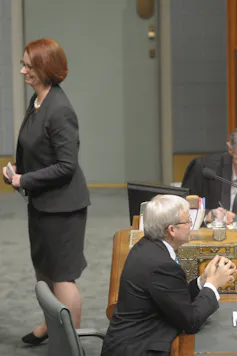
Strangio contrasts the turmoil within the Labor Party during the Rudd and Gillard years with the Liberal Party turmoil during the Abbott, Turnbull and Morrison period. Along with the personality clashes, the latter had more of an ideological aspect, as Turnbull was much more progressive than his rivals.
Abbott essentially failed to make the transition from opposition leader to prime minister. Unlike Menzies and Whitlam, who took over when their parties were in much worse shape than did Abbott, he had not developed a positive program while opposition leader. He was soon complaining about how hard the job was.
Turnbull, like Rudd, came in with great enthusiasm, but proved a disappointment. He had made a Faustian bargain with the Nationals and conservative Liberals. As a result, there was no action on the issues with which he had been associated, such as climate change and the republic.
Strangio’s book evolved from a chapter he contributed to The Conversation’s How Australian Democracy Works. Like Megalogenis’ book, it will be an important reference on the era.
KioskNews shows a cleaned-up reading view extracted from the publisher’s page — the original always lives on their site, not ours.