Trump-Xi meeting: ‘Anti-China card’ has lost impact: KMT lawmaker
By Liu Wan-lin and Fion Khan / Staff reporter, with staff writer


Last week’s meeting between US President Donald Trump and Chinese President Xi Jinping (習近平) has rendered ineffective an “anti-China card” that Washington and Taipei could play together, Chinese Nationalist Party (KMT) Legislator Lee Yen-hsiu (李彥秀) said.
Xi and his wife, Peng Liyuan (彭麗媛), on Friday concluded their three-day state visit to the US, during which Xi and Trump held their second face-to-face meeting this year, following a summit in Beijing in May.
Taiwan remains China’s top concern, with Xi telling Trump that he hoped Washington would oppose Taiwanese independence and handle the Taiwan issue with caution, while the US Department of State said its policy toward Taiwan has not changed, Lee said.
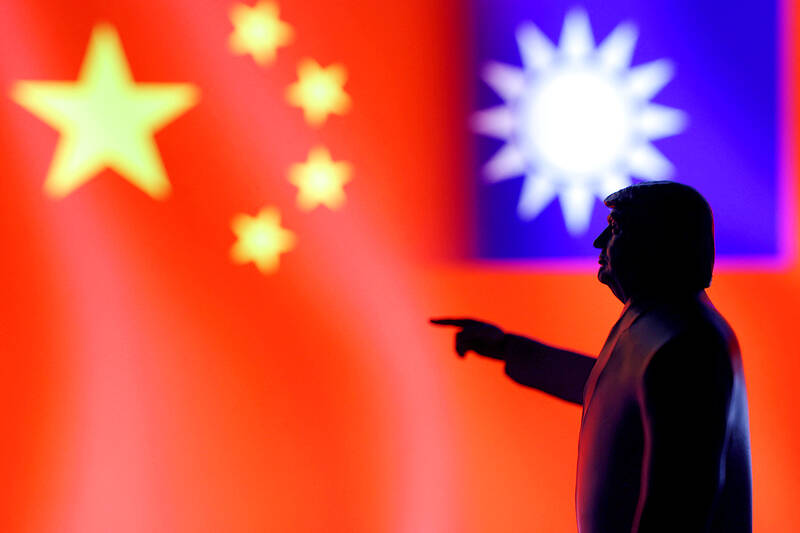
A 3D-printed miniature model depicting US President Donald Trump stands in front of Chinese and Taiwanese flags in an illustration photograph taken on April 17 last year.
Photo: Reuters
Washington understands that the Taiwan issue is a “core interest” for China, and that the “Taiwan card” remains an important bargaining chip for Trump, she said.
The State Department statement provided a lifeline for the Democratic Progressive Party’s (DPP) domestic messaging, but the scale of the second Trump-Xi meeting also stripped away the effectiveness of the “anti-China card,” she added.
Lee was referring to comments by Minister of Foreign Affairs Lin Chia-lung (林佳龍), who in a radio interview broadcast on Sept. 15 said the Chinese Communist Party was seeking to portray a situation of “US-China joint management of Taiwan.”
In reality, Taiwan and the US maintain close communication and are partners, Lin said, adding: “We should be managing China.”
The US and China have maintained their longstanding positions, but Taiwan’s role in that relationship can only be determined based on developments in US arms sales to Taiwan, the level of official exchanges between Taipei and Washington, and whether transit diplomacy resumes, Lee said.
Taiwan’s core interests lie in trade and economic ties, security and international space, she said.
The DPP should take a more pragmatic approach by focusing on securing preferential treatment on chip tariffs, ensuring the smooth approval and delivery of US arms sales, and regaining the nation’s presence on the international stage, she said.
While during Trump’s first term, the US imposed tariffs and technology sanctions against China as part of a broader policy of strategic competition, the two meetings this year confirmed a shift toward a “constructively stable strategic relationship,” with Washington moving toward “transactional bargaining and relationship management based on realism,” Lee said.
For Trump, “America First” remains a core principle, but rather than relying on containment, deterrence and comprehensive decoupling, he increasingly seeks to use a combination of “carrots and sticks” to secure economic returns or strategic concessions for the US, she said.
Trump favors government-to-government negotiations where he can leverage his personal influence, with his meeting with Xi establishing a “G2” framework for global decisionmaking, she said.
While the artificial intelligence (AI) race and efforts to contain each other would continue, the agreement to launch official AI dialogue mechanisms to establish crisis notification systems and hotlines is important, she said.
KioskNews shows a cleaned-up reading view extracted from the publisher’s page — the original always lives on their site, not ours.