Welcome aboard the Costa Serena, the Asian Games floating hotel
NAGOYA, Japan – Mongolian athletes dig into a buffet including mozzarella made by an expert, an aroma steam bath awaits its next visitor and competitors saunter across the carpeted floor.
Welcome on board the Costa Serena, the cruise ship with a capacity of nearly 4,000 people serving as a floating hotel for Asian Games participants in Japan.
The continent’s premier sports event has made headlines for the wrong reasons, with teams complaining about a general shortage of rooms and buses that do not turn up when they should, and sometimes not at all.
In a break from previous Asiads, organisers in Aichi-Nagoya did not construct a traditional athletes’ village in order to save money.
Instead, more than 17,000 athletes and officials – a greater number than the Olympics – are staying in hotels, temporary wooden units and on the Italian-flagged Costa Serena.
Cruise ships have been used to house athletes at sports events before, but not on this scale.
Asiad organisers say it could be a template for future multi-sports competitions.
Some teams have complained about the shipping container-style units, saying the rooms are cramped and the beds too short.
But the Costa Serena, which is nearly 300m long and floating in Nagoya’s port, appears to have no such issues.
On Sept 25, AFP became the first media outlet to step inside the vessel during the Asiad, heading down a steep ramp and through another layer of security.
“It’s perfectly fine. The food is plentiful. For anyone that’s been on a cruise ship, it’s as advertised on the tin,” said Tom Stevens, a Canadian rowing coach with the Lebanon team.
“In my experience, if you don’t want to build huge complexes, this is the way to go.”
A typhoon lashed eastern Japan this week, with Tokyo taking a hit, and the wind did pick up noticeably in Nagoya.
Did he feel anything on board?
“Not a thing,” said Stevens, who has been on the ship for a week.
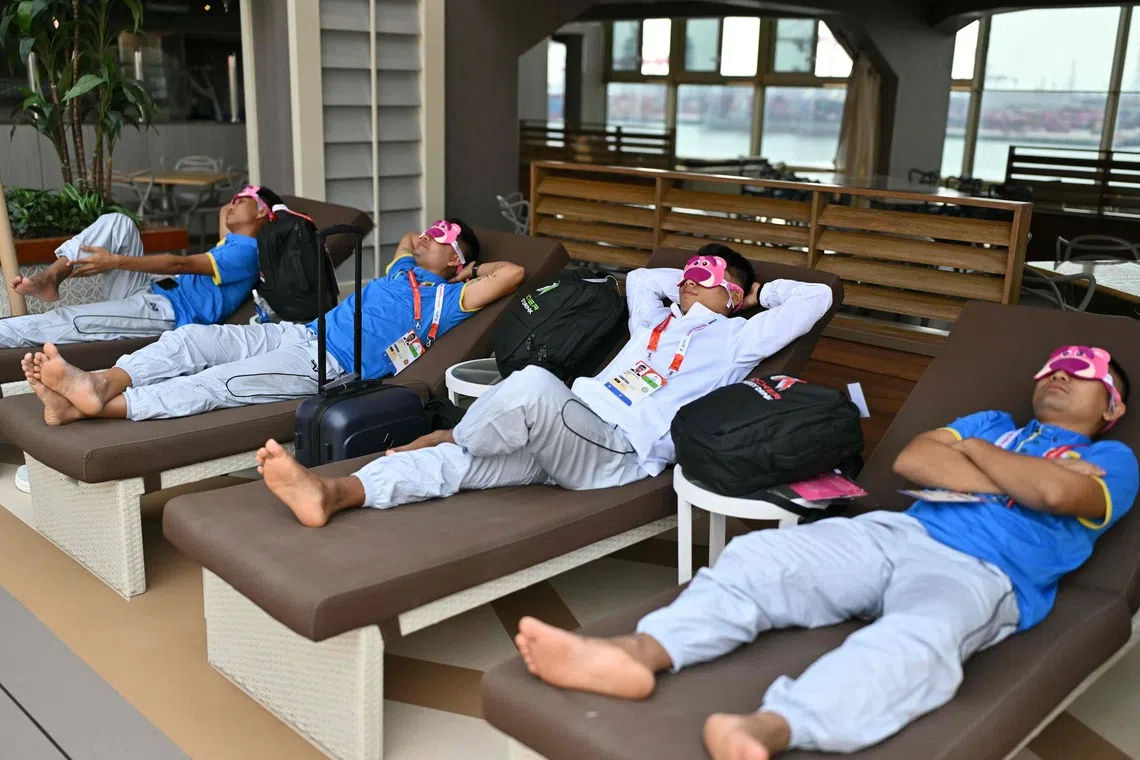
Athletes relax on the Costa Serena cruise ship where Asian Games competitors and team members are staying, in Nagoya on Sept 25.
PHOTO: AFP
In an Asiad facing criticism from multiple angles, Stevens said his stay had not been without issues, but put that down to inconsistent transport and long travelling times on land.
Organisers have admitted to long boarding times onto the ship earlier in the Asiad, blaming teams for failing to do the paperwork properly.
Next stop: the world
There were no such delays as AFP reporters ventured into the ship, which is effectively being hired by the Asiad.
The vessel is slightly different to how it would be for holidaymakers – the luxury watch shop is closed and there is no casino.
New exercise machines were lifted onto the ship for athletes to have an extra gym, where a Qatari competitor sweats as he lifts weights.
In a lounge area there are soft chairs of different colours in the shape of hearts, and light fittings made to look like dangling chillies.
The theme of the interior is a combination of Greek mythology, traditional Japanese elements and hints of other cultures, reflecting the diverse range of crew members and athletes.
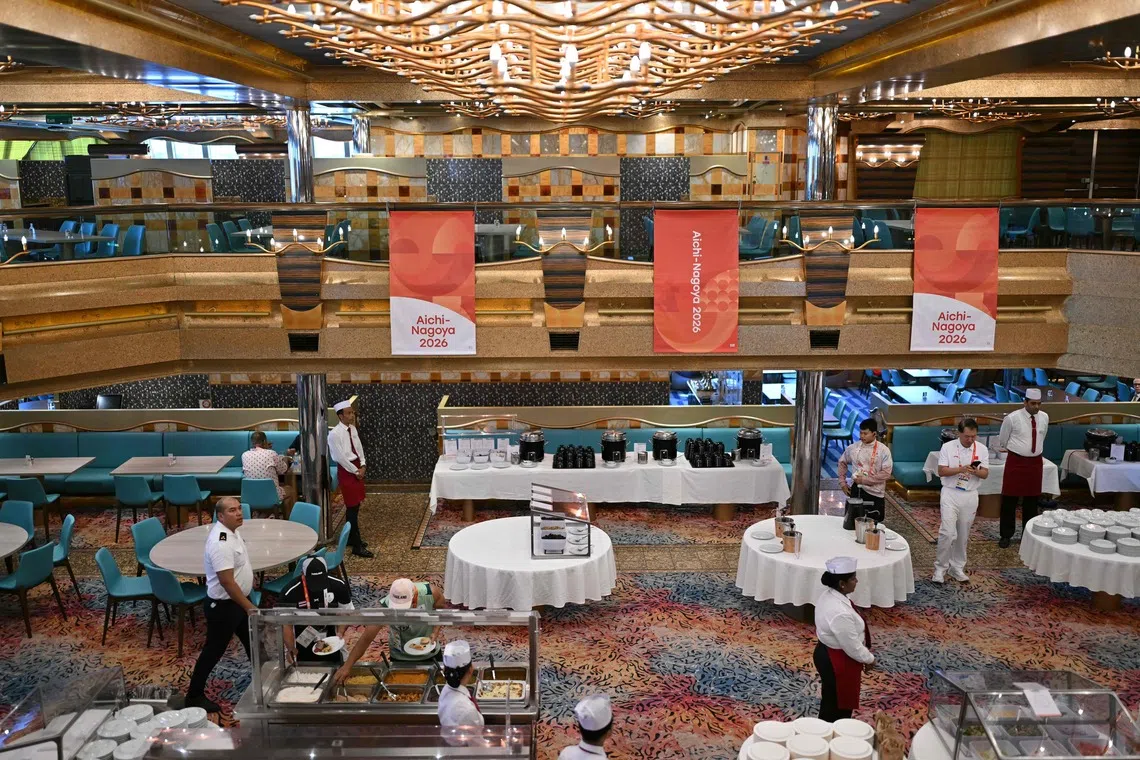
The dining room on the Costa Serena cruise ship where Asian Games competitors and team members are staying as it is docked at Port Messe Nagoya.
PHOTO: AFP
There are 1,500 cabins, some for one person and others have twin beds.
Back in one of the gyms, Sajjad Anoushiravani, a top official with Iran’s weightlifters, is stretching on a mat.
“Fantastic, really, everything is available, modern, perfect staff and very clean,” he said of his experience.
After the Asiad, the Costa Serena will get back to its day job crossing the seas and oceans, ending up in Buenos Aires in time for Christmas.
KioskNews shows a cleaned-up reading view extracted from the publisher’s page — the original always lives on their site, not ours.