Hamlet embraces cricket
Visitors to the chateau in the tiny village of Liettres in northern France heard some unfamiliar terminology this weekend at an international cricket tournament.
“Howzat,” cried the players from France and Belgium taking part in the 11th edition of the Liettres Challenge 1478.
The tournament, the brainchild of the Lille Cricket Club, was launched in 2015 to celebrate the hamlet’s unlikely place in cricket history.
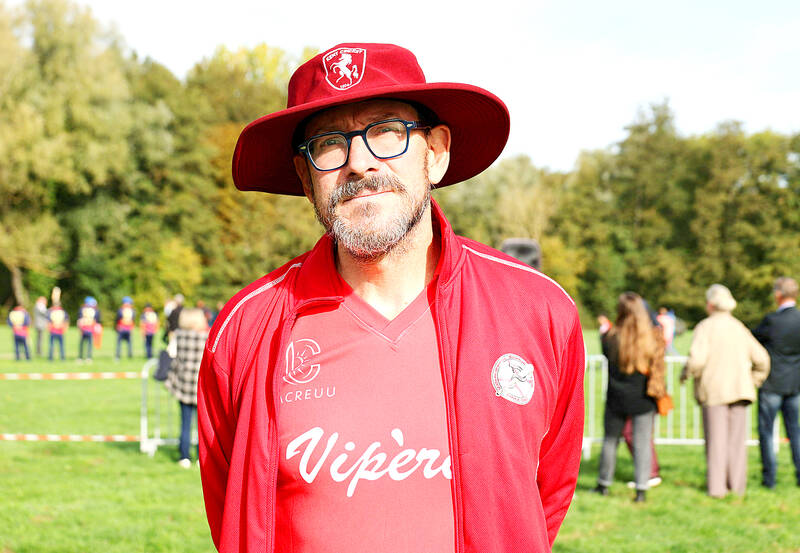
Vipers de Valenciennes manager James Worstead attends the Liettres Challenge 1478 cricket tournament in the French hamlet on Saturday last week.
Photo: AFP
According to organizers, Liettres was the site of the earliest recorded cricket match.
A letter written to France’s King Louis XI in 1478 mentions an argument that broke out between a “poor gunner” at the Liettres castle called Estievenet le Grant and a man called Cotaine le Brasseur, who was playing “criquet” with others.
Words led to blows, and Le Brasseur was stabbed in the arm with a javelin and later died from his wound.
This reference predates by about a century the first known mention of cricket in English sources, in court papers from 1589 mentioning that a pupil from Royal Grammar School in Guildford had been playing “creckett.”
To celebrate the fact, the village contacted Philippe Dethoor, who was Lille president at the time, to ask if they would come down to put on a cricket workshop.
The club had other ideas and decided to create a tournament.
They secured access to a farmer’s field, rolled it and laid out a portable plastic wicket.
Lille invited a team from Belgium, 12 Stars Brussels, and another one from Whitstable in Kent.
“The English team were bowled out for 13 runs,” said James Worstead, who was the Lille secretary at the time, but now runs the leisure section at Viperes de Valenciennes, one of the invitees to this year’s Liettres Challenge. “Lille beat them for the loss of one wicket.”
Since then, the local authorities agreed to move the annual tournament to “a bumpy field behind the castle” and have also created a medieval fair around it, including jugglers, fire-eaters, pony rides, axe throwing, a javelin tournament, Viking battles and, of course, a bouncy castle.
“Initially, there were all these entertainment activities to attract people, but since the tournament was launched, we’ve noticed ever more interest in the game and people actually come to watch the matches — and they are connoisseurs,” said Franck Pailleux, from the regional Bethune-Bruay tourism office.
When the tournament was launched in 2015, it was widely covered in the British press and even by one Indian media firm.
“Historians claim cricket was invented by the FRENCH,” the Daily Mail wrote in an article on Aug. 30, 2015.
However, Dethoor says that was not the case.
“We never said that cricket was invented in France,” he said. “We know that cricket was codified in England. As far as we know — and it wasn’t contradicted at the time — it’s the first written trace referring to a cricket match.”
Worstead, who is an English-language teacher in nearby Valenciennes, said that there was “a good-humored ambiguity” to the suggestion that cricket could have been invented in France.
“There’s something quite iconoclastic about that,” he said. “Serious cricket historians do trace cricket back to Flanders and shepherds playing it. So, it’s not quite as outrageous as it might seem, but of course, for a tabloid headline, it’s: ‘The frogs say they’ve invented cricket.’”
However, some experts in the field dispute the idea that the “criquet” in the letter to King Louis XI relates to the game.
Neil Robinson, head of heritage and collections at the Marylebone Cricket Club, the guardians of the laws of the game, pointed to an article in the April 1973 issue of the Journal of the Society of Archivists.
It includes a detailed analysis of the handwriting and concludes that the word “criquet” is in fact “etiquet” and refers to a stake being used in a game, which was probably not cricket.
“I think it’s a pretty solid rebuttal and I think most historians who looked at it closely would probably agree with that,” Robinson said.
“It’s obviously a great story from the French point of view, but like so many other things in cricket history, I don’t think it happens to be true,” he said.
Still, there is a certain charm to the idea that a tiny hamlet of little more than 300 people could have a claim to a piece of cricket history.
“I love to believe it because it gives them [the French] a certain belongingness to the game itself,” said Judson Daniel Raj Moses, the tour manager at 12 Stars Brussels, who this year lost to Lille in the final.
KioskNews shows a cleaned-up reading view extracted from the publisher’s page — the original always lives on their site, not ours.