Mexico in Numbers: How Taiwanese imports are fueling Mexico’s record tech exports
Data came out last week showing that Mexico’s exports were worth a record high US $81.4 billion in July, an increase of almost 44% compared to the same month of 2025.
In the first seven months of 2026, Mexico’s export revenue totaled $471.4 billion, a year-over-year gain of 27.7%, according to the national statistics agency INEGI.
In July, almost three-quarters of Mexico’s export income came from the shipment abroad of non-automotive manufactured goods. Within that category, revenue from the export of electrical and electronic equipment and appliances soared 134% annually. Among those products are inputs for AI servers and other computer equipment. Mexico is currently shipping large quantities of such goods to the United States.
On the surface, the AI-related export boom appears to be great news for Mexico, but the reality is more nuanced.
As Pedro Casas, CEO of the American Chamber of Commerce of Mexico, wrote in an article that MND published this week, “a significant share of the inputs” in the AI-related products Mexico is exporting is not Mexican, or even North American, but rather Taiwanese. That means that a significant share of the revenue Mexico receives from the export of such products has already been spent on imported inputs.
In a recent LinkedIn post, economist Gilberto García-Vaquez wrote that “a single trailer of servers” entering the U.S. from Mexico “can be worth as much as a thousand cars.”
Mexican exports hit record $81B in July, up nearly 44% on AI-driven manufacturing boom

“But most of that value entered Mexico as imports before the servers ever left,” he added.
In his article, Casas wrote that Mexico, “in many instances,” is “assembling and integrating components that arrive from Asia, then shipping the finished product north.”
“That’s not nothing — assembly creates jobs and keeps supply chains on this side of the Pacific,” he wrote. “But it’s not the same as manufacturing a vertical regional integrated supply chain.”
In that context, this “Mexico in Numbers” article looks at some of the key numbers related to Mexico’s exportation of AI servers and other electronic products — and the Mexican content (or lack thereof) in those goods.
* The data in this article comes from various sources, each of which is mentioned below. In some cases, the numbers cited are estimates rather than proven figures.
More than 1/3 of US server imports come from Mexico
As we reported on Aug. 14, a report by the Economic Studies Department of Grupo Financiero Banamex found that Mexico’s share of U.S. server imports through the first half of 2026 was 34.5%, just behind Taiwan’s 36%. In the second quarter of 2026, Mexico’s share of the U.S. market for imported servers was nearly 40%.
During the first half of the year, Mexico exported more than US $60.4 billion worth of computer servers to artificial intelligence data centers in the United States, according to Banamex. In May, it surpassed Taiwan in sales.
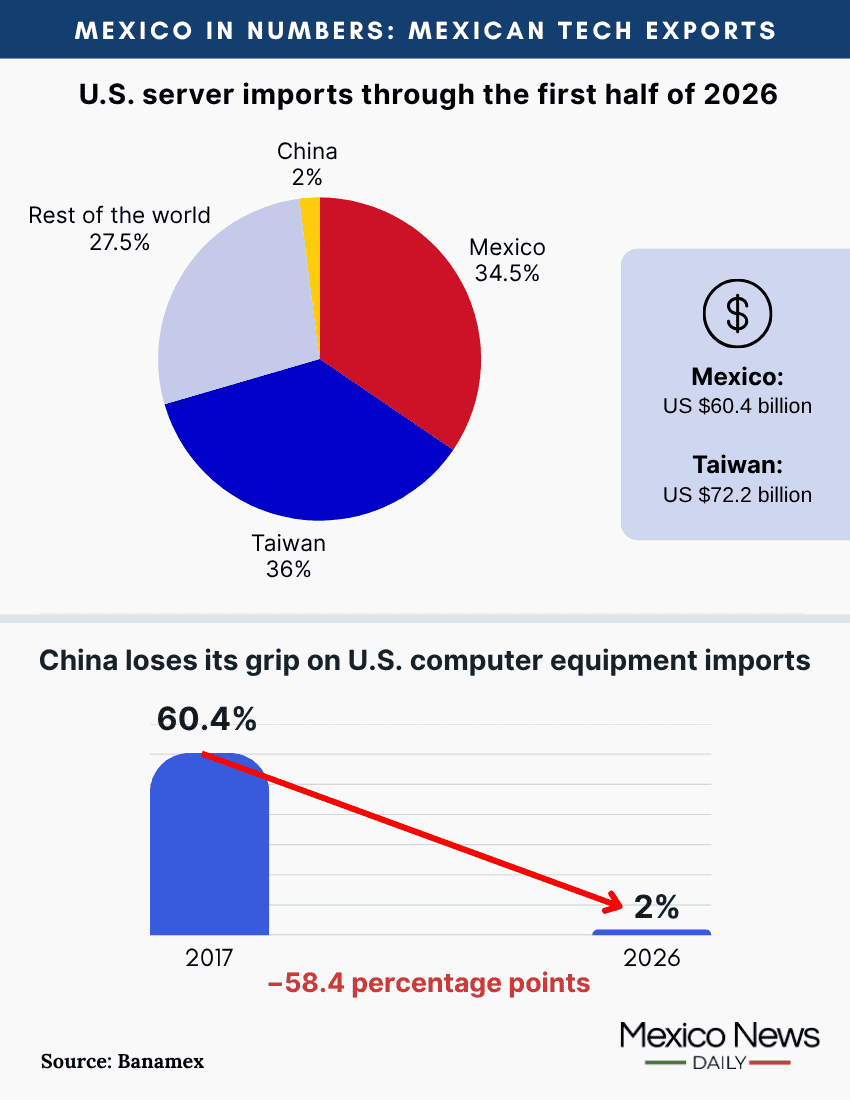
Banamex said that “Mexico has established itself as an assembly platform close to the U.S. market, while design, technological integration and chain coordination activities (for artificial intelligence computing production) remain concentrated in Asia.”
Taiwan’s exports of artificial intelligence servers to the United States were worth $72.2 billion in the first half of 2026, according to Banamex.
As MND wrote last month, “Mexico and Taiwan have captured the U.S. market for artificial intelligence data center servers, which had previously been dominated by China.”
“In 2017, China accounted for 60.4% of U.S. purchases of computer equipment, while in the first half of 2026 its share fell to 2%.”
The vast majority of inputs in computing and other electronic products made in Mexico are foreign
According to a recent report by Swiss multinational investment bank UBS, more than 95% of inputs used in the manufacture or assembly in Mexico of computing and other electronic products are imported, primarily from Asian countries such as Taiwan. In other words, less than 5% of the content in such “Made in Mexico” products is actually Mexican.
“Mexico is capturing an important role in the North American AI supply chain, but much of the value of the products it exports is still generated abroad. Computers and electronics rely heavily on imported inputs, limiting their domestic value-added and employment multipliers,” UBS says in its report.
The bank also says that “a server assembled in Mexico can have a very high export value without generating a proportionally large amount of Mexican income, employment, or local demand.”
Similarly, the Financial Times (FT) reported in August that the “surge in high-value exports is yet to translate into proportional local benefits” in Mexico.
“Each dollar of investment in the highly automated [AI server] plants creates far fewer jobs than more manual sectors such as car parts,” FT wrote, also noting that “Mexico manufactures very few of the parts” used in the country’s AI server sector.
Fernando Alba, deputy economy minister in the state of Chihuahua, told FT that in current conditions Mexico could realistically aspire to reach 3-7% Mexican content in each server, compared to 39% for autos.
“It could do electronics, cooling and product design but making chips was very unlikely, he said, as the country lacks the engineering and design knowhow, as well as enough energy and water,” FT reported.
Alba also said: “A car is a value chain disseminated up and down the country. … It’s much harder to do that with AI servers. We are much less prepared.”
In its report, UBS says that “Mexico does not need to produce advanced chips to capture more value from the AI boom.”
“The more immediate opportunity is to build a broader ecosystem around the manufacturing capacity already being established. Potential areas include electronic components, cooling and power systems, testing and packaging, design, and other specialized industrial inputs,” the bank said.
Mexico’s imports from Taiwan have surged
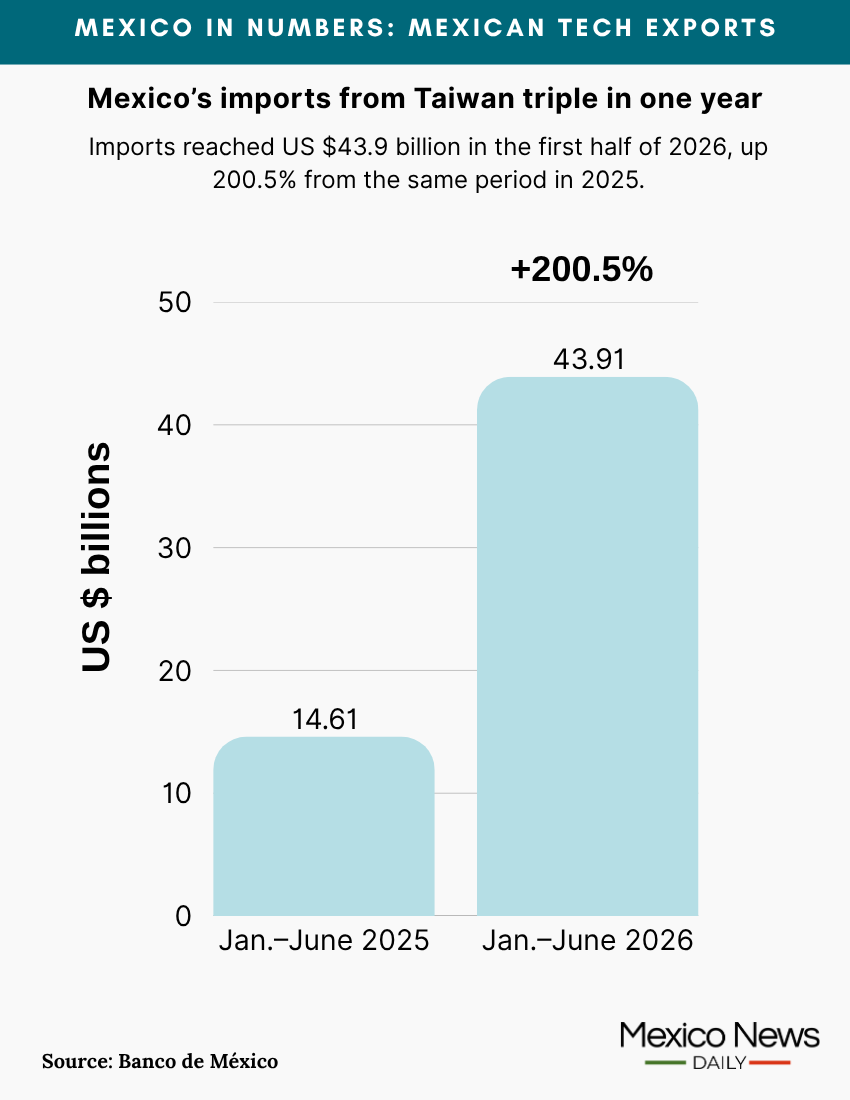
FT reported in August that “Taiwanese manufacturers are rapidly expanding factories in Mexico to assemble servers, which are now the country’s top U.S. export, overtaking autos that dominated its trade for decades.”
As noted above, the vast majority of the inputs going into servers assembled in Mexico — whether by Taiwanese manufacturers, Mexican manufacturers or anyone else — comes from abroad. Taiwan is a top supplier of those inputs.
“Much of the increase in technology imports is coming from Taiwan,” UBS notes in its report.
Therefore, it is not surprising that official data shows that Mexico’s imports from the East Asian island have significantly increase.
According to Bank of Mexico data, Mexico’s imports from Taiwan totaled US $43.91 billion in the first six months of 2026, an increase of 200.5% compared to the same period of last year. In all of 2026, Mexico imports from Taiwan were worth $46.58 billion, less than $3 billion above the total in the first half of this year.
As Mexico News Daily reported in April, much of the recent significant rise in trade between Taiwan and Mexico is in the semiconductor industry. In other words, Taiwan is sending large quantities of chips and other electronic components and inputs to Mexico, where they are used in the assembly of AI servers and other computer hardware, much of which is sent across the border to data centers in the United States.
KioskNews shows a cleaned-up reading view extracted from the publisher’s page — the original always lives on their site, not ours.