Millions of red crabs begin migration to sea
More than 100 million red crabs on Australia’s Christmas Island have begun their annual migration from the forest to the sea, conservationists said this week.
The yearly march of the crabs on the remote territory in the Indian Ocean comes when the rainy season hits and the crustaceans move to the sea to breed.
The timing of their epic migration through forests, across roads and over bridges is tied to lunar cycles — the crabs hope to spawn “before dawn on a receding high tide during the moon’s last quarter,” Parks Australia said.
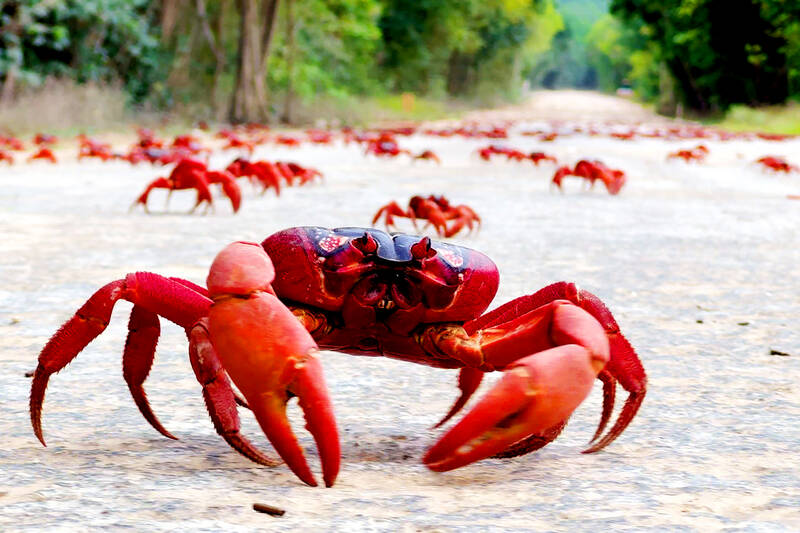
Thousands of red crabs march toward the sea during their annual migration on Australia’s Christmas Island in a screen grab from a handout video released by Parks Australia yesterday.
Photo: Parks Australia via AFP
It requires months of preparation by conservationists on the island, which lies 350km south of Indonesia and more than a 1,000km from the Australian mainland.
The island has an area of 135km2.
“People travel from around the world to witness this incredible wildlife spectacle on Christmas Island,” Christmas Island National Park Manager Chris Chartres said.
“Ongoing conservation efforts have been crucial to the species’ recovery, particularly work to control yellow crazy ants, one of the biggest threats to red crabs,” he said.
Those ants — called “crazy” for their frenetic behavior when disturbed — had displaced an estimated tens of millions of the crabs by occupying their burrows.
However, efforts to control them have seen the crab population rebound from about 50 million to the current levels, conservationists said.
“That’s a great sign the population is thriving,” Chartres said. “Red crabs are the island’s keystone species.”
“They play a critical role in maintaining the health of the forest, so when the crabs are doing well, the whole ecosystem benefits,” he added.
KioskNews shows a cleaned-up reading view extracted from the publisher’s page — the original always lives on their site, not ours.