‘The Terence Conran of his day’: the visionary Victorian futurist adored by design superstars today

Victorian industrial designer Christopher Dresser was always a visionary. As a child, he was so artistically gifted he went to design school in 1847 when he was just 13. He became a professor at 21, dreaming up theories based on plant structure that changed the way designers worked.
But it was after he quit academia that he really started to break boundaries. As a self-declared “design doctor”, he experimented with metal alloys and production techniques that brought beautiful, futuristic homeware into everyday houses. He was one of the first western designers to travel to Japan, helping introduce Japonisme to British life, which has had a transformative effect on furniture and decoration ever since.
Using his ideas on botanical form, he created designs strikingly at odds with the aesthetic of the times. He took the everyday – teapots, toast racks and pitchers – and made them unfamiliar and futuristic. But his achievements are now not widely known.
“Everyone knows about William Morris and the Arts and Craft movement,” says Ian Robinson, a collector of Dresser’s work. “Morris’s politics kept him in with the era’s movers and shakers, and subsequently on the radars of curators and historians. But Dresser was focused on technological developments and using mass production to bring design to every home, which didn’t sound as sexy. It’s interesting how history plays out in these stories. Dresser was embracing new methods; Morris was looking backwards.”
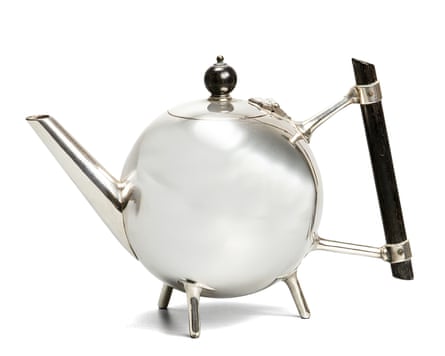
A new exhibition, Christopher Dresser: The Pursuit of Beauty at the Hub, a centre for craft and design in Sleaford, hopes to reinstate the designer’s legacy with a survey of his modernist ceramics, fluid glassware and sharply angular metalwork.
“Ask your friends if they’ve heard of Christopher Dresser, and nine times out of 10 they’ll say no,” says Joshua Lockwood, exhibitions manager and curator at the Hub. Robinson, who has lent work to the exhibition, is such a Dresser fan that he’s got one eye on an online auction for a piece while we talk on a video call.
“If I show people his designs, they recognise some pieces, such as the sugar bowl that Italian design brand Alessi brought back into production in the 1990s, but they don’t know who made them,” Robinson says. “He was the Terence Conran of his day, but he’s not remembered.”
Dresser was born in Glasgow and studied structure and science at the Government School of Design (later renamed the Royal College of Art) under influential academics architect Owen Jones and art critic Gottfried Semper. He became professor of artistic botany there himself, but after missing out on the chair of botany at London University in 1860, Dresser ditched academia and worked instead as a consultant for businesses such as Wedgwood pottery, Minton’s porcelain, Liberty of London and Tiffany & Co.
He created an experimental body of work, remarkable in terms of technology and influence. In his metalwork, Dresser experimented with unusual metal alloys and then cutting-edge processes such as electroplating to make exceptionally sleek household objects. He was co-founder and art director at Linthorpe Art Pottery, a revolutionary workshop set up in 1879 that was the first in the country to use gas-powered kilns. This innovation let Dresser develop his signature mottled glazes, and he designed over 1,000 vessels in the three years he worked there.
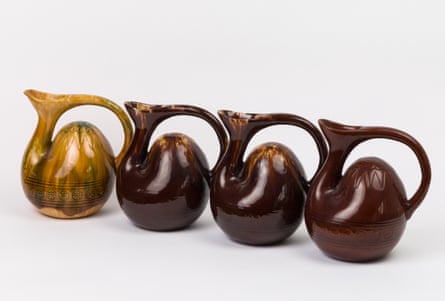
He travelled to Japan in 1876 on behalf of the South Kensington Museum (now the V&A), and helped start the Victorian craze for Japonisme. “That was his thing, to bring beautiful things to the home,” says Robinson. “He wanted to bring good design to as many people as possible. To buy Morris’s furniture you had to be very wealthy. Dresser mainly worked in silverplate or even painted tin. It was beautiful design but it was also affordable.”
Dresser’s family tried to continue his design studio after his death in 1904, but when that proved unsuccessful they disposed of all his account books and drawings, effectively destroying his archive. “I think they burned everything,” says Robinson. “All the documents were lost and it wasn’t until the 1970s that anyone started looking into his work again.”
Designers Philippe Starck, Terence Conran and Alberto Alessi have all expressed admiration for Dresser’s ability to bridge great design, mass production and respect for the middle-class consumer; and artists such as ceramicist Magdalene Odundo and sculptor Alice Channer have been influenced by the sleek, sinuous botanical shapes that define his work. Odundo saw Dresser’s ceramics at the British Museum as a student, and was inspired by the way he pulled ideas together to create something new, rather than to emulate what already exists. Her work will also be on show at the Hub alongside Channer and artists Coco Crampton and Gabriele Beveridge.
“Hopefully this exhibition will bring more awareness of Dresser,” says Lockwood. “Not just his production of objects but that his work has lineage. This history hasn’t really been told and I want to bring this wonderful designer to the forefront.”
-
Christopher Dresser: The Pursuit of Beauty is at The Hub, Sleaford, from 28 November to 7 March
KioskNews shows a cleaned-up reading view extracted from the publisher’s page — the original always lives on their site, not ours.