EXPLAINER: What is the ASEAN Digital Economy Framework Agreement?

Already have Rappler+?
to listen to groundbreaking journalism.
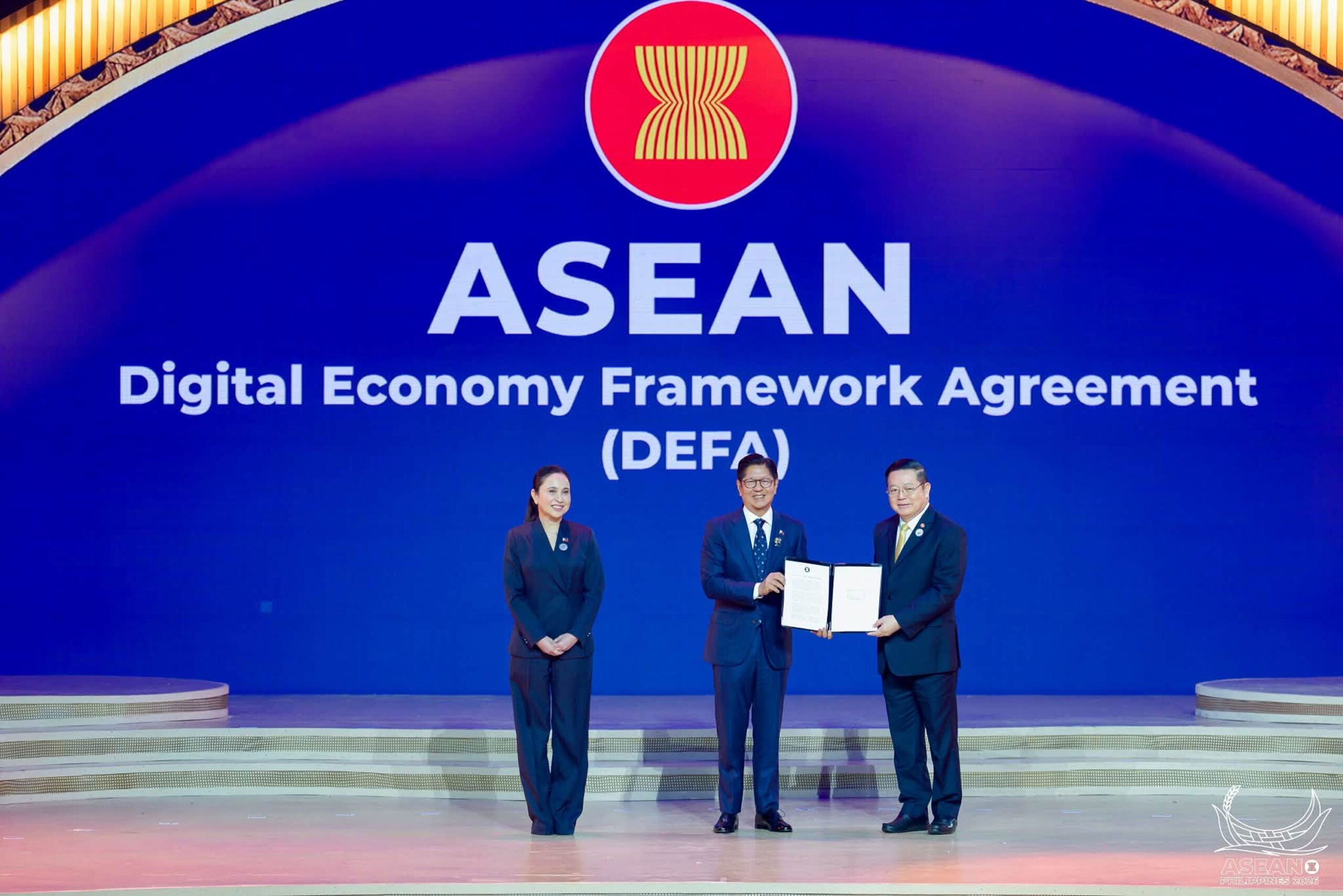
Philippine President Ferdinand Marcos Jr. hands over the ASEAN Digital Economy Framework Agreement (DEFA)—the world’s first region-wide digital economy agreement—to ASEAN leaders during the opening of the 49th Summit at the PICC on November 15, 2026.
PCO
'DEFA will facilitate paperless trading, cross-border e-commerce, and trusted cross-border data flows, and it will establish interoperable trade systems,' says ASEAN Secretary-General Kao Kim Hourn
AT A GLANCE
- ASEAN member countries signed the ASEAN Digital Economy Framework Agreement (DEFA) on November 14, establishing common rules for digital trade in a market of nearly 680 million people.
- DEFA aims to create an interconnected digital marketplace, facilitating paperless trading, cross-border e-commerce, and lowering transaction costs, particularly benefiting micro, small, and medium enterprises (MSMEs).
- While the agreement is signed, its implementation rules are still being developed, with expectations for it to take effect by 2027, and the success of DEFA will be measured by its impact on MSMEs.
This is AI-generated. Read the article for full context. Report any errors.
MANILA, Philippines – Members of the Association of Southeast Asian Nations (ASEAN) have signed the ASEAN Digital Economy Framework Agreement (DEFA), the first region-wide agreement of its kind.
Signed by ASEAN’s 11 member-countries on Saturday, November 14, DEFA establishes common rules for digital trade in a market of nearly 680 million people. Negotiations began in 2023, with the agreement becoming a priority deliverable of the Philippines’ ASEAN chairmanship this year.
“DEFA is not simply about economic growth. It is establishing the rules, systems, and cooperation that will allow our people and businesses to participate more fully in that growth,” Trade Secretary Cristina Roque said during the signing ceremony on Saturday.
Roque also said DEFA could help ASEAN’s digital economy grow from an estimated $1 trillion to $2 trillion by 2030.
But what exactly will it do?
At a high level, DEFA hopes to establish an “interconnected ASEAN digital marketplace,” with a framework covering cross-border e-commerce, electronic payments, protection of source code, cybersecurity, online consumer protection, and cooperation on emerging technologies such as artificial intelligence. It’s another step in ASEAN’s long-held aspiration of economic integration, though critics say progress toward a single market and production base has been painfully slow.
“DEFA will facilitate paperless trading, cross-border e-commerce, and trusted cross-border data flows, and it will establish interoperable trade systems,” ASEAN Secretary-General Kao Kim Hourn said at the ASEAN Business and Investment Summit on Saturday.
In practical terms, that means lower transaction costs, simpler cross-border operations, and easier access to customers in the region, especially for micro, small, and medium enterprises (MSMEs). This includes cutting down on paperwork through the wider use of electronic trade documents, signatures, and invoices, as well as establishing clearer rules for cross-border data transfers.
According to Finance Secretary Frederick Go, more than half of enterprises trading in ASEAN still face paper requirements at the border, and two out of three in using digital payments also reported delays.
“DEFA is built to remove exactly those frictions,” Go said in a speech at the ASEAN Business and Investment Summit.
When will it take effect?
Though the agreement has been signed, its implementing rules have yet to be fully developed, meaning many of the specifics remain unclear, and its benefits could still take months, if not years, to be felt.
“We hope, after signing today, ASEAN will fast track the ratification process and while the ratification process is moving forward, we are working on the implementation plan so that this will be ready by May next year when DEFA goes into effect,” Hourn said.
ASEAN expects the agreement to enter into force in 2027, with May identified as a target for implementation. The full text of the ASEAN DEFA is also expected to be published on the ASEAN Secretariat website by early 2027.
Locally, the Department of Trade and Industry plans to conduct trade shows and information campaigns in 2027 to help entrepreneurs understand the agreement.
Another thing to watch would be whether the gains under DEFA would redound only to large businesses or would reach all the way to MSMEs. As ASEAN Business Advisory Council (ASEAN-BAC) chair Joey Concepcion III put it, MSMEs will be the acid test for the agreement.
“What works for the smallest businesses can also work for the largest companies. If we can make cross-border trade simple, efficient, and secure enough for MSMEs, we create a foundation that can benefit businesses of every size,” the Go Negosyo founder said in a statement. – Rappler.com
KioskNews shows a cleaned-up reading view extracted from the publisher’s page — the original always lives on their site, not ours.