A coalmine on Trish’s Queensland farm has been abandoned. Will anyone clean it up?
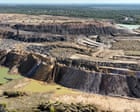
When Trish Goodwin discovered this week that the Bluff coalmine – cut like a gaping wound into her cattle farm – had been officially abandoned, it came as no surprise.
“I always said they’d walk away from it,” she says of the long mothballed central Queensland highlands mine, 175km west of Rockhampton.
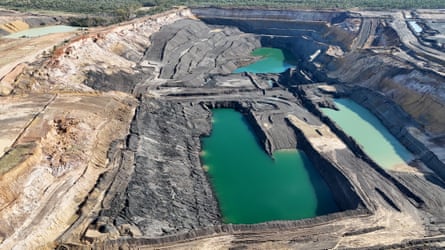
Last week liquidators disclaimed the mining lease – and associated environmental authority and exploration permits – for the 1,100ha site, after failing to sell it following the financial collapse of its owner, Bowen Coking Coal, in July 2025.
With responsibility to clean up the mine handed to the state government, Goodwin is far from certain what happens next.
Who will pay compensation she claims she is owed for the loss of land, road and communication access? To what extent will the country her family farmed for generations be rehabilitated? Who will prevent methane gas spewing from the open cut mine? Who will stop toxins leaching into the waterways that run through her land? Suppress the pit dust? Stop the erosion?
These are among a long list of questions she put to representatives from the Abandoned Mine Lands Program in an emergency meeting on her property on Wednesday.
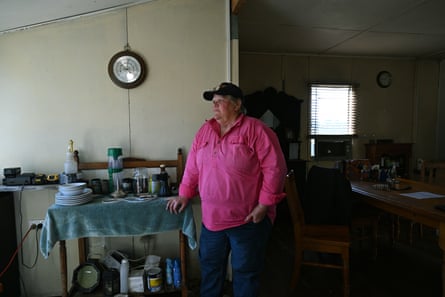
For now, they are all questions the mines department will have to take on notice.
The program manages numerous abandoned mines, but this is the first since the state introduced a financial provisioning scheme designed to ensure taxpayers are not left to foot the bill when mines go bust.
The scheme, which came into force in 2019, requires miners to provide surety to cover remediation and rehabilitation costs when mines close.
It is understood a mine the size of Bluff would have had to pay a surety of about $10m, which would cover most of the department’s estimated cost of $12.3m for rehabilitating the mine. It is unknown whether Bluff’s management did so.
A Queensland Treasury spokesperson said it did not “disclose site-specific amounts under the financial provisioning scheme”.
But with the Liberal National party government of premier David Crisafulli currently reviewing those laws, introduced by its predecessor, in an effort to “cut red tape”, some say the legacy of Bluff should act as a cautionary tale.
Andrew Gorringe of the Institute for Energy Economics and Financial Analysis says Bluff “won’t be the last that goes this way”.
Bluff had been in care and maintenance mode since November 2023, the second time it was mothballed since breaking ground in 2019. Gorringe says at least another five coalmines are in care and maintenance, while new mines continue to be approved or have their leases extended “without a view to the long term outlook for coal”.
“That creates a greater risk that this sort of thing is going to accelerate at some point in the future,” he says.
“Our argument has always been that these marginal miners, that either have lower coal quality or higher operating costs, they’re going to be the ones to fall off the tree first.
after newsletter promotion
“This is going to be a test.”
The central Queensland coordinator for the Lock the Gate Alliance, Claire Gronow, says department’s estimate of the rehabilitation cost is likely to be an underestimate, and whatever the shortfall “it is the taxpayer who has to pay for it”.
The farm and environment advocate says that, as a taxpayer, Goodwin would “pay twice”, having also been left materially impoverished by the failed mine.
She contrasts the cattle farmer’s fortunes with those who have owned and walked away from Bluff, including Bowen Coking Coal’s former chair Nick Jorss, who founded and led the industry group Coal Australia.
“I think we should all care about what has happened to Trish because this shows that mining companies have got a huge amount of influence on the government, and ordinary Queenslanders don’t,” she says.
The Lock the Gate campaigner says the scales are being tipped further towards the interests of the big end of town, with proposed legislation that would ban some mining project opponents from being heard in court and the passage of a bill that enables the government to seize land for select private development.
“Another reason we should care is because there’s a dirty big hole in the ground that’s just going to keep polluting forever – or until someone cleans it up,” Gronow says.
A mines department spokesperson said it was working with relevant agencies to ensure Bluff was “secured and risks to public safety and the environment are appropriately managed”.
Asked for details about the process of rehabilitation, the spokesperson said the liquidators had “only recently disclaimed” their leases and permits, so “we have no further information to provide … at this stage”.
KioskNews shows a cleaned-up reading view extracted from the publisher’s page — the original always lives on their site, not ours.