Tomi Adeyemi on the film of her hit novel Children of Blood and Bone: ‘I don’t plan to watch it’

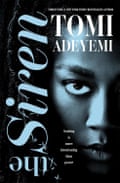
There is a photograph of Tomi Adeyemi staring out from the cover of her new novel, The Siren. It is an arresting image: her face fills the frame, unsoftened by a smile, her piercing gaze fixed directly on the viewer. “It’s terrifying – like the Mona Lisa, staring at you everywhere,” she says, laughing.
Using an author portrait on the cover of a novel is highly unusual, and a decision that Adeyemi says is a statement of ownership. After 12 years spent inside the world of Children of Blood and Bone – the first book in the YA trilogy that made her a literary star and its film adaptation which has become a source of profound distress – Adeyemi wanted this book to belong unmistakably to her.
“It was an intense choice, and I think it’s because I needed people to see me in this one,” she says. “I’ve had so much success, but it was also done in a way where so many people’s interpretations were put on to who I was.”
The recent public fallout from the forthcoming film adaptation may have drawn attention, but the 33-year-old Nigerian American author had already spent much of her adult life being watched. Children of Blood and Bone, her 2018 debut, became a publishing phenomenon, netting a major seven-figure deal and debuting at No 1 on the New York Times young adult bestseller list. Its story of Zélie, a young woman fighting to restore magic to the kingdom of Orïsha, was inspired by West African mythology and offered something Adeyemi had craved as a child: a dark-skinned Black girl at the centre of an epic fantasy.
The success brought its own mythology. Adeyemi was not merely a successful young writer; she became, she feels, a symbol of what the next generation of Black YA literature might be, something she felt the weight of acutely.
“I felt pressure to be the perfect dark-skinned Black girl, to be ‘Oprah good’,” she says. “This was the biggest YA book deal in history, not just for a female or Black author. And so few of us are given a shot at all, so for the last 12 years there’s been this sense of carrying everyone.”
Readers would tell her what the book had meant to their children. “You have no idea what this did for me,” they would say. Such responses were moving, but also difficult to know what to do with.
Now, with The Siren, Adeyemi has moved from epic fantasy to something more contemporary. The standalone novel follows Emery, a Black student arriving at Dartmouth College determined
to leave her troubled past behind. She is drawn into a mysterious sorority of “Sirens” and desperate to fit in. In some ways, Adeyemi says, the book is deeply personal. “[Emery] is my inner teen,” Adeyemi says. “I just want to give her a hug.”
She may have found success, but in the beginning Adeyemi’s career never looked certain. She wrote her first story at five – a Parent Trap fan fiction because, she says, she “wanted a twin and a horse”. She then spent years trying not to become a writer. Her parents had moved to Chicago from Nigeria in their early 20s, and Adeyemi grew up with the ethos of relentless achievement that often comes with first-generation immigrants – one that does not take kindly to creative pursuits. She considered medicine, investment banking and consulting, but kept coming back to writing. “Being called to be an artist is terrifying,” she says. “It’s not a logical choice.”
After studying English at Harvard, Adeyemi won a fellowship to study West African mythology and culture in Salvador, Brazil, an experience that would later inspire Children of Blood and Bone. She moved to California and began working part time at a film production company in Los Angeles, alongside writing her first novel.
That first attempt took four and a half years to write and received 63 rejections. She decided to drop the manuscript and wrote Children of Blood and Bone instead. When it was finally published in 2018 it quickly became one of the most talked about YA novels of the year. For a writer who had spent years being turned down, the speed and scale of what followed were dizzying. “I never really adjusted, because there was so much work still to do,” she says. “It’s been 12 to 14 years of intense grinding.”
And then came the film. On paper, it was the stuff of a writer’s dreams: her novel was to be transformed into a major Hollywood production, with an impossibly starry cast including Viola Davis, Idris Elba, Regina King, Damson Idris, Amandla Stenberg and Cynthia Erivo, premiering in January 2027. Adeyemi co-wrote the screenplay, but as the adaptation progressed, she became increasingly unhappy with the process.
In July, Adeyemi posted a five-minute video on TikTok in which she described the adaptation process as “the worst thing I have ever had to live through”. She said she had left the set “hyperventilating and sobbing”, and that afterwards she experienced severe physical pain and panic attacks. “I never want to hear about this project again,” she said.
She says she had little hesitation about speaking publicly. “I understood that if I didn’t speak up, I couldn’t move forward,” she explains. “I can’t really worry about the response, because I don’t have to live with how people respond to me – I have to live with me, every day.”
When I ask what exactly happened on set, however, Adeyemi hesitates. “I won’t go into the specifics,” she says carefully. “[But] the whole journey of the trilogy and the adaptation felt biblical … It took all of me.”
There has, though, been public discussion around the film’s casting of Amandla Stenberg, who is mixed race, and questions around colourism: Stenberg’s character is described in the book as having “dark copper skin”. Adeyemi’s July TikTok also appeared to show messages she sent to Stenberg in February 2025, around the time Stenberg responded to the colourism backlash, telling the actor: “Do not ever use my name in an interview or video again. Do not text me. Do not call me.”
When I ask Adeyemi whether she wants to clarify anything about the casting, she demurs. “With a film, the director makes every decision,” she says. “With my book I can talk about every choice down to the commas, because that’s truly in my hands. So there’s nothing for me to add, other than the clarity that these aren’t my choices.”
She is clear, though, about one thing. When I ask her if she would ever adapt another one of her books for screen she responds simply: “Never.” She has no desire to watch the upcoming film either. “I still don’t plan to watch it, but it’s not really for me to watch,” she says.
Instead, she is trying to leave the world of Children of Blood and Bone behind, and focus on what she has achieved. “I’m proud of my strength, resilience, and grace,” she says.
She is also proud of what she believes her debut set in motion: the fact that she can now walk into a bookshop and see shelves of dark-skinned protagonists across fantasy, romance, thrillers and mysteries. “The girls who grew up after me will never have that experience,” she says. As her publisher told her: “You changed things.”
KioskNews shows a cleaned-up reading view extracted from the publisher’s page — the original always lives on their site, not ours.