Mexico to establish smart hospital with China’s help: Tuesday’s mañanera recapped
- 🏥 Healthcare the focus at Tuesday’s mañanera: Sheinbaum outlined part of her vision for the future of healthcare in Mexico. Her remarks came as the government works on a universal healthcare scheme and an AI-assisted program to improve the control, storage and distribution of medications.
- 🇨🇳 Mexico and China to collaborate on a smart hospital: Sheinbaum said the two governments “agreed on at least two actions” after her visit last week to a 1,500-bed smart hospital in Shenzhen. The first is to establish a smart hospital in Mexico, although she didn’t say which existing hospital would be converted or give a timeframe. The second is greater cooperation on scientific training and research, including sending Mexican doctors to China for training.
- 🤖 Sheinbaum backs more tech in healthcare: “We have to take advantage of technology to improve healthcare,” the president said, citing China’s levels of automation and digitalization as a benchmark.
- 📱 Universal healthcare app is Sheinbaum’s “dream”: She said she wants every Mexican to have a universal healthcare app on their cell phone for scheduling appointments. It could also include an AI chatbot to advise users on whether they need to see a doctor immediately, although she said it “doesn’t replace a doctor.” She didn’t say when the app might be available.
Why today’s mañanera matters
Healthcare was a key focus at President Claudia Sheinbaum’s Tuesday morning press conference.
The federal government is currently working on a range of healthcare initiatives, including the establishment of a universal healthcare scheme and the implementation of an artificial intelligence-assisted program aimed at improving the control, storage and distribution of medications.
Accompanied by several health officials at today’s mañanera, including Health Minister David Kershenobich, Sheinbaum outlined part of her vision for the future of healthcare in Mexico. Her vision is informed, in part, by her visit last week to China’s tech capital, Shenzhen, where she attended the APEC Leaders’ Meeting, met with several world leaders including Chinese President Xi Jinping and U.S. President Donald Trump, and visited a smart hospital — that is, a hospital that uses a range of digital technologies, including AI, to improve patient care and operational efficiency.
On Tuesday morning, Sheinbaum told reporters that her government reached an agreement with its Chinese counterpart to work together on the establishment of a smart hospital in Mexico.
Mexico and China are seeking to deepen bilateral cooperation in a range of areas, including science and technology, agriculture, healthcare, clean energy and water resources.
Mexico to collaborate with China on the establishment of a smart hospital
Asked about future healthcare collaboration between Mexico and China, Sheinbaum said that her administration and the Chinese government “agreed on at least two actions” during their meeting in Shenzhen last week.
“… The first is to establish a smart hospital in Mexico, we’re going to start with that,” she said.

“From there, we’ll look at how we can make progress in other hospitals,” Sheinbaum said.
She said that her government had not yet determined which existing hospital in Mexico would be converted into a smart hospital.
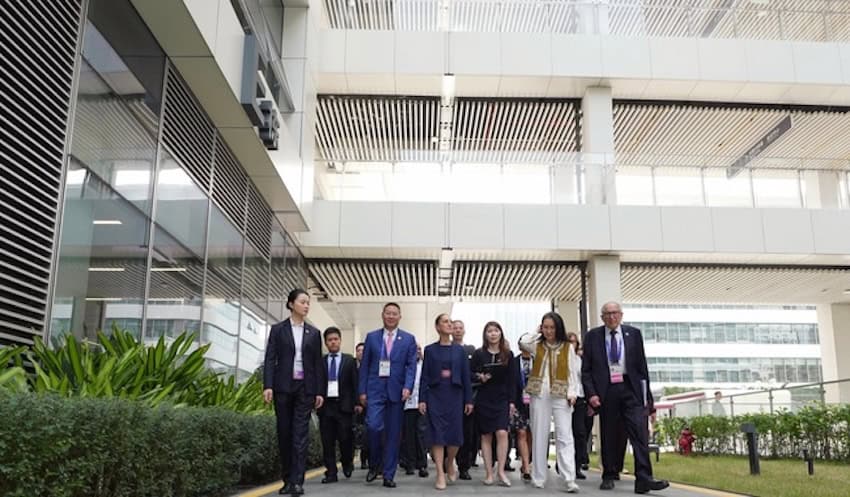
“But the hospital we visited [in Shenzhen] has 1,500 beds and it has advanced technology and provides extraordinary care. So the objective is to establish one of these hospitals [in Mexico] and continue collaborating [with China],” Sheinbaum said without providing a timeframe for establishing Mexico’s first smart hospital.
She said that the second “action” Mexico and China agreed to is “greater cooperation on scientific training and research.”
“The objective is for a group of Mexican doctors to go to China to undergo training and we’ll also look at whether doctors from China can come to Mexico to receive training,” Sheinbaum said.
Sheinbaum: ‘We have to take advantage of technology to improve health care’
A week after touring a “smart hospital” in Shenzhen, China, Sheinbaum expressed her support for the greater use of technology in healthcare facilities.
“We have to take advantage of technology to improve healthcare,” she said.
“That’s what we’re doing now. If we can reach the levels of automation and digitalization China has, including the use of robots for certain things, what could be better? What we want is to care for people in the best possible way,” Sheinbaum said.
Sheinbaum’s healthcare dream? A universal healthcare app
Sheinbaum told reporters that “the dream all of us here have is for every Mexican to have a universal healthcare service application on their cell phone.”
“You tap [the] universal healthcare service [app] and say: ‘I’m going to the doctor’s office, I want to make an appointment,” she said.
🤖🏥 ¡Con todo y ayuda de la IA para saber si necesitas ir al médico! Sheinbaum señaló que su objetivo es que cada mexicano y mexicana tenga una aplicación del Servicio Universal de Salud en su celular, desde la que pueda programar sus citas médicas https://t.co/XzQylXyqBG
— El Financiero (@ElFinanciero_Mx) November 24, 2026
In addition to scheduling medical appointments, Sheinbaum said that such an app could have artificial intelligence features.
For example, she said that app users could describe their symptoms to an AI chatbot.
“Of course it doesn’t replace a doctor, but [the chatbot could advise on whether] you have to go to the doctor immediately or not,” Sheinbaum said.
She didn’t say when a universal healthcare app might be developed and made available.
Sheinbaum said last month that a limited version of the government’s new universal healthcare scheme is set to commence in January 2027, with additional healthcare services to be universalized in the coming years,
KioskNews shows a cleaned-up reading view extracted from the publisher’s page — the original always lives on their site, not ours.