Conway ruled out of opening ODI after collision with Henry
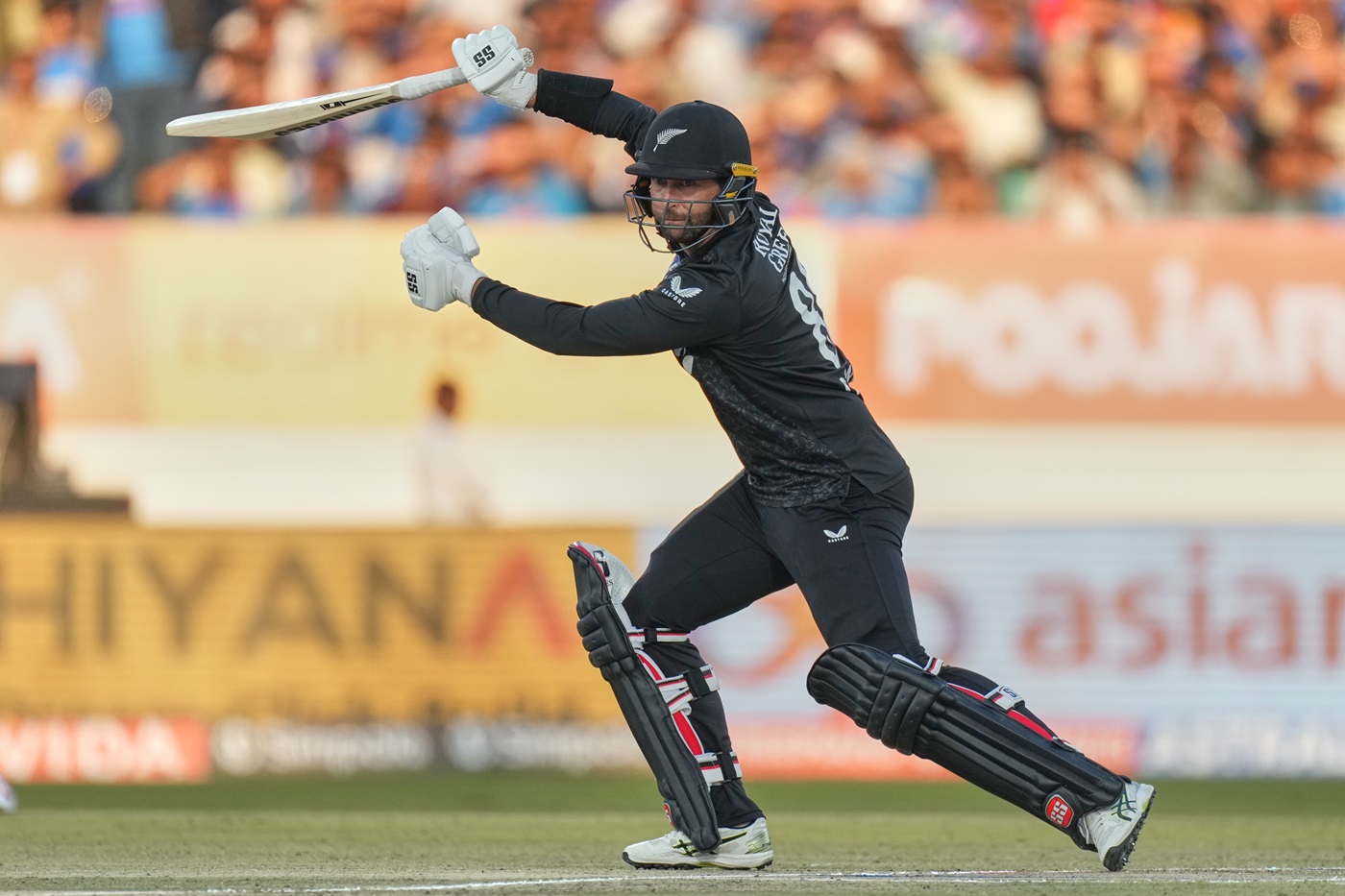
Devon Conway is the latest in a significant list of injured New Zealand players • Associated Press
Devon Conway has been ruled out of New Zealand's ODI series opener against India in Auckland on Wednesday. The opener took a blow to his head during a collision with fast bowler Matt Henry during New Zealand's pre-match training session at Eden Park on Tuesday.
New Zealand captain Mitchell Santner said Henry seemed fine after going through concussion tests, but Conway had been rushed for scans.
"Not yet," Santner said when asked if he had a definitive update on Conway's participation. "I think Matt went through his concussion thing. He seems okay, but Dev's been raced off-premises. So, yeah, it didn't look too good, actually, that collision."
Conway has since been ruled out of the Auckland ODI after he was "taken to A&E for further examination which confirmed a concussion," according to an NZC media release.
Conway is the latest in a significant list of injured New Zealand players, with batters Mark Chapman and Rachin Ravindra having been ruled out of the ODI series with hamstring and shoulder injuries. Tim Seifert, who was originally only in consideration for the first two ODIs, had been included in the squad for the entire series on Monday. Santner indicated that Seifert would likely play if Conway was ruled out.
"Yeah, I guess he's [Seifert] the back-up batter in our squad," Santner said. "So it'll probably be a direct swap if Dev's unavailable, which is a shame. He [Conway] is obviously very good in one-day cricket and, you know, was biding his time in the T20 series. And, yeah, I guess another one of those freak accidents that happens."
The dimensions at Eden Park, with its short straight boundaries, are expected to pose both teams a challenge. Santner felt there would be some bounce on offer for the fast bowlers, as there had been during the fourth match of the recently concluded T20I series. New Zealand's quicks had used hard lengths to telling effect in that game, an 87-run win for the home side.
"Yeah, I guess it's a different format, but we've played here a lot in one-day cricket," Santner said. "The pitch traditionally has a bit of bounce, like we saw in the T20, and it's the same surface.
"Ground dimensions is always one to play into your mind at Eden Park. Traditionally, there's a little bit of bounce, which, you know, is good for the seamers. And it can be quite swirly with the wind, you know, which can make it quite a tough catching ground."
Catching had been an issue for New Zealand through the T20I series, and possibly a factor in the eventual scoreline - 3-2 in India's favour.
"We reviewed after the last game in Hamilton, [the] 3-2 loss," Santner said. "But it could have looked a lot different if we took those small moments. And I guess the guys did good fielding [practice]. I guess you're practising during the day where you're training; catching under lights is always a different task. And I guess with the wind in New Zealand, it can be quite challenging at times.
"But it's one of those ones, you don't want guys to be afraid of it or shy away from a catch, if they're going for it and [drop it], you know, everyone's trying. So, it's one of those ones where, if you drop good players, they're going to make you pay. And I guess they [India] did during the series."
"If we are going to get a little bit of green surfaces, or a little bit of bounce, a bit of nibble, which traditionally we do in one-day cricket, it'll be quite nice. And then if it's not the case and it's flat, we have to adapt pretty quickly as a unit."
Santner on the surfaces he expects in the ODIs
Another challenge both teams could face through the ODI series is dew, particularly with the unusually late starts, with all five games set to begin at 3pm local time. The late starts, Santner said, could also challenge the players with recovery between games.
"Yeah, I think with the dew, especially within the T20s, it was quite prominent, especially second innings," Santner said. "So I think with a 3pm start, it's probably going to be no different [in] the back end of the second innings here around the country.
"So yeah, and obviously the recovery [period after matches] is a little bit shorter with travel as well. So I think guys [have] just got to be on top of it, whatever it looks like."
The T20I series began on flat pitches where both teams scored big; New Zealand's two wins, in the fourth and fifth T20Is, came on pitches that had a little more help in them for the seamers.
"Yeah, I hope so," Santner said when he was asked if he would like pitches with help for the fast bowlers in the ODIs too. "But again, you're moving around the country. Christchurch, we probably expected [there] to be more in the surface than there was [in the first two T20Is].
"I know there was obviously a lot of hot weather and stuff [in the lead-up to the series], which naturally dries out pitches. I think we saw a little bit of a blueprint in the last two [T20Is] that they did a little bit, and obviously here [and] in Hamilton, which was quite nice.
"And we know how to operate on those wickets. So if we are going to get a little bit of green surfaces, or a little bit of bounce, a bit of nibble, which traditionally we do in one-day cricket, it'll be quite nice. And then if it's not the case and it's flat, we have to adapt pretty quickly as a unit."
KioskNews shows a cleaned-up reading view extracted from the publisher’s page — the original always lives on their site, not ours.