US B94 nuclear bomb designation signals renewed push for bunker-busting weapons
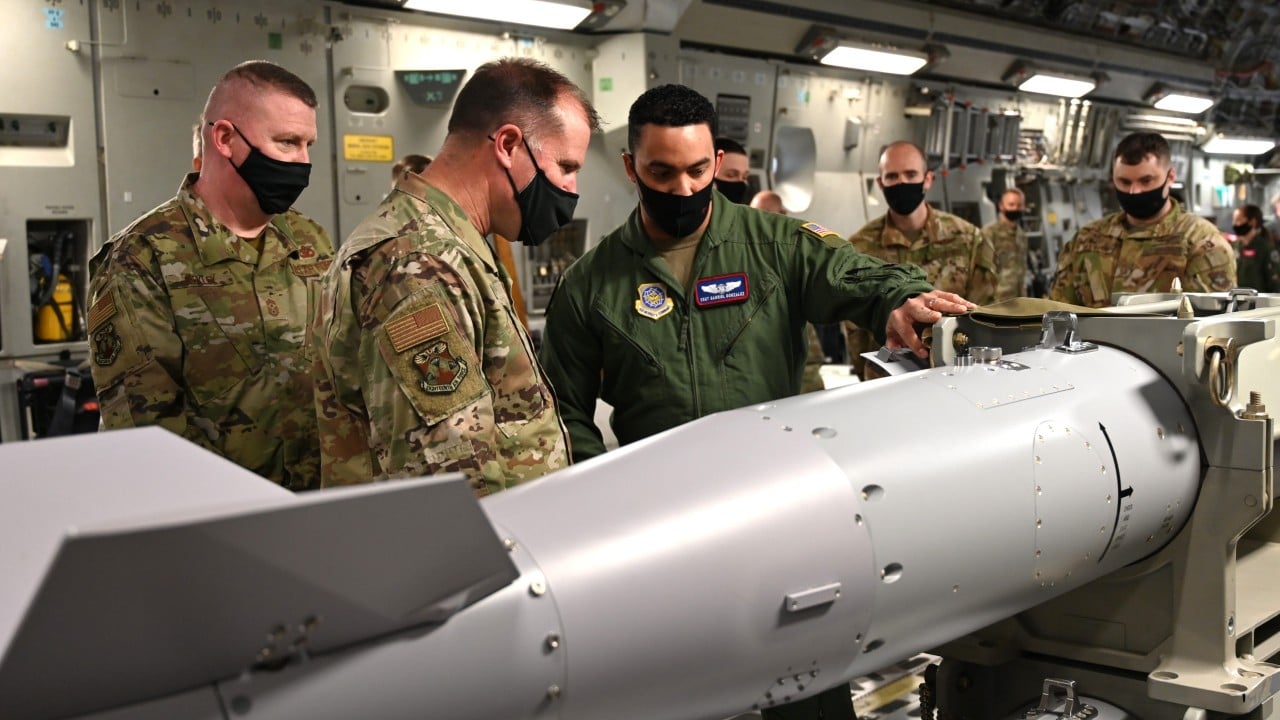
A new nuclear bomb designation buried in a US Senate budget document suggests Washington may be pursuing a weapon to destroy targets deep underground.
The B94 designation surfaced on November 12 in an explanatory statement accompanying the US Senate Appropriations Committee’s draft energy and water funding bill for the 2027 financial year.
Listed under the National Nuclear Security Administration’s (NNSA) stockpile modernisation programme, the entry recommends US$77.1 million for the B94, alongside US$122.9 million for “future programmes”. Neither line lists 2026 enacted funding, and both remain committee recommendations rather than law.
03:07
What’s known about the 3 Iranian nuclear sites hit by US bunker-buster bombs
But analysts said little beyond the designation was known. The document does not identify potential target countries or offer details about the B94’s design, including whether it would have its own propulsion or be an unpowered gravity bomb – a distinction that could affect how it is deployed and countered.
Nuclear weapons specialists have pointed to the “B” prefix as indicating an aircraft-delivered nuclear bomb rather than a missile warhead. If confirmed, the B94 would be the first entirely new US nuclear bomb designation since the B90, which was cancelled in September 1991 before entering service, according to a report published by US defence news website TWZ on November 16.
Whether and when the B94 will enter production remains uncertain. Washington abandoned an earlier nuclear bunker-buster programme, the Robust Nuclear Earth Penetrator, in 2005.
Stanford University scholar Jeffrey Lewis and other analysts suggest the B94 could be the formal designation for the Nuclear Deterrent System-Air-delivered (NDS-A), which earlier US Air Force budget documents described as a prototype programme to address a capability gap identified in the 2022 nuclear posture review.
Xiaodon Liang, senior policy analyst at the Arms Control Association, said “the new B94 programme is probably that programme”, adding that analysts had anticipated a corresponding nuclear weapons programme since the NDS-A budget documentation emerged two years ago.
Asked about NDS-A, the NNSA previously told TWZ that the programme would give the US president “additional nuclear options to defeat Hard and Deeply Buried Targets, ensuring that adversaries cannot place their most valued assets beyond the reach of America’s nuclear forces”.
That rationale is consistent with US nuclear employment guidance from 2024, which emphasised the need to “hold at risk” what adversaries value most.
Liang said nuclear bunker-busting weapons could help meet that requirement. However, on Washington’s need to develop the B94, he said: “Neither this administration nor the former [one] have explained which targets create a requirement for this new weapon.”
Neither the US Senate statement nor the air force budget documentation mentions China. Timothy Heath, founder of defence consultancy Perceptum, said North Korea or Iran were more plausible targets given their weaker air defences and more limited underground facilities.
A new weapon would join an existing US arsenal that includes the B61-11 nuclear earth-penetrating bomb and the high-yield B83-1, which relies on explosive power rather than ground penetration to threaten hardened targets.
One reason Washington might be developing the B94 is to overcome the limits of its existing weapons. Heath said the US lacked a bomb that could reliably destroy targets substantially deeper than those the B61-11 could reach.
But it is not known whether the B94 would overcome those limits. Mackenzie Knight-Boyle, research and project manager for the Nuclear Information Project at the Federation of American Scientists, said it was “unclear whether the B94 will offer any new capabilities, or whether it is simply meant as a successor to the B61-11”.
“If it is powered, it would provide a stand-off capability that the B61-11 does not have as an unpowered bomb, meaning the aircraft delivering it would not have to get as close to the target as they would with the B61-11,” Knight-Boyle said. “We simply don’t know yet.”
Another possibility is that the B94 could replace the high-yield B83-1 to destroy hardened targets, as suggested by Lewis and James Acton, co-director of the Nuclear Policy Programme at the Carnegie Endowment for International Peace.
Acton told Breaking Defence that the B94 was “clearly a new capability” that could increase “somewhat the number of targets that could be destroyed”.
Citing a 2005 National Academies study, however, he questioned whether nuclear bunker-busting weapons could reliably destroy facilities buried more than 700 metres (2,300 feet) underground, while acknowledging that weapons technology might have since become more effective.
02:37
Trump orders US military to resume nuclear weapons tests for first time in 33 years
Acton said that adding US nuclear capabilities without a clear strategic rationale risked fuelling wider competition.
“One could go on forever identifying new missions for nuclear weapons and inventing new requirements, and I view that as an essentially endless process, if not guided by some kind of broader strategy,” he told Breaking Defence.
Russian foreign ministry spokeswoman Maria Zakharova said on Friday that Moscow was closely monitoring US nuclear weapons development but that more information was needed to assess the B94 programme.
She also expressed concern that Washington was increasingly focused on developing options for the limited use of nuclear weapons in regional conflicts, according to Russian news agency Interfax.
Unlike Moscow, Beijing has yet to publicly comment on the B94.
Like the US, China has developed weapons for attacking hardened targets. It fields the ground-launched DF-15C short-range ballistic missile with a conventional earth-penetrating warhead, according to the Centre for Strategic and International Studies, but is not known to have a comparable nuclear earth-penetrating bomb.
Heath questioned whether Beijing would need to develop one, given its existing nuclear forces and conventional strike options.
KioskNews shows a cleaned-up reading view extracted from the publisher’s page — the original always lives on their site, not ours.