Nvidia CEO encourages Europe’s lagging AI sector and offers tools to accelerate data center buildout
Nvidia Corp chief executive officer Jensen Huang (黃仁勳) urged players in Europe’s lagging artificial intelligence (AI) industry to get going and touted a modular system to quickly build AI data centers with the massive computing capacity the continent’s developers need but currently lack.
In an upbeat speech on Wednesday at the company’s GTC conference for developers and investors in Berlin, Huang also laid out tools to keep AI applications from running amok by confining them in a digital “sandbox.”
“Europe’s AI economy is starting, and it’s accelerating, and it’s great to see,” Huang, striding across the stage in his trademark leather jacket and sneakers, said in front of some 3,000 developers, analysts and journalists at Berlin’s Tempodrom auditorium.
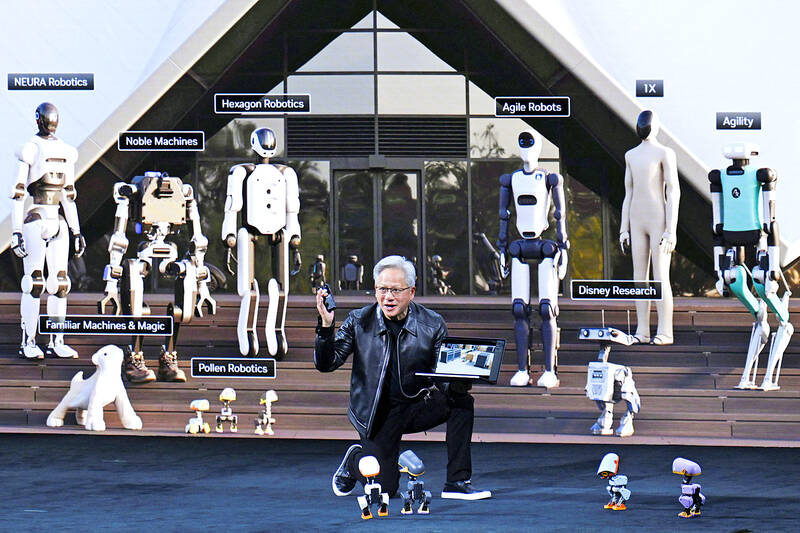
Nvidia chief executive officer Jensen Huang speaks to Microducks, 25cm-tall biped robots, during his keynote at the Nvidia GTC conference, focused on advances in artificial intelligence and computing shaping industries, in Berlin yesterday.
Photo: Reuters
Huang, whose company designs the computer chips and software used by AI developers like Anthropic PBC and OpenAI, frequently name-checked European partner companies such as Siemens AG, Mercedes-Benz AG and Volkswagen AG’s Audi.
“Europe is building its AI economy” as the technology moves from language models to so-called physical AI in manufacturing, Huang said. “Every company in the future will be an AI company.”
Mercedes-Benz CEO Ola Kallenius, whose company is working on developing autonomous driving technology with Nvidia, said that the technology could reduce the number of auto fatalities caused by human error “down to zero... we will have safer streets once we have full autonomy.”
Huang said Nvidia’s design for the Vera Rubin DSK Pod, a ready-made modular computing center that is delivered in a shipping-container like box, will reduce the time needed to set up a data center from months to days. The pod “will change the way people build AI centers,” he said. Nvidia has invested US$10 billion in European start-ups and partners in the past year, Huang said.
Building out data centers is key for Europe, which has only about 5 percent of the world’s AI computing capacity, compared to 75 percent in the US. Lack of the massive computing power, or “compute” in digital jargon, needed to train AI applications is a key obstacle for European developers.
“The big bottleneck is compute,” General Catalyst Partners LLC president and managing director Jeannette zu Furstenberg said ahead of the speech. General Catalyst invests in AI companies.
Huang was briefly interrupted by protesters who stood up with a banner urging him to “clean up” his business. Huang promised “to talk to you later” and urged security to avoid rough handling as they removed the protesters.
Huang also addressed concerns about safety by talking about the company’s OpenShell open-source software designed to exert external control over what AI applications are doing and block them if they violate company policy.
The event is part of a tour through Europe by Huang, who has been signing deals with local companies and trying to persuade the continent’s political and business leaders that AI is safe. His trip comes at a delicate moment for the industry. AI stocks have been battered during the past two weeks, and the closely watched Philadelphia semiconductor index suffered its longest losing streak since 2008.
Nvidia, the world’s most valuable publicly traded company, has frequently cited supply chain constraints as an impediment to its growth. To combat that, Ibiden Co, Samsung Electro-Mechanics Co and Unimicron Technology Corp (欣興電子) will help it get more substrates — the materials used to house other components.
Amkor Technology Inc will help increase the amount of chip packaging available by fourfold by the end of 2028. That material is used to encase semiconductors and connect them with other components. KYEC Microelectronics Co, a subsidiary of King Yuan Electronics Co (京元電子), will increase testing capacity. Nvidia is also helping to boost the availability of on-package optical connections, which will speed up communication between components.
KioskNews shows a cleaned-up reading view extracted from the publisher’s page — the original always lives on their site, not ours.