Asian allies anxious ahead of US-China meeting
By John Geddie, Tamiyuki Kihara, Yukiko Toyoda and Ben Blanchard / Reuters, Taipei, Tokyo


US allies in Asia are growing anxious that US President Donald Trump might be tempted to soften Washington’s support for Taiwan in return for an economic win with Beijing as he prepares to host Chinese President Xi Jinping (習近平) next week.
Concerns that Trump could make concessions on Taiwan have heightened since he described US arms sales as a “negotiating chip” in May, and as he tries to shore up approval ratings dented by the Iran war.
Xi would likely press Trump on Taiwan during their summit on Thursday next week, and even a subtle change in US rhetoric could embolden Beijing and risk the region’s fragile peace, according to interviews with government officials, lawmakers and analysts in Taipei, Tokyo and Washington.
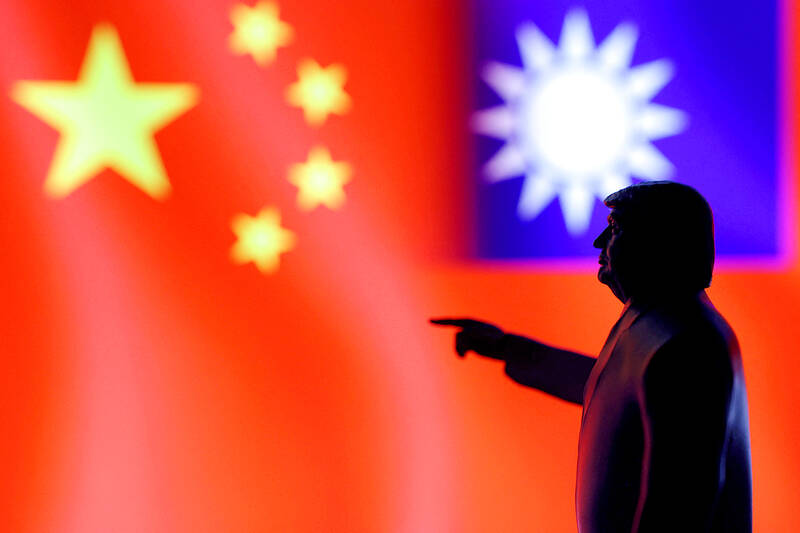
A 3D-printed miniature model depicting US President Donald Trump, the People’s Republic of China flag and a fragment of the Republic of China flag are pictured on April 17, last year.
Photo: Reuters
“There’s a great deal of trepidation, particularly from our allies, about where our China policy is going to land,” said Emma Chanlett-Avery, political-security affairs director for US-based think tank Asia Society Policy Institute.
“Any indication of a softness on Taiwan would be quite alarming,” she added.
The Chinese Ministry of Foreign Affairs and the White House did not respond to questions.
Trump has said Xi has personally assured him that China would not attack Taiwan while Trump is in office.
Former US president Joe Biden repeatedly said that the US would defend Taiwan if China attacked, while Trump has declined to say whether he would.
Speaking at a defense forum in Beijing on Tuesday, China’s former envoy to Washington Cui Tiankai (崔天凱) said “reunification” with Taiwan would bring stability that is “in the interest of the United States.”
Ahead of the summit, Taipei has been clearly conveying its positions to the US side, Mainland Affairs Council Deputy Minister Shen Yu-chung (沈有忠) told reporters in Taipei on Monday.
“We hope ... there will be no situation that harms Taiwan,” he said.
Minister of Foreign Affairs Lin Chia-lung (林佳龍) on Tuesday said that he expected Xi to bring up Taiwan, but that Washington had repeatedly said its policy had not changed.
Japanese Prime Minister Sanae Takaichi — who angered Beijing by saying last year Tokyo could be drawn into a conflict over Taiwan — has also been trying to get Trump’s ear ahead of his meeting with Xi, two Japanese government sources said.
A senior Japanese foreign ministry official visited Washington last week to help try to secure a meeting, the sources said, requesting anonymity due to the sensitivity of the matter.
The UN General Assembly in New York early next week is the most likely venue for an exchange, they added.
Japan’s foreign ministry declined to comment on trips by working-level officials and said nothing had been decided regarding contact between Takaichi and Trump.
Japan will “closely follow with great interest” the upcoming summit and believes it is important that US-China relations contribute to the “stability of the international community,” it added.
Tokyo wants Trump to stick to established diplomatic language on Taiwan and avoid making it the focus of the summit, as it was when he last met Xi in Beijing in May, one of the sources said.
The biggest fear for Japan is that Trump signals a softer stance on Taiwan to secure Chinese commitments to buy US goods, an economic win he could sell to voters ahead of important midterm elections, two senior Japanese ruling party lawmakers said, requesting anonymity.
While Trump has cast his summitry with Xi as rebalancing trade relations between the two economic superpowers, he said the Chinese leader repeatedly asked him about Taiwan when they met in Beijing in May, including about arms sales and Washington’s resolve to defend the nation.
A US$14 billion US arms package for Taiwan has been awaiting Trump’s approval for months.
After the May summit, Trump said he was holding the package in abeyance and described it as a “very good negotiating chip.”
Washington must take Beijing’s concerns about arms sales seriously after long brushing them off, Wu Xinbo (吳心伯), a professor at Fudan University who advises China’s foreign ministry, told the defense forum in the Chinese capital on Tuesday.
Beyond the arms, experts say that even a slight change of Trump’s wording could embolden Beijing.
The US follows a “one China” policy under which it officially takes no position on Taiwan’s sovereignty and acknowledges, but does not endorse, Beijing’s position that Taiwan is part of China.
Xi asked Biden to clearly denounce Taiwanese independence at a summit in 2023, although Washington refused.
Trump’s propensity to make off-the-cuff remarks is particularly worrisome given the sensitivity of this issue, the two Japanese government sources said.
The US and other Western countries significantly underestimate the importance of Taiwan to Beijing, Malaysia Council Director-General of National Security Raja Nushirwan Zainal Abidin said during a visit to Washington this week.
A Chinese invasion of Taiwan, which produces more than 90 percent of the world’s advanced semiconductors, would roil the global economy.
“It will change the world as we know it, and because of that we have to be very, very careful,” Raja Nushirwan said.
KioskNews shows a cleaned-up reading view extracted from the publisher’s page — the original always lives on their site, not ours.