Sugarcane farm workers demand reforms in social benefits system
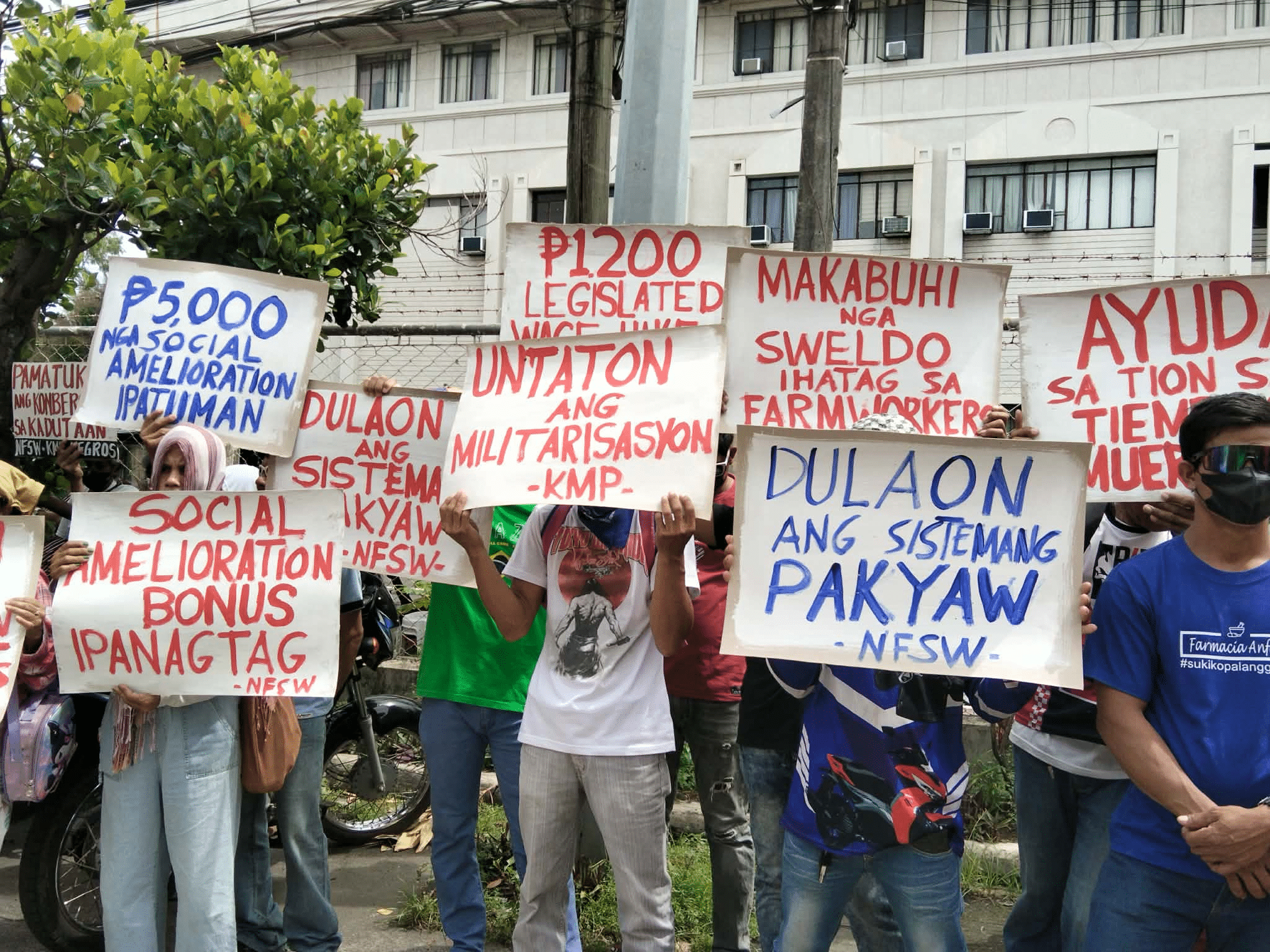

BACOLOD CITY — Sugarcane workers staged a protest outside the Department of Labor and Employment (DOLE) office here on Thursday, Aug. 27, demanding urgent reforms to the Social Amelioration Program (SAP) and the abolition of the “pakyaw” (piece-rate) system amid the crisis facing the sugar industry.
The protest was led by the National Federation of Sugar Workers (NFSW), alongside the Kilusang Magbubukid ng Pilipinas (KMP) and national fisherfolk organization Pamalakaya.
In a position paper submitted to the DOLE, the NFSW proposed policy changes and reforms to the SAP for consideration by the Bureau of Workers with Special Concerns (BWSC).
Article continues after this advertisement
READ: Negros sugar workers say economic recovery must include rural areas
FEATURED STORIES
NEWSINFO
NEWSINFO
NEWSINFO
It asked for a minimum amelioration bonus of not less than P5,000 for field workers and migratory sugar workers, whose master list shall be based on registration with the DOLE and validated by barangay officials.
The amount could provide enough funds to cope with the hardships during the off-milling season in the sugar industry, which in Negros runs from May to September, it said.
The aid is important for the sugar workers and their families, as it coincides with the opening of the school year and the typhoon season, it added.
It also asked for institutional reforms for sugar workers’ associations to easily access socio-economic projects, maternity benefits, and funeral benefits as provided for by law.
Article continues after this advertisement
READ: Labor group hits Marcos’ silence on wages, sugar industry woes
According to research, more or less 70 percent of the funds for socio-economic projects are implemented by the Sugar Industry Foundation Inc. (SIFI), a private institution composed of big landlords on Negros Island, the NFSW said.
Article continues after this advertisement
The NFSW also asked for an increase in the minimum funds allocated for maternal and funeral benefits, along with a simplified policy for field workers and migratory workers.
“It is the blood, sweat, and hard labor that made Philippine sugar sweet. They deserve to be compensated,” it said.
The SAP was established through Republic Act 6982, or the Social Amelioration Act of 1991, to “strengthen the rights of workers in the sugar industry to their just share in the fruits of production by augmenting their income and enable them to enjoy a decent living,” the NFSW pointed out.
It said that through the SAP, the government imposes a P10 lien per picul (1 picul is equivalent to 63.25 kilograms) and, in the bioethanol industry, a lien of P13.43 for every metric ton of cane. The amounts collected are distributed to field and mill workers in sugar mills and bioethanol plants as cash bonuses, provision for maternity and funeral benefits, and funding for socio-economic projects.
“Yet, the reality on the ground shows that the program has failed to provide an increase in income, nor was it able to uplift the conditions of the field workers as envisioned by the said law and mechanism,” the NFSW said.
It stated that the majority of field workers receive a dismal amount during the distribution of the Social Amelioration Bonus (SAB), negating the objectives for which it was established. On average, field workers receive P200 to P400 every year—too low to help them survive the lean months of the closed season, the NFSW said.
It also noted an emerging trend showing that migratory field workers employed by contractors work without receiving social benefits, including local harvesters or karga-tapas.
Field workers are also not listed by sugar planters, as the majority of sugar farms do not use payrolls or provide pay slips to their field workers, denying them their rightful share in the production-sharing scheme, the NFSW said.
In sugar mills, those who are employed under pakyaw work do not receive a Social Amelioration Bonus as mandated by law, it added.
Mill workers and workers in bioethanol plants, on the other hand, receive an SAB of not less than P10,000. In sugar plantations, farm management officers and office workers receive a similar amount—far higher than what field workers can receive in a year, the NFSW said.
The discrepancy between what a field worker receives and what mill workers receive is created by the pakyaw system. The pakyaw system, which depresses wages significantly below the minimum wage set by the RTWPB in the region, has contributed to the low amelioration bonus, it added.
Your subscription could not be saved. Please try again.
Your subscription has been successful.
Presently, sugar workers face hardships and crises because of pest infestations, low millgate prices of sugar due to a deluge of imported sugar, and a decline in production, the NFSW noted. /das
KioskNews shows a cleaned-up reading view extracted from the publisher’s page — the original always lives on their site, not ours.