Beyond its luxury resorts, Riviera Nayarit is facing an education crisis
Mexico’s Riviera Nayarit was not always a thriving vacation destination. However, over the past couple of years, ultra-luxury real estate developers have been building multimillion-dollar homes and resorts across the region.
That much is true for Punta de Mita — a jewel of the Riviera Nayarit on Mexico’s Pacific coast — where a strong tourism industry has prompted people with significant purchasing power to settle there. In the second quarter of 2026 alone, Nayarit recorded US $9.28 million in new investment, notching the area the #1 spot for tourism investment in all of Mexico with roughly 20% of the share.
However, that influx of capital does not necessarily translate into equitable living conditions for the local population, says José Antonio Salgado, executive director of the education advocacy organization Peace Punta de Mita
Semarnat halts Nayarit luxury beach development over environmental violations
For instance, despite the surge in high-end developments, combined dropout rates among Nayarit students in secondary and upper-secondary education sit at roughly 15%, according to Mexico’s Education Ministry.
While the private sector has made efforts to build decent housing, Salgado believes that’s only half the battle. Proper education for children, he argues, should come first.

According to Salgado, Mexico must address the high dropout rate by examining the root causes preventing students from completing their education, including “economic factors” and a “lack of infrastructure.”
Navigating a deficient education system
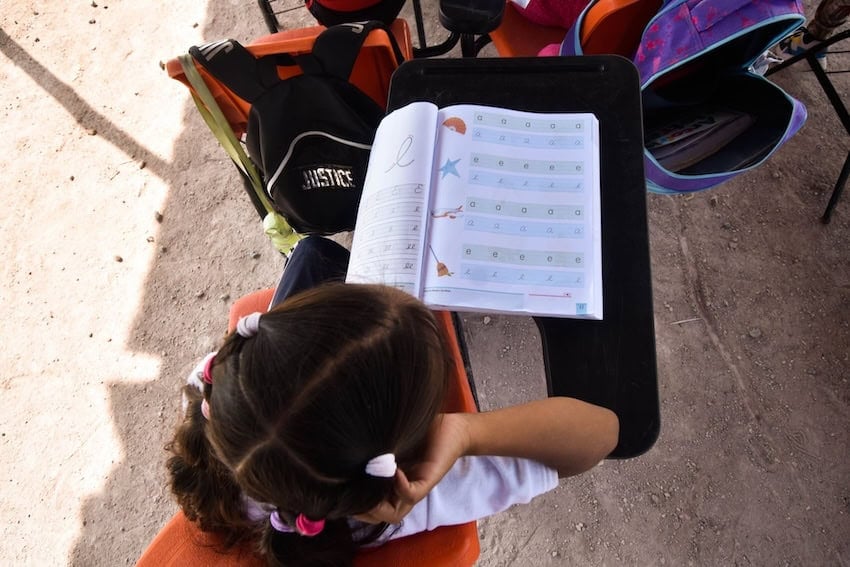
To truly effect change in local communities, Salgado embarked on a challenging endeavor: ensuring quality education for children in the Nayarit Riviera.
He spent 26 years in the local education sector and says that “the greatest challenge for the Mexican educational system is to break the vicious cycle of structural inequality and the lack of comprehensive support” from the state.
Today, many of the secondary schools in the area operate under the telesecundaria model, a televised education system for rural communities that the Mexican government first introduced in the 1960s.
Thousands of schools nationwide use the model, reaching roughly 1.3 million students. However, on the whole, it has proven deficient.
“The telesecundaria model serves nearly 20% of the national secondary school enrollment,” Salgado explains. “Despite its vast reach, it frequently operates with a lack of connectivity, outdated materials and absenteeism.”
While the model can be up to 50% cheaper than, for example, a technical secondary school — in terms of both initial investment and operating costs per student — academic achievement remains far below expectations.
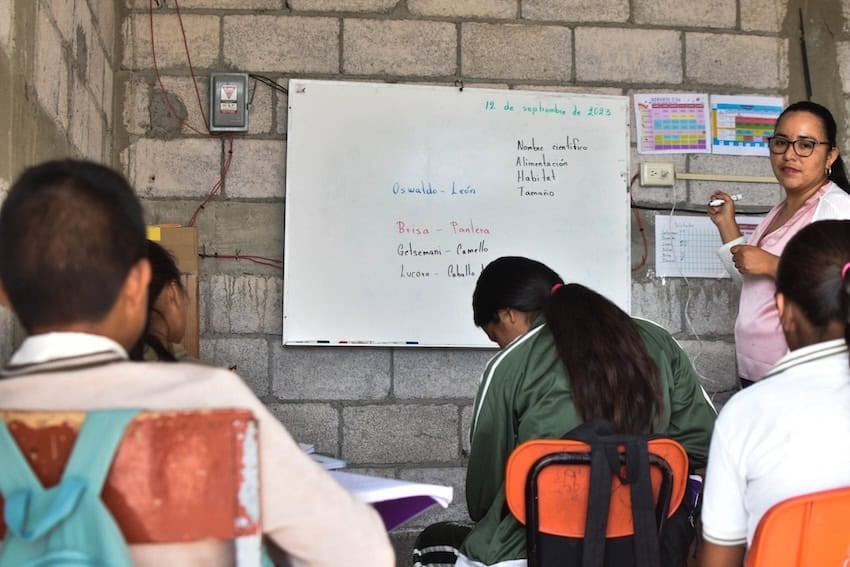
What’s more, a single teacher is responsible for instructing all subjects, ranging from mathematics and chemistry to history and English.
To help solve these issues, Salgado began working with PrepaNet, a joint project between Tec de Monterrey (Tec) and Mexico’s Public Education Ministry (SEP). To date, he said, PrepaNet has an internal completion rate of 86.3%.
“This figure is exceptionally high for a virtual model,” Salgado says. “Especially considering that the average completion rate for general upper secondary education in Mexico drops significantly, to 76.3%.”
A new horizon
PrepaNet is part of Peace Punta de Mita, a nongovernmental organization that has expanded its network, providing quality education to local children beyond the telesecundaria model.
Without a comprehensive plan from the SEP to standardize rural and low-income education, PrepaNet is a valuable alternative. Especially, Salgado says, given that “technological or online high school programs often see dropout rates exceeding 50%.”
Enrollment is contingent upon an entrance exam. If accepted, however, students attend the program on a full-ride scholarship.
Over the next two years, they receive training from Tec de Monterrey professors via distance learning, with the support of local faculty members who provide in-person guidance. At the end, students graduate with a dual certificate — jointly endorsed by the Tec and the SEP — which qualifies them for admission to university-level education.
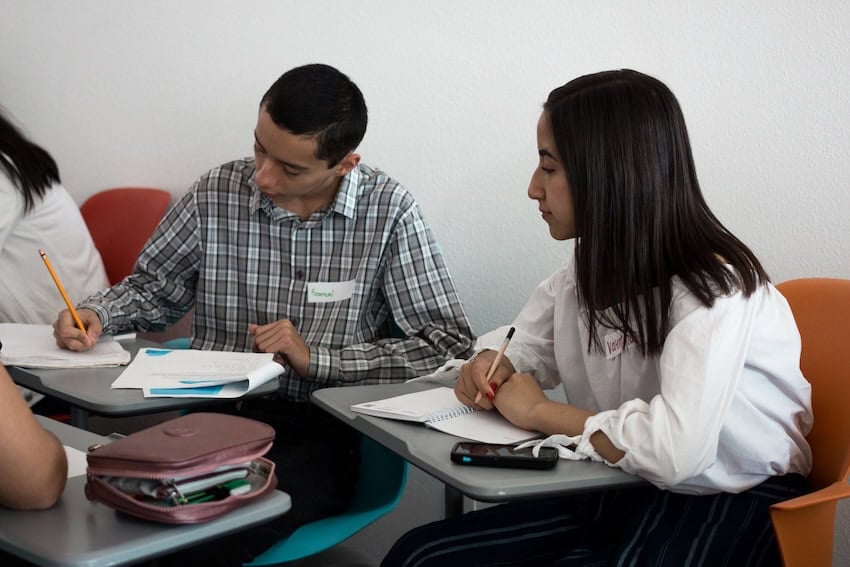
“PrepaNet highlights what is missing from public basic education,” Salgado says. “Technology alone does not educate; it requires the active guidance of a teacher, as well as the involvement of parents who, often due to exhausting work schedules, are unable to provide follow-up support at home.”
To help close that resource gap, the program also offers students free meals, as well as afternoon courses in computer skills, the arts and English.
In a short time, Salgado and his team managed to enroll 23 students, 19 of whom graduated, and 11 of whom have already entered university. Due to the program’s success, it will expand to a three-year high school curriculum starting in 2027.
With more robust in-person care, the program is also working to accommodate children who are neurodivergent.
“It is urgent to design ‘personalized learning pathways’ that leverage intelligent, adaptive diagnostic platforms,” Salgado says.
Education in Mexico by the numbers
An encouraging report from INEGI, Mexico’s national statistics agency, suggests that the country’s educational landscape improved between 2020 and 2025. Despite disruptions brought about by the COVID-19 pandemic, school attendance increased across all measured age groups.
Particularly within the 6-to-14 age group — as children enter primary or secondary school — there was an increase from 92.7% to 96%.
Similarly, the adult illiteracy rate fell from 4.8% to 3.7%. The work of Peace Punta de Mita has certainly played a role in this by providing training in English and computer skills for adults, which in turn broadens their employment opportunities.
Mexico in Numbers: How does Mexico’s education system compare to other countries?
Essential tools for better opportunities
PrepaNet considers it vital for local children and adults to acquire tools that will be useful when looking for a job — especially in the Punta de Mita region, as its international tourism profile continues to grow.
For this reason, Mercedes Rubio, coordinator of the program’s English department, says that PrepaNet offers certifications for both children and adults, beginning from the basic A1 level all the way through C2, comparable to a native speaker.
Incidentally, foreign language instruction presents a significant challenge, as students often “have gaps in their native language,” Rubio says, adding “we must adapt to their specific needs.”
Nevertheless, Rubio believes that “speaking English is essential” for getting better job opportunities.
Fostering a safe space for learning
According to Rubio, every school year, PrepaNet’s numbers are getting better and better. Likewise, the students are responding to programs such as “Campeones Jr.” or “Junior Champions,” which she says is “really resonating across the Bay.”
Word is spreading. And so too is the initiative’s impact.
Nowadays, students are arriving from more remote communities, such as Cruz de Huanacaxtle, Sayulita, Bucerías and Mezcales. According to Salgado, even students from nearby telesecundaria schools go to the PrepaNet facilities to improve their reading comprehension and math skills.
“When you ask the little ones what they think of Peace,” Rubio says with pride, “they say it’s their safe place.”
Andrea Fischer contributes to the features desk at Mexico News Daily. She has edited and written for National Geographic en Español and Muy Interesante México, and continues to be an advocate for anything that screams science. Or yoga. Or both.
KioskNews shows a cleaned-up reading view extracted from the publisher’s page — the original always lives on their site, not ours.