Taipower planning 43 substations in 15 years
State-run Taiwan Power Co (Taipower, 台電) plans to build 43 substations over the next 15 years to meet growing electricity demand, chairman Tseng Wen-sheng (曾文生) said yesterday.
The expansion also includes about 1,922km of new power lines, Tseng said at a forum during the Energy Taiwan exhibition in Taipei.
Growing demand from semiconductor manufacturing and artificial intelligence (AI) is making the timely delivery of electricity a key challenge for the utility, he said.
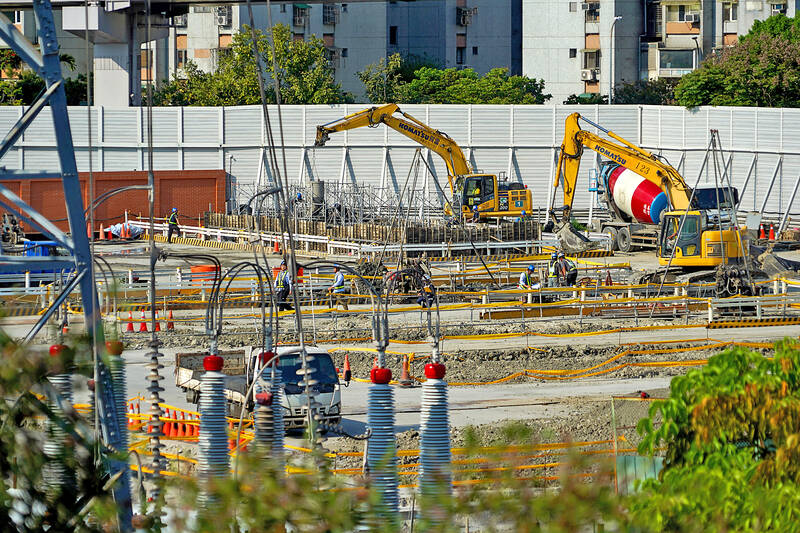
The construction site of Taiwan Power Co’s Songhu ultra-high voltage substation in Taipei’s Neihu District is pictured on March 25.
Photo: CNA
“We need to build 43 substations in 15 years, averaging about three a year. This is unprecedented,” he said.
Tseng cited the Songhu ultra-high voltage substation project in Taipei’s Neihu District (內湖) as an example of the difficulties facing grid construction.
The project broke ground last month after 26 years of planning and administrative procedures and is scheduled for completion in 2029, Taipower said.
The limited availability of land means shorter transmission distances, but also densely packed infrastructure that makes new lines difficult to build, he said.
Tseng cited growing power demand at the Southern Taiwan Science Park (南部科學園區) as an example of why additional substations were needed.
Grid planning would also need to account for AI equipment spreading beyond large data centers to businesses and potentially homes.
Such equipment could shift evening peak demand between 8pm and 10pm, prompting Taipower to adjust its load forecasts and assess upgrades to older urban grids, he said.
For companies planning new facilities, access to electricity on schedule has become an early investment consideration because power infrastructure could take longer to build than factories, Tseng added.
He urged large data centers to build near power plants, saying shorter dedicated power lines could reduce construction time, engineering difficulties and costs.
Speaking to reporters afterward, Tseng said Taipower is coordinating locations and investment schedules with major users and hopes to work directly with companies committed to investing in computing infrastructure.
Allocating supply capacity to a site developer before an actual investor is secured could leave less capacity available for other projects, he said, adding that Taipower is considering fair rules to address that issue.
The utility’s fastest-growing AI-related electricity demand comes from manufacturing, including chip fabrication, memory production, packaging and server production, rather than computing service providers, Tseng said.
Planning with those industries is beginning earlier, including during industrial park development, to align electricity infrastructure with their expansion schedules, he added.
KioskNews shows a cleaned-up reading view extracted from the publisher’s page — the original always lives on their site, not ours.