Claims of vote-buying across Taiwan being probed
BALLOT INTEGRITY: Prosecutors are following election investigation guidelines and would enforce the law objectively and impartially, the Ministry of Justice said
By William Hetherington / Staff writer, with CNA


Prosecutors have investigated more than 2,300 vote-buying cases ahead of next month’s nine-in-one local elections, involving a range of alleged vote-buying schemes, the Supreme Prosecutors’ Office said yesterday.
As of Oct. 19, prosecutors had received 2,302 reports of suspected vote-buying involving 2,593 people, the office said.
The cases accounted for about 35.9 percent of the 6,415 election-related offences reported to prosecutors, it said, adding that authorities also received 53 cases involving 54 people suspected of contravening the Anti-Infiltration Act (反滲透法).
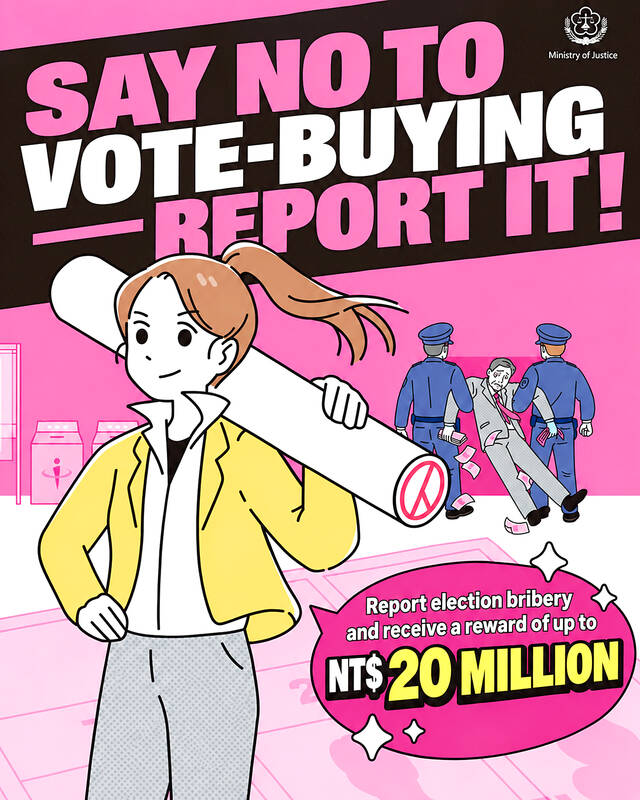
The Ministry of Justice’s poster promoting rewards of up to NT$20 million for tips on vote-buying is pictured in an undated photograph.
Photo: Screen grab from the ministry’s Web site
Investigations have uncovered suspected vote-buying methods ranging from cash payments and banquets to gift boxes, as well as the use of charitable organizations and local groups to offer benefits in exchange for votes, it said.
The Ministry of Justice said prosecutors were following election investigation guidelines and would enforce the law objectively and impartially, regardless of political affiliation or the identities of candidates and others involved.
They would also follow due process, protect human rights and ensure fair elections, it said.
Among the cases being probed is suspected vote-buying involving Sioulin Township (秀林) Mayor Wang Mei-kuei (王玫瑰) and her husband, Hu Chih-min (胡智民), in Hualien County. Hu allegedly offered voters free meals at a birthday banquet. He also allegedly distributed cash gifts of NT$1,000 to NT$2,000 (US$31 to US$62) during exchange visits and used funds from a charitable organization to hold banquets.
Wang, Hu and a third person surnamed Hsu (徐) who heads a charitable organization have been detained and barred from receiving visitors by court order.
In Taichung, prosecutors are investigating a city council candidate surnamed Cheng (鄭) who allegedly used an intermediary to offer voters gift boxes. Investigators seized more than NT$15.26 million in cash and 69 gift boxes during a search on Sept. 21.
The intermediary, surnamed Yang (楊), was detained and barred from receiving visitors, while Cheng was released on NT$100,000 bail. Prosecutors are investigating the flow of funds and other aspects of the case.
Separately, prosecutors are investigating Changhua County Council Speaker Hsieh Dien-lin (謝典霖) over allegations that he used council funds to hold banquets as part of a vote-buying scheme. Investigators also uncovered alleged embezzlement of public funds.
Hsieh and his father, Hsieh Hsin-lung (謝新隆), were detained and barred from receiving visitors. Both appealed their detention orders, but the High Court’s Taichung branch rejected the appeals.
In Kaohsiung, prosecutors in Ciaotou District (橋頭) are investigating city council candidate Chang Chi-cheng (張騏晟) over suspected vote-buying. Chang allegedly gave voters gift boxes of pastries at a Mother’s Day banquet.
He is also suspected of using fishing association resources through his father, Chang Han-hsiung (張漢雄), a former director of the Kaohsiung City Government’s Marine Bureau, and his elder brother, Chang Chun-hua (張鈞華), to help voters obtain fishing-related qualifications and subsidies using false documents in exchange for votes.
The Supreme Prosecutors’ Office said Chang’s father and elder brother had been detained.
Investigations are ongoing, and the alleged offenses and criminal liability of the suspects remain subject to judicial proceedings.
The Supreme Prosecutors’ Office said that from the 2022 local elections to Sept. 21, it had paid a total of NT$161.44 million in rewards for reporting vote-buying.
The office previously proposed exempting the rewards from taxation and held discussions with agencies and officials. However, participants failed to reach a consensus, citing the principle of tax fairness. As a result, the rewards remain taxable.
KioskNews shows a cleaned-up reading view extracted from the publisher’s page — the original always lives on their site, not ours.