‘I struggle to see myself as someone special’: Sandra Hüller on being the star of four - or, possibly, five - of the year’s biggest films

Sandra Hüller is crying, and it feels very strange. A wildly gifted actor, she can convey every human emotion there is. On screen, though, she is most often asked to embody deep self-possession. Even doing karaoke, Hüller is in control. And in real life, life is good. Her 2026 will end with four high-profile movies this year alone. Two (Fatherland and Rose) are black-and-white arthouse films that centre on her brilliance, and though one of the others (Digger) is already a Hollywood cautionary tale, a second (Project Hail Mary) was a giant $684m hit. (There may also be a fifth movie, bigger still. We will come back to that.)
And yet, dressed in film star black, she is in tears. “This is really hard for me,” she says.
We are talking about Fatherland. Directed by acclaimed Polish film-maker Paweł Pawlikowski, Hüller plays the German polymath Erika Mann, who in the film drives her novelist father Thomas Mann through newly divided postwar Germany. The Nazi past shadows everything – but the movie is also tied up with the birth of East Germany, where Hüller grew up. (She still lives in what was once the GDR.) I tell her I’ve never before seen a film that acknowledged the utopian dreams of that place and time, however damaged they became. Yes, she replies: German directors don’t know how to approach it.
“But Fatherland has a grief that you feel clearer coming from the East.”
And then her voice cracks, and she cries. We reflexively apologise to each other. “I’m just grateful Pawel gave space to this political idea that didn’t survive in Germany, but is one maybe people can still think about. The socialist idea.”
Hüller wipes her eyes. Finally, she laughs. “You’re going to say I cried, aren’t you? I can see the headline.”
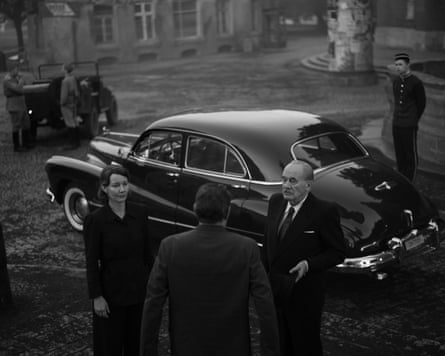
And yet she has always been open about the nuance to the East Germany she remembers from childhood – a place defined by more than the Stasi men of cold war thrillers. “What fascinates me is that in East and West were two systems that for a certain time could have learned from each other.” She apologises again; I’m not sure why. “It is this situation we live in now. I feel like I’m on thin ice.”
Inevitably, we come to the far-right Alternative für Deutschland (AfD). The subject is doubly unavoidable in light of Fatherland. The Manns originally fled the country in 1933 and they would end up in the US. “It’s no secret there are similarities now,” Hüller says. “Fascism doesn’t arrive overnight. It gets here slowly, in little doses.” Her tone turns businesslike. “The question is what we do about it.”
We all contain multitudes, but Hüller more than most. At home in Leipzig, she is a co-founder of the experimental Farn Kollektiv theatre group; a politically engaged woman of 48, she is the single mother to a teenage daughter. She is also deadpan funny. An account of her excellent safety record as a driver is a comic treasure. “That should be your headline. ‘Sandra Hüller – a clean licence.’”
She is also a movie actor with snowballing momentum. In 2024, she astonished twice over as the wife of the commandant of Auschwitz in The Zone of Interest and a woman suspected of murdering her husband in Anatomy of a Fall. The latter saw her Oscar-nominated. Now, after Project Hail Mary, Digger and Fatherland, there will also be Rose, a stark 17th century fable in which she plays a war veteran – who is, in fact, a woman passing as a man. Oscar talk is simmering once more. America is freshly excited.
“OK, so what is happening is that I made very different movies at different times, but they’re all coming out together. It’s nothing I control.” What is good, she says, is that, with her as the common thread, Hollywood marketing budgets end up spotlighting the likes of Fatherland too. “On the other hand, I struggle with seeing myself as someone special. I still consider myself part of a group. That is actually the highest praise I can give myself.”
Curiously, a collective spirit might also apply to the fifth film Hüller is strongly rumoured to be in this year: Marvel relaunch Avengers: Doomsday. Whatever else Marvel movies represent, they have a reputation for an oddly egalitarian vibe on set. I wonder aloud if that’s true. “Me too!” She gives an impish tilt of the head. Ah. For the record, then, Hüller still may or may not be part of the new Avengers.
But in theory, a Marvel film might feel unexpectedly non-hierarchical? “I heard that as well! Which would show having a lot of money available doesn’t have to mean abusing your power. And that would be a great thing. In theory.”
If the thought of Hüller doing Marvel takes getting used to, it makes more sense after Project Hail Mary. In a deft piece of Hollywood feelgood, she proved the perfect foil for Ryan Gosling’s reluctant spaceman as stone-faced mission controller Eva Stratt. The air of ultra-competence was very Sandra Hüller for Beginners. The film even harked back to her 2016 breakthrough in skewed German comedy Toni Erdmann. Hüller has a glorious singing voice. Then, she karaoked Whitney Houston’s Greatest Love of All. Now, it was Harry Styles’ Sign of the Times.
“But I think Eva Stratt made some people uncomfortable. It can feel unusual to be governed by a woman.”
Still, making Project Hail Mary was another pleasant surprise – her first Hollywood set where the directors – Phil Lord and Christopher Miller – actually lightened the mood. “They made sure we could actually play. Have fun.” She did, though, find it strange being wrangled by runners on the kind of blockbuster where producers want to know where a star is at all times. (Unlike almost every actor on her level, Hüller doesn’t even have an assistant.) “But you can always hide in the bathroom.”
Would she spend more time in the US than necessary? “Not right now. No. It’s a workplace.” Anyway, she says, she likes where she lives. “It’s simple. America is just very far away.” And she smiles.
She believes audiences embraced Project Hail Mary because the film-makers sought to unite them, inside a cinema at least. “And entertain them without the usual things – death and weapons. So you have a story about a human with a task that lets them be bigger than themselves. That inspired people.”
But what about their response to Digger? Directed by Alejandro González Iñárritu, with Tom Cruise as a cartoonish oil tycoon, the movie got poor reviews, then did cataclysmically at the box office. Can we talk about it? “Sure!” she says brightly. “I mean, we expected a strong reaction. It’s a polarising movie. And a political movie, which we weren’t able to say in interviews. For whatever reason.” A beat. “But personally – I was surprised by the harshness of the rejection. People really hated it!”
Hüller, though, says she loves it. “Years from now, it will be seen as a document of our times.” But time won’t be able to fix a problem like the thinness of her role as the sister of Cruise’s character. There should have been more of her, I say. “Well, there was.” Naturally, she smiles. Ah. (Again.) More rumours put forward that her role was heavily cut by Iñárritu. “You’d have to talk to Alejandro.” Are they still friendly? “Of course!”
At the movie’s royal gala premiere in London, the audience spent hours watching on screen the introductions of Prince William and Catherine, Princess of Wales, to the cast and many others. I tell Hüller a cameraman briefly focused on her, waiting in a red carpet frock with a look that suggested a looming medical procedure. The memory clearly tickles her.
So what was she thinking? “Well, I thought of the people in the cinema, waiting for us to start the movie, and not being able to leave. Also, my feet really hurt.” But she has a surprise in store. “I mean, I’ve never met any royalty in my life, so I was also fangirling.” Really? Hüller seems an unlikely monarchist. “I don’t find the monarchy interesting. But they are fascinating, remarkable personalities.” So what did she finally talk about with the royal couple? “Oh, I can’t remember. I was in shock!” Would she like to meet them again? “Of course! I want to have tea with them! I want to talk about everything with them!”
Hüller is now hooting with laughter.
If we do include the Avengers, her fifth film of this most productive year is Rose. Like Fatherland, it is a story of the German past, in black and white. And yet, after fun with royals and Ryan Gosling, Rose now brings her back to modern Germany. It was filmed in Saxony-Anhalt, “where a certain party recently won power”. (This is the German state where the AfD claimed 43.8% of the vote in September.)
In preparation to play a character passing as male, Hüller says she watched men more closely than she ever had before. The result was a study of all that goes into being read as male. “Honestly, it left me astonished. I realised that as a woman, I rarely enter a room and think of it as a battleground. But male behaviour is so related to that. Where is the enemy and how can I defeat him?”
So do men make bad socialists? “No! Some of the most famous socialists have been men.” Could that be why we don’t have socialism, though? She grins and wags a finger. “You forgot Mamdani?” She also has a related point. “One advantage of being born in the GDR and seeing it fall apart, or reunified, however you want to call it, is you learn no system is for ever. And that is interesting in a time when the things we’ve done so long don’t work any more. So maybe it is good to think of different ways they could work in future.”
Hüller is having to rethink the present too. Despite still seeing herself as a theatre actor who sometimes makes films, her German stage career is now on hold – at least in front of the curtain. Fame complicates. “If you are part of an ensemble but people come to see you as if the others matter less, I don’t enjoy that.” But she has a workaround. Farn are now creating two new plays she will instead direct. (“One is about revenge. The other goodbyes.”) So far, she says, the new role has been a pleasure. “I love the discussions. I love watching people invent. And we will see how long this wave continues.”
She tells me she is also curious how my piece will turn out. In Germany, she says, interview subjects give notes on a draft before anything goes to print. We don’t do that in the UK, I say. “I know. But as the interviewed person, it gives you a feeling of being respected. Not that I don’t feel respected here. Anyway, I never change much.” She smiles. “Sometimes just a comma.” So will she read this? “No, because I have no say.”
And yes, she agrees, laughing, that means I can write whatever I want.
KioskNews shows a cleaned-up reading view extracted from the publisher’s page — the original always lives on their site, not ours.