When women like Julie win at this sport, some men still accuse them of ‘getting lucky’
The first thing you’ll notice if you attend a chess tournament is how few women there are. It’s not uncommon for men to outnumber women by as many as 20 to one, often more, at these events.
Chess remains stubbornly dominated by men, especially among adults. At elite and professional levels, the bias is glaring. Globally, women make up only 2 per cent of Grand Masters, the Everest of achievements in the ferociously competitive chess world.
Despite the success Australia has enjoyed in women’s sports domestically and internationally — cricket, rugby league, Australian rules, soccer, to name a few — when it comes to chess Australia is placed 108th of 119 nations for gender equality, which is measured by participation, rating performance and progression at international tournaments. That’s according to a report published in March by the University of Queensland and FIDE, the worldwide governing body of chess.
But chess is not the only sport that skews heavily towards men for participation, prize money, achievements and stigma. Men outnumber women in cue sports (billiards, snooker, eight-ball, pool) and darts, which have long been associated with cultures and settings where women don’t feel welcome, or been barred from playing.
The paradox is there are no physical, biological or financial barriers to playing these games, be that at a social or even professional level. Gender is a raw nerve at the heart of these sports. Here,
three champions reveal how they are hoping to boost female participation.
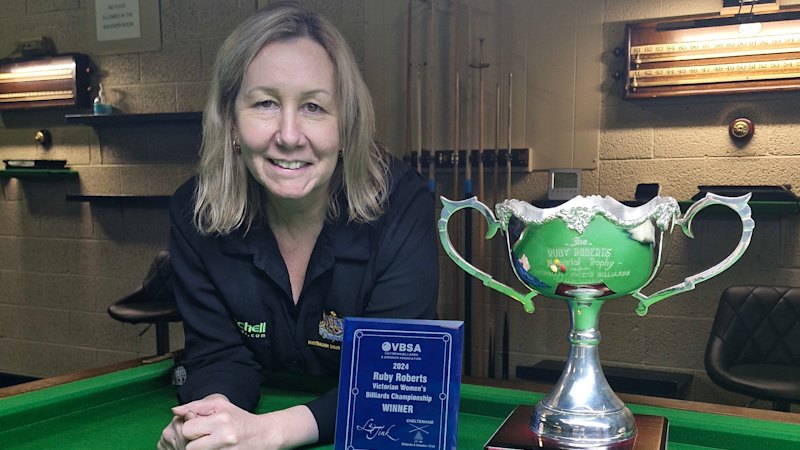
Julie Watson, 53, Australian Women’s Billiard Champion 2023
”I started playing billiards as a teenager, then pool in my 20s. It was social, with loud music, drinking, partying. When I got into my 50s, it was the same environment but I didn’t like it anymore.
In 2022 I returned to playing billiards and snooker, and I’ve won 10 state and national titles in the past four years.
Historically, women weren’t allowed in billiard rooms. It was a place men could go and be themselves, smoke cigars, drink cognac. It was for the upper class. It was a men’s sport.
The biggest problem now is that men don’t see women as their equal in snooker; even if we beat a man in snooker, it will be their belief that we got lucky. Quite often even if I win, my [male] opponent will tell me what I could have done better, what I should have done better.
That happens in billiards as well but not as much. It’s not as attacking as snooker. There tends to be less ego in it.
Funding is an issue for promoting women’s competitions, because if there are seven women for every 500 men in the sport, the focus will be on the men. That’s driven us to incorporate the Women’s Billiards and Snooker Network, which is solely devoted to promoting and developing women’s cue sports. We have no objections to men being on the board, and we have no objections to men being involved, but the network is purely to encourage women to play the sport.
Women get scrutinised. We’ll be told, ‘She looks good bending over the table’ – really sexist remarks like that. Weight, whether we look good in our clothes … they’re things that come up regularly.
When I play in open events, I’m often the only female playing. I don’t have an issue with that, but initially it was very difficult. Any new women who come in will be scrutinised. I don’t know what the answer is. You just have to get a thicker skin. You can’t be too sensitive if you’re coming into the sport.
Cue sports are huge in China, which has developed a new variant. It’s called Heyball and there’s massive money in it. One of our Australian girls just won the under-19 world championship.
I find the discrimination is more of a generational thing. Younger players are more accepting of women being part of the field. The 50-year-old to 70-year-old generation is very old-school. I was a firefighter for the Country Fire Authority and it was the same thing. I ended up leaving.”
Chloe Fan, 19, Australian Under-18 Girls Chess Champion 2023
“I didn’t really notice it until I was 13, but it was really common for me to be the only female chess player among 50 or 100 boys. After I won the girl’s title, I felt it was a better learning experience to play in open events than in women’s. It wasn’t about gender, there was simply better competition.
Chess is a social game, so as a young girl I would watch the boys bunch together and make friends more easily than I did. There were a couple of incidents that made me feel on edge or more vigilant.
Sexism today looks quite different to a couple of decades ago, when Russian grandmaster Garry Kasparov said women were weaker fighters. It’s more covert and hidden [today]. If I win against a boy, he will complain to his friends that he lost to a girl. I have witnessed boys making unwarranted observations about girls’ physical appearance.
I had close friends in chess when I was younger, but a lot of them dropped off because their passion was not worth the treatment and uncomfortableness.
CHLOE FAN
For a long time, I didn’t realise these comments were offensive. They were disguised as humour, jokes, trivialised. As I’ve got older, I’ve felt more confident to stand up for myself and for other girls. There definitely needs to be work in supporting girls who speak up because there are so many boys involved, both explicitly and as bystanders. There needs to be support from the whole community.
I had a lot of close friends in chess when I was younger, but a lot of them dropped off because their passion was not worth the treatment and uncomfortableness they felt. But things like more prize money and women’s titles mean women are willing to stay and compete compared to previously.
There are no physical reasons women can’t play a board game like chess. The gaps between men’s and women’s participation and achievement comes down to the number of men/women taking part and socialisation.”
Joanne Hadley, 65, Darts Pacific Masters Women’s Winner 2025
“Darts is not just a pub game, which is what it’s thought of. When I was in my early 20s, there were no other women there. That environment of it being just a bloke’s game doesn’t exist any more.
A lot of women are playing. People like [three-time women’s world champion] Beau Greaves inspire young players because she’s only 22 and younger girls look up to her. And then you have the Luke Littler effect, as we call it, who has inspired younger kids to play. [In 2025, aged 17, Littler became the youngest ever world darts champion.]
There are a lot more tournaments for women and teenagers today. The stigma is not there as much as it used to be. We’ve had to fight hard to get where we are. A lot of women are getting the respect they deserve.
It’s just a matter of having a go. It doesn’t matter if you’re male or female.
There’s still some people out there who don’t think women are as good, but we’re just as competitive and we’ve earned our spot. Once you start beating blokes, you get respect. They know I can play, so they don’t take me lightly.
Prize money is weighted towards the men because they get more entries. I get annoyed because we are taking off the same amount of time to be away from work or our families as the men are. [Women’s events] don’t always get the same number of entries. I understand why [women’s prizes are less] but I don’t have to like it.
I tend to say [darts] is 95 per cent mental, 5 per cent body. Playing darts all day takes a lot. The concentration, standing up, you’re just exhausted at the end of the day. It can be physically exhausting.”
Get the best of Sunday Life magazine delivered to your inbox every Sunday morning. Sign up for our newsletter.
KioskNews shows a cleaned-up reading view extracted from the publisher’s page — the original always lives on their site, not ours.