Data centers to increase emissions: IEA
NEW TECH, OLD FUEL: About half of the electricity needed to power China’s AI data centers would come from coal, while about 60% of the US’ would come from gas
The world’s data centers are expected to create 70 percent more carbon emissions within the next four years as the US and China turn to fossil fuels to power their artificial intelligence (AI) growth agendas, the world’s energy watchdog said in a report released yesterday.
The International Energy Agency (IEA) warned in its flagship annual World Energy Outlook that data centers are expected to consume twice as much electricity by 2030 compared with today, with the global expansion of AI accounting for three-quarters of that growth.
The Paris-based agency found that the breakneck pace of the industry’s growth means that within four years AI data centers would consume an extra 350 terrawatt-hours of electricity every year, or more than the annual electricity consumption of the UK.
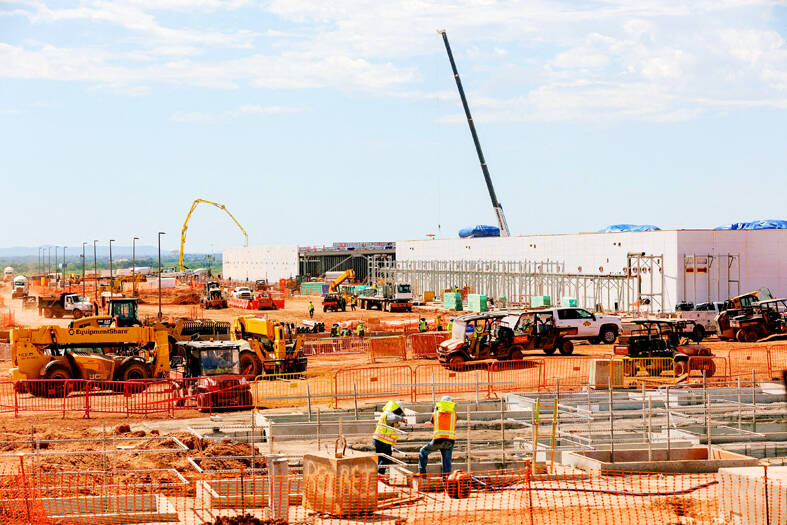
Data center buildings under construction are pictured in Abilene, Texas, on Sept. 23 last year.
Photo: Reuters
Its influential annual report warned that the world’s energy future was less certain after the impact of the Middle East war.
In his forward to the report, IEA Executive Director Fatih Birol called the crisis in the Strait of Hormuz, which followed US and Israeli strikes on Iran in February, “the largest threat to energy security, one that dwarfs the scale of the oil shocks of the 1970s.”
“I don’t see any credible pathway for the energy world to return to the way it was before,” Birol said.
Instead, the world would be reshaped by the policy decisions governments make after the crisis to meet the increasing demand for energy to power a growing global population, the rising need for air-conditioning and a booming AI economy, the report said.
Data center developers have emerged as the world’s biggest corporate buyers of renewable energy to help fuel their servers which have a connection to local power grids. Despite this, the report showed that the appetite for fossil fuels is expected to grow even faster, particularly in the US and China.
By the end of the decade, about half of the electricity needed to power China’s AI data centers would come from coal power plants, the IEA said.
The rest would come from renewable energy, with smaller amounts from nuclear reactors and very little from gas plants.
In contrast, the US is expected to rely on gas to provide about 60 percent of the electricity for its data centers by 2030.
There were plans for about 180 gigawatts (GW) of new gas-fired power plants linked to US data centers in August, the agency said.
That is almost as much new gas capacity as the total installed across the EU.
As a result of the growth in fossil fuel generation for data centers, emissions associated with this sector were on track to rise by 70 percent by 2030, the IEA said.
The appetite for gas power among US data centers developers is more than 16 times higher than in Canada, where the IEA identified plans for 11GW of gas generation to power their servers. In the rest of the world, AI developers have put forward plans for new gas plants with a combined capacity of just 4GW, the agency said.
This is because renewable energy is expected to play a greater role in supplying data centers outside the US and China. In the EU, the IEA expects data centers to rely on renewables for about 70 percent of their electricity by 2030 — followed by nuclear power, gas generation and a small amount of coal power.
KioskNews shows a cleaned-up reading view extracted from the publisher’s page — the original always lives on their site, not ours.