India’s bullet train not delayed, even Japan can’t do it in 10 yrs: High-speed rail body head
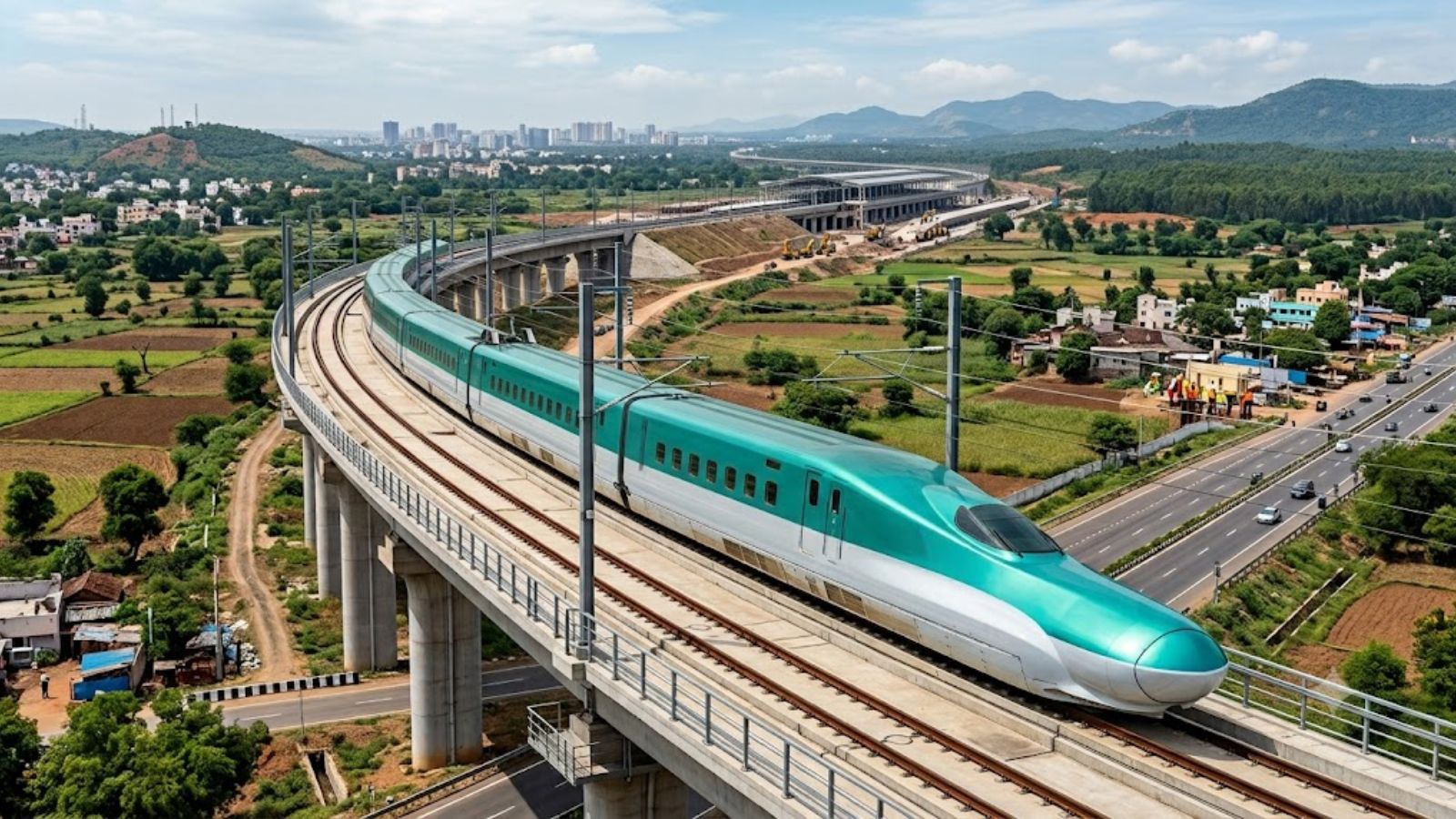
The Mumbai-Ahmedabad High Speed Rail (MAHSR), India's first ever bullet train project, was initially expected to be completed in 2022.
Amid allegations over delays in India’s first bullet train project between Mumbai and Ahmedabad, the head of the international high speed rail body said it should not be said that the project is delayed given the many unforeseen problems India encountered, such as the Covid-19 pandemic and land acquisition.
Speaking to The Indian Express on the sidelines of the Kautilya Economic Conclave, Masafumi Shukuri, Chairman of the Japan Transport and Tourism Research Institute (JTTRI) and International High-Speed Rail Association (IHRA), defended the Indian government, saying that even though Japan has 62 years of experience in building and operating bullet trains, it cannot complete a 500-km long stretch in 10 years.
“The first high-speed rail (project) in Japan was launched in 1964, which means Japan has 62 years of experience of constructing and operating the high-speed train. Now, let’s just say today Japan decides to make a high-speed rail track of 500 km. It is not possible to complete it in 10 years. Even today’s Japan cannot do it… I think from this perspective, given the different conditions, building a high-speed rail of 500 km long in India is a big deal,” Shukuri said.
“We also have to remember that initially when any project starts, there are many unforeseen problems. I know that there was a delay in land acquisition and many other things which have to be factored in,” the IHRA Chairman added.
Shukuri’s comments come after Hideki Makihara, a former justice minister and a member of Japan’s ruling Liberal Democratic Party, who alleged in July that India had displayed “sheer recklessness” in its bullet train project that stalled its progress.
The Mumbai-Ahmedabad High Speed Rail (MAHSR), India’s first ever bullet train project, was initially expected to be completed in 2022.
“I do not think there is a delay really, because you have to look at the size of this project. It is a 500 km long alignment. It is being done for the first time in India. With all of this together, it is a humongous, massive project. It is not a project which is expected to be wrapped up and completed in a matter of just a few years. It is just not possible,” Shukuri said.
Story continues below this ad
“Another thing is that we also had to deal with the Covid-19 (pandemic), which came with disruption that it took time to get back on track. I feel that despite all of that this project is proceeding very strongly,” he further said, adding that IHRA has been involved with the project since 2014, even before it was officially announced.
The first section from Surat to Vapi in Gujarat of the 508-km project is scheduled to begin operation by the end of 2027. The entire project is expected to be completed by 2029. The priority section will begin the operation with India-made bullet trains, since the Japanese E10 Shinkansen won’t arrive before 2034 and is still under design in Japan.
India is currently developing its own bullet train set (B28). The design speed of the train is 280 kmph and two sets are being developed by BEML in Bengaluru. It will operate at a maximum speed of 250 kmph. The manufacturing of the train is scheduled to be completed by April 2027, with testing to be done between May-July 2027. The commercial operation of the train will begin by December 2027.
Shukuri also said that while it is absolutely fine that India has decided to use its own rolling stock, or India-made bullet train, for the project, it has to ensure the operation is not only stable, but safe and reliable.
Story continues below this ad
“I think it is not only about procurement of rolling stock and signalling systems. It is also about making sure that training of the people is in place on time, they have the requisite skill-set, they have the technical know-how, as well as enough trials are done to really get a full performance of the final commissioning of the train,” said Shukuri.
In the Mumbai-Ahmedabad project, three systems were to be taken from the Japanese: the Shinkansen bullet train, the Signalling System, and the Operation Control Centre (OCC). However, this is yet to be finalised between both countries. The civil construction work is to be done by India.
© The Indian Express Pvt Ltd

Dheeraj Mishra is a Principal Correspondent with the Business Bureau of The Indian Express. He plays a critical role in covering India's massive infrastructure sectors, providing in-depth reporting on the connectivity lifelines of the nation. Expertise & Focus Areas: Mishra’s journalism is focused on two of the country's most capital-intensive and public-facing ministries: Ministry of Railways: Tracking the operations, safety, and development of India's vast railway network. Ministry of Road Transport & Highways: Covering policy decisions, infrastructure projects, and highway development. What sets Mishra apart is his rigorous use of the Right to Information (RTI) Actas a primary tool for news gathering. By relying on official data and government records, he ensures a high degree of accuracy and trustworthiness in his reporting. This data-driven approach has resulted in numerous impactful reports that hold public institutions accountable and bring transparency to government operations. Find all stories by Dheeraj Mishra here ... Read More

Siddharth Upasani is a Deputy Associate Editor with The Indian Express. He reports primarily on data and the economy, looking for trends and changes in the former which paint a picture of the latter. Before The Indian Express, he worked at Moneycontrol and financial newswire Informist (previously called Cogencis). Outside of work, sports, fantasy football, and graphic novels keep him busy. ... Read More
KioskNews shows a cleaned-up reading view extracted from the publisher’s page — the original always lives on their site, not ours.