Long-distance flights can interfere with the internal clocks of seabirds
Oct 30 : People who travel across many time zones, like a trip from London to Tokyo, may experience jet lag, with the body's internal 24-hour clock — the circadian rhythm — thrown out of sync with the local time at the arrival location. A new study shows that birds that fly long distances may experience a similar phenomenon that causes them to drift off course.
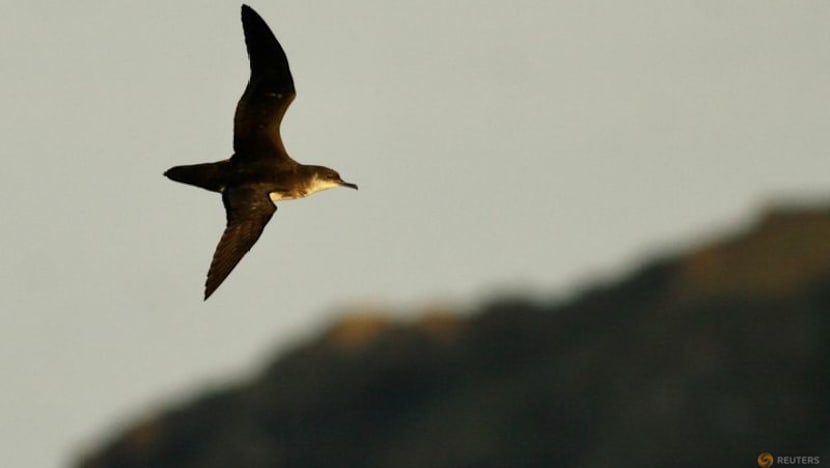
Research involving seabirds called Manx shearwaters found that crossing the Atlantic at speed can throw their internal clocks out of sync with local time, causing errors in the strategy they use to navigate their way home.
Birds can use several cues to find their way, including having the sun serve as a compass. A bird flying south sees the sun on its left at sunrise and on its right toward sunset, so it must keep adjusting its heading as the sun moves across the sky.
"Animals use an internal clock to do this, the same one that tells our bodies when to sleep, when to be active," said Patrick Lewin, a researcher at the University of Oxford's Department of Biology and one of the leaders of the study published in the journal Science.
To investigate how the birds navigate across vast stretches of open ocean, researchers analysed 20 years of GPS data from 1,045 breeding Manx shearwaters, birds that can travel as far as about 1,000 km (620 miles) west from colonies on islands off Britain on foraging trips.
Using the positions of the birds and the sun's movement across the sky, the researchers calculated the error each bird should make if its internal clock stayed set to the time at dawn. Across 335 homing flights made out of sight of land, the headings of the birds closely matched those predicted errors.
"The process behind what we're observing here — the mismatch between the internal clock and external time caused by longitudinal movements — is exactly the same as what causes jet lag in humans," Lewin said.
The researchers have not yet investigated whether the clock mismatch affects the birds beyond navigation. But internal clocks influence behaviours including feeding and rest, raising the possibility that those too could be mistimed.
Shearwaters tend to hunt shortly after dawn and before dusk, when fish and other prey are closer to the surface, meaning a mistimed rest period could cost them a feeding opportunity, Lewin said.
The study also showed that birds kept using their solar compass even when another source of information was readily available. Along coastlines, where familiar land could potentially guide them, their distance from shore still shifted in the direction predicted by clock-related sun-compass errors.
A TWO-STEP PROCESS
"For most navigational tasks, it is thought that compass systems are used in conjunction with a map system in a kind of two-step process. In the map step, the animal determines where it is in relation to a goal, such as a home colony. Then in the compass step it uses a compass to translate that into movement," said Tim Guilford, a University of Oxford professor of animal behaviour who was one of the study leaders.
The birds may continue to combine these systems even in familiar areas, rather than relying entirely on one or the other.
"If this only produces small deviations, there might not be strong selection against it," Lewin said.
Another possibility is that the sun compass helps the birds determine which way to go along the linear feature, Lewin said.
Even clouds may not render the sun compass useless. Evidence suggests that birds can sense polarised light and estimate the sun's position unless conditions are heavily overcast, Lewin said.
In people, jet lag can cause unpleasant short-term effects and has been linked to longer-term health problems in those who experience it frequently, such as airline pilots and flight attendants. It is not yet known whether birds experience similar effects, but species such as shearwaters that regularly travel rapidly east-west may have evolved ways to cope with repeated disruption to their internal clocks, Lewin said.
"Knowing this phenomenon is occurring is only the first step, but perhaps these birds could teach us something about how to treat or avoid jet lag," Lewin said.
KioskNews shows a cleaned-up reading view extracted from the publisher’s page — the original always lives on their site, not ours.