The 10 Best Spaghetti Westerns in Film History, Ranked

Jeremy has more than 2800 published articles on Collider to his name, and has been writing for the site since February 2022. He's an omnivore when it comes to his movie-watching diet, so will gladly watch and write about almost anything, from old Godzilla films to gangster flicks to samurai movies to classic musicals to the French New Wave to the MCU... well, maybe not the Disney+ shows.
His favorite directors include Martin Scorsese, Sergio Leone, Akira Kurosawa, Quentin Tarantino, Werner Herzog, John Woo, Bob Fosse, Fritz Lang, Guillermo del Toro, and Yoji Yamada. He's also very proud of the fact that he's seen every single Nicolas Cage movie released before 2022, even though doing so often felt like a tremendous waste of time. He's plagued by the question of whether or not The Room is genuinely terrible or some kind of accidental masterpiece, and has been for more than 12 years (and a similar number of viewings).
When he's not writing lists - and the occasional feature article - for Collider, he also likes to upload film reviews to his Letterboxd profile (username: Jeremy Urquhart) and Instagram account.
He has achieved his 2025 goal of reading all 13,467 novels written by Stephen King, and plans to spend the next year or two getting through the author's 82,756 short stories and 105,433 novellas.
Sign in to your Collider account
For a definition of what a spaghetti Western is, exactly, the easiest way to describe them is to say that they're Westerns made primarily (or at least partly) in Italy. Or, if they weren’t filmed in Italy, but were produced by Italy and/or had Italian directors helming them, they probably count as spaghetti Westerns, too. It’s also worth noting that the golden era of the spaghetti Western didn’t last all that long, because the sub-genre’s heyday was the 1960s, and maybe a bit of the 1970s, too.
Beyond the following classic movies holding up well, the legacy of the spaghetti Western is there – and persists – with filmmakers who've been influenced by such classics. Quentin Tarantino is the most obvious one, seen with Django Unchained and Kill Bill: Vol. 2, but you can also see it with Robert Rodriguez (his Mexico Trilogy) and Edgar Wright (A Fistful of Fingers). The following movies, though, are the very best genuine spaghetti Westerns in film history, with plenty of them also worthy of being called the best Westerns of all time, just generally speaking.
10 'Keoma' (1976)

This one might well have come out after the golden age of the spaghetti Western was over… though, at the same time, spaghetti Westerns have earned higher levels of acclaim post-whatever period that was, so take that for what it’s worth. Anyway, this one is Keoma, and it’s one of a fair few iconic spaghetti Westerns that starred Franco Nero (the most iconic one will be mentioned a little later).
Also, Keoma is perhaps the best spaghetti Western directed by someone whose first name wasn’t Sergio, since Enzo G. Castellari was behind this one. The nine remaining Westerns… nothing but Sergios. It’s some kind of wild coincidence. But as for Keoma, it does what it needs to. It’s about a ruthless hero getting into a conflict with some thugs and three of his half-brothers, and it contains some good action alongside solid melodrama (over-the-top in some ways, yes, but in a manner that does generally work).
9 'A Fistful of Dollars' (1964)

Get used to seeing Sergio Leone and his movies show up quite a bit here, because he was the most legendary of all the spaghetti Western directors. He made his mark as a director of Westerns with A Fistful of Dollars, which was really good, but also not quite as great as his subsequent four Westerns (two of which also starred Clint Eastwood, and they formed what’s come to be known as the Dollars trilogy).
A Fistful of Dollars was infamously an unofficial remake, but still a fairly good one regardless.
If you want a summary of what happens in A Fistful of Dollars, you can also look up the premise to Yojimbo, but just imagine it happening in Old West times, rather than in Japan during samurai times… though the same time period is covered, roughly, because Yojimbo is set in the 1860s, and A Fistful of Dollars takes place (probably) in the 1870s, so that’s something. But yeah, A Fistful of Dollars was infamously an unofficial remake, but still a fairly good one regardless, and then it did end up leading to bigger and better things for the likes of Leone, Eastwood, and composer Ennio Morricone.
8 'The Big Gundown' (1967)

The Big Gundown is good stuff, and the best Lee Van Cleef spaghetti Western outside the big two (he was in two of Sergio Leone’s Dollars films, so they're a bit hard to top). He’s unequivocally the lead character in The Big Gundown, though, playing an efficient bounty hunter who has a reputation for tackling some properly nasty criminals, and he does so as “one last mission” here.
That immediately makes things sound a bit clichéd, but The Big Gundown makes that premise work, and Van Cleef does prove himself to be more than capable of simultaneously leading a movie and being a hero (well, a spaghetti Western sort of hero) here. If you like spaghetti Westerns even a little bit, you're pretty much guaranteed to find something to appreciate and worth enjoying in The Big Gundown.
7 'The Mercenary' (1968)
.jpg?q=49&fit=crop&w=825&dpr=2)
With The Mercenary, it felt like Sergio Corbucci was possibly trying to make something Sergio Leone-esque, because it really does line up, in places, with the Westerns Leone had directed in 1965 and 1966 (more on those shortly). To Corbucci’s credit, there are also things here that feel like the Westerns Leone directed in 1968 (the same year The Mercenary came out) and 1971.
Like, The Mercenary is strange, and it gets pretty convoluted for something that’s only 101 minutes long. It feels like it could've benefited from a little more time to breathe, or things getting fleshed out more, but the stuff that’s good makes the problems here feel like nitpicks. It’s all worth it for the ending, basically, which is one of the very best in spaghetti Western history.
6 'Once Upon a Time... the Revolution' (1971)

Once Upon a Time... the Revolution stands as the middle chapter of Sergio Leone’s thematic Once Upon a Time trilogy, though it has to be acknowledged that “Once Upon a Time... the Revolution” is not the most popular name for the movie. Duck, You Sucker is the one you'll see more often, which has the effect of making it sound kind of tacky, or like an exploitation film, while its other alternate title, A Fistful of Dynamite, isn't a whole lot better.
But Once Upon a Time... the Revolution alludes to the importance of the Mexican Revolution within the film’s story, and then it also hints at how radical the film feels, too. This one goes to some incredibly dark places, and does so while also getting kind of weird at times. It’s equal parts unstable and underrated, and isn't always called a spaghetti Western, either, since Once Upon a Time... the Revolution is sometimes referred to as a Zapata Western (see also the previously mentioned The Mercenary).
5 'Django' (1966)

Obviously an influence on the previously mentioned Django Unchained, Django is almost as iconic as spaghetti Westerns get, even if there are a handful that are even better… including one more by Sergio Corbucci, who went to new heights quality-wise (and new lows, emotionally) with one other soon-to-be-mentioned Western. Django, if you need a plot summary, is pretty straightforward.
The titular character is a gunslinger, and his distinguishing feature (as a character) is that he drags around a coffin with him. He clashes with a large group of adversaries, or more like two large groups of adversaries, and then there’s a whole lot of shooting and violence that, by 1966 standards, is quite graphic. The music here is pretty iconic, too, and surprisingly not done by Ennio Morricone, who has been praised in this ranking a bunch of times elsewhere.
4 'For a Few Dollars More' (1965)
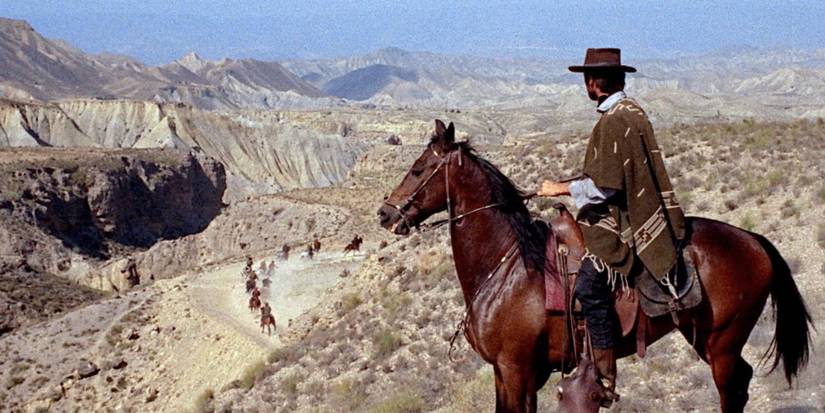
More Leone, and a few dollars more, literally, because it’s For a Few Dollars More. Clint Eastwood was in this one again, as the Man with No Name, but he shares screen time with Lee Van Cleef’s Col. Mortimer, who’s the more interesting character. Eastwood’s still got a lot to do, and is effortlessly charismatic, but both characters are pursuing the same target, and Mortimer does have the more interesting/personal reasons for doing so.
That’s all you really need, in terms of a plot. It’s not a complicated story, and it’s told well, with the two lead characters being memorable and the main antagonist being sufficiently despicable. As for its technical qualities, For a Few Dollars More is a step forward for Leone, and Morricone composed an even better score here than he had for A Fistful of Dollars. And, on the topic of that movie, it’s nice that For a Few Dollars More sticks out for being a bit more original overall.
3 'The Great Silence' (1968)

The Great Silence has bounty hunters in it as well, like For a Few Dollars More, but they're decidedly not heroic this time around. They're terrifying, actually, and serve as the film’s villains, while a group of outlaws being targeted by those bounty hunters are ultimately more sympathetic, as is the gunslinger who strives to defend the outlaws from the incoming bounty hunters.
Also, for one more For a Few Dollars More connection, the infamous (and himself terrifying) Klaus Kinski is in both, and you get some typically amazing music from Ennio Morricone, who certainly could compose great scores even when not working with Sergio Leone. The Great Silence was instead directed by the second-most iconic spaghetti Western director, Sergio Corbucci (who also did The Mercenary and Django). Those two Sergios really did know what they were doing. Well, same goes for Sergio Sollima, who directed the previously mentioned The Big Gundown. To say anything more about The Great Silence would be giving away what makes it really work (and pack a punch), but the important thing is that it’s a must-watch, as far as spaghetti Westerns go.
2 'Once Upon a Time in the West' (1968)
After the Dollars trilogy, but before Once Upon a Time… the Revolution, Sergio Leone directed Once Upon a Time in the West, which sits nicely (and tonally) between those other two Westerns (or a trilogy of Westerns, in the case of the former). Once Upon a Time in the West also only just qualifies as a spaghetti Western, since it was an Italian and U.S. co-production, and some of it was shot in the U.S.
It’s got enough here, with an Italian director and some locations shot in Italy, to make it sufficiently spaghetti-esque. If it was left off, people would probably be unhappy. Because, like, it’s Once Upon a Time in the West. If it had been the last Western ever, it would've concluded the whole genre pretty well. It’s good that it wasn’t, because then the likes of The Wild Bunch and Unforgiven wouldn’t exist, but if things had to end here, for whatever reason, it would've been quite the genre-wide send-off.
1 'The Good, the Bad and the Ugly' (1966)
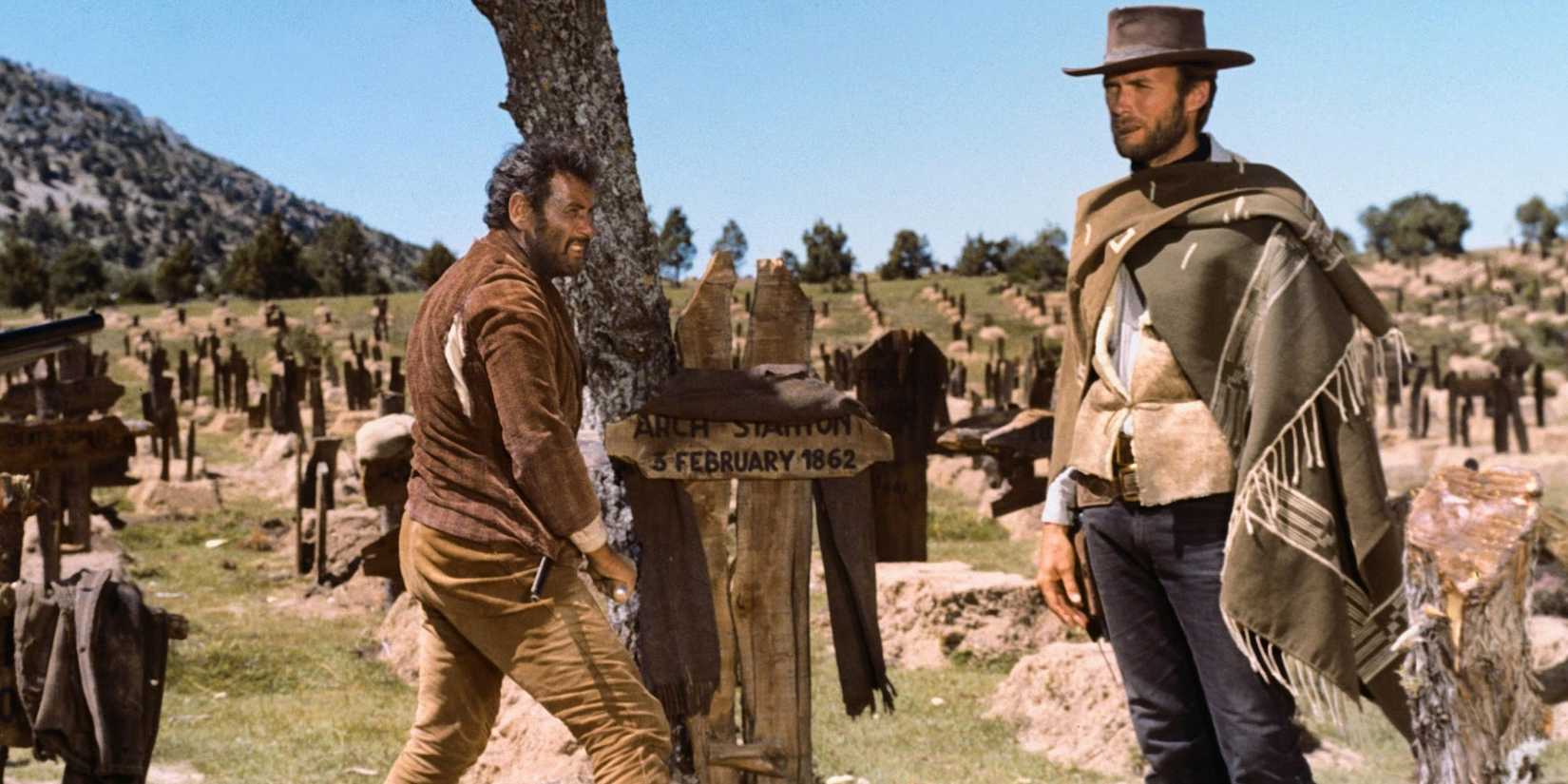
If you want the spaghetti Western sub-genre condensed into just one movie, and to be able to understand what it is more or less because of that one movie, then here’s The Good, the Bad and the Ugly. There are three main characters here, each one representing the three adjectives in the title… kind of. And they compete with each other to try to find a buried fortune in the desert while the Civil War wages around them.
It was the final Dollars film by Sergio Leone, and even if his two later Westerns were a bit more mature and boundary-pushing, The Good, the Bad and the Ugly remains his best for entertainment value and the undeniable spectacle offered. It’s one of the biggest Westerns ever made, and also one of the most perfectly directed, written, acted, and scored. It’s got everything, basically.
KioskNews shows a cleaned-up reading view extracted from the publisher’s page — the original always lives on their site, not ours.