Terry Newman: Standing alone is brave, actually
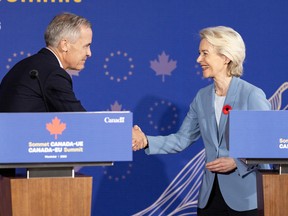
The 21st Canada-European Union Summit kicked off in Montreal this week, and so far, it looks like Prime Minister Mark Carney and European Commission President Ursula von der Leyen forgot to compare notes.
Sign In or Create an Account
In her speech, Von der Leyen, once again, used the term “associate member” and said that Canada and the EU could “build a partnership that comes closer to membership than anything we’ve done before.”
What is that supposed to mean?

Columnist Jesse Kline keeps you up to date with what’s happening in Israel and the effects of antisemitism on life here in Canada. Friday mornings.
By signing up you consent to receive the above newsletter from Postmedia Network Inc.
A welcome email is on its way. If you don't see it, please check your junk folder.
The next issue of Channel Israel will soon be in your inbox.
We encountered an issue signing you up. Please try again
Von der Leyen stated the obvious about Canada not being able to become a full member, due to our geography, but said, “We are discussing the idea of Canada becoming the first associate member of the European Union,” adding that it would be “association without accession.”
She made it sound simple, suggesting the arrangement would be mutually beneficial, without downsides. Canada would simply work with the EU on policies relating to “everything,” including student-mobility programs, energy, security, artificial intelligence, climate and “more work shared” between the two, which could include co-operation between parliaments, courts and “closer alignment in each other’s programs.”
Which programs they are considering aligning on were left unclear, like the definition of our membership.
More importantly, how does linking Canada to the EU and its decisions strengthen Canada’s sovereignty, as Carney suggested at the summit?
Von der Leyen’s explanation did not clarify how European or Canadian citizens may be affected by this new kind of membership. If the EU members overwhelmingly vote for something, will Canada be required to go along? How will it be defined?
And the last time I checked, Canadians hadn’t voted on any of this. Who says Canadians want to be in line with EU policies?
At a press conference Thursday, Carney told reporters, in his characteristically dismissive way, “This new alliance is not a marketing exercise. The name doesn’t matter. What matters is that the complementarities of our two jurisdictions strengthen our sovereignty.”
Of course, we know that’s not true. Members of the EU are bound to certain requirements and responsibilities because they are “members.” You can guarantee that “associate member,” or whatever Canada ends up being labelled, will have its own detailed requirements, which will likely never be run by Canadians for approval.
We continue to be Carney’s mushrooms, left in the dark, whether it be about the specifics of why he walked away from a U.S. trade deal at the last minute or what the specifics of Canada being wrapped up in an EU membership will actually entail.
This is unacceptable.
The Wall Street Journal discovered that Carney rigorously pursued this membership, though he rebuffed this, and said he was looking for a “unique alliance.”
We shouldn’t have been surprised. Deepening integration appears to have been Carney’s plan from the get-go.
In October 2025, Carney created a new position, “personal representative of the prime minister to the EU,” appointing former privy council clerk John Hannaford to “prioritize increased trade and investment levels with EU partners, and new and deeper security arrangements that reinforce our already strong ties — ensuring that commitments by Canada and our partners are quickly delivered upon and implemented.”
In December 2025, the Prime Minister’s Office announced that Canada was now a member of Security Action for Europe.
At the last Canada-EU Summit in Brussels, Canada signed the Security and Defence Partnership.
One has to wonder whether Ottawa put half as much effort into negotiations with the United States.
Earlier this week, one premier started to object to how the summit would be conducted.
On Wednesday, Quebec Premier Paul St-Pierre Plamondon officially withdrew from the summit after his request to address it was declined by the federal government, which he referred to as a “serious lack of respect.”
Before doing so, he posted a letter he’d wrote to the members of the summit on X, writing, “The reality is that we are facing a strategy of marginalizing Quebec on the international stage and subordinating Quebec’s areas of jurisdiction to the will of the federal government.”
Plamondon pointed out that topics discussed at the summit — including education, health care and natural resources — all fall under provincial jurisdiction.
He said that any deal Ottawa makes without Quebec’s consent “will simply not be implemented,” and accused the federal government of withholding “critical information” about the negotiations from the province.
Quebec Justice Minister Marie-Claude Sarrazin reminded reporters on Tuesday that Carney once said: “ ‘When you’re not at the table, you’re on the menu.’ ”
“The federal government has chosen to prevent Quebec from having a say on its own territory. This is a fundamental lack of respect toward Quebec and a denial of the role of our legislature,” she said.
Carney didn’t appear bothered. On Tuesday, he told reporters in Ottawa, “He was invited to the dinner and he refused,” and that, “It’s his decision to leave the chair empty.”
On Thursday, over-seasoned Globe and Mail journalist Andrew Coyne took to X to mock Plamondon for standing alone for his province. Standing alone in Canada’s consensus culture should be applauded, not mocked.
Premier Plamondon is right. All provinces and territories should feel the same way.
It’s one thing for the PM to make deals on behalf of Canada with other nations. It’s another thing entirely for him to bind our country closer to these nations, including whatever that might entail, without voters’ consent. Never mind the obvious incoherency of defending our sovereignty by linking us to European nations.
National Post
Join the Conversation
This website uses cookies to personalize your content (including ads), and allows us to analyze our traffic. Read more about cookies here. By continuing to use our site, you agree to our Terms of Use and Privacy Policy.
KioskNews shows a cleaned-up reading view extracted from the publisher’s page — the original always lives on their site, not ours.