When peace given no chance
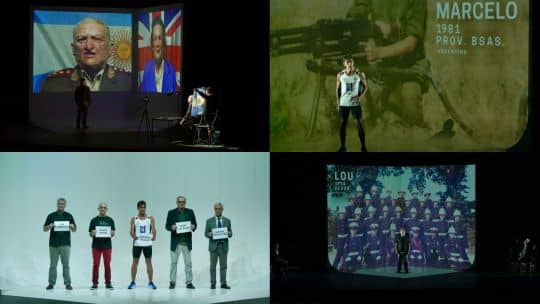
As a possibly unique case of a British immigrant to Argentina in the year 1982 who ended up working 34 years for the Buenos Aires Herald, how could this columnist not make seeing the powerful Malvinas war play Campo Minado (Minefield, in English) the centre of his week? As a play about memory and tackling the most difficult issues, it was picked by the Herald as a fitting way of marking its 150th anniversary this year and staged at the downtown Teatro Coliseo with a little help from some friends (last two performances this weekend) – Daniel Grinbank’s DG Experience and the British Council. And it just so happens that this review will be published on the 36th anniversary of Margaret Thatcher’s last day as prime minister.
Arriving in Argentina four months after the end of the war, this columnist could not claim to be an eye-witness, living and working in Hamburg during those 74 days. Since the German media had only a passing interest in the conflict, the only way to follow it closely was to listen continually to BFBS (British Forces Broadcasting Service, the radio for the British troops still occupying northwestern Germany at that time) – hardly the most impartial source. But at least the war forms part of my living memory – looking around the full house at the Teatro Coliseo, this reviewer concluded that not much more than 10 percent of the audience at best could say the same. Hence the vital importance of this play.
To say that Campo Minado is a call for peace is both to convey its central message and to fall short. The question it poses is not so much who can argue with peace as who should argue for it? Donald Trump launches his Board of Peace but gives the impression of being bored with peace much of the time. Beauty contestants almost invariably place world peace at the top of their wish lists but somehow this lacks the force of this play’s genuine veterans who have learned the value of peace through the bitterest experiences.
Just as you cannot have day without night or light without shadow, so peace is merely an abstraction without entering fully into the horrors of war. Nor is there any denialism about having been warriors 44 years ago on the part of these veterans now crusading for peace. Just before the grand finale – when Tip Cullen (standing in for Lou Armour) belts out such challenges to the audience over the rock music as “Have you ever seen a dead body?” or “Have you ever held a dead man in your arms?” – the two sides man their trenches and argue their cases in the sovereignty dispute, starting with the Malvinas being discovered by John Davis in 1592 versus being a stepping-stone in Magellan’s 1519-1922 circumnavigation of the world through to United Nations resolutions versus the 2013 referendum on the islands. Three men speak English throughout and three Spanish.
Time to meet the cast. Lou Armour was a key figure in launching this play 10 years ago as a rare case of being directly part of the war from start to finish – one of the 68 Royal Marines surrendering to Argentine forces in Stanley on April 2 and there for the Argentine surrender on June 14. With his replacement by Tip Cullen (an actor since ending his military service) the play loses authenticity but gains dramatic force.
David Jackson is the only British member of the original cast in these performances and the only one never on the front line despite coming from a family with several generations of military service – he spent the war decoding radio messages and is now a psychologist, giving free therapy in the play to Marcelo Vallejo.
Gurkha Sukrim Rai could not come due to a domestic accident but is not absent in the play. He serves to show that truth is the first casualty of war (while also exposing a certain latent racism in Argentina) – amongst other misreporting (such as sinking HMS Invincible, which only went to the scrapyard in 2011), Argentine propaganda media stated that over 300 prisoners-of-war had been massacred by Gurkha knives at Goose Green, often being cut up into little pieces. That this was fake news can easily be deduced from the figure that Argentine Army casualties in the entire war totalled 194.
On the Argentine side, sailor Rubén Otero was one of the 770 survivors of the ARA General Belgrano, torpedoed with the loss of 323 lives outside the exclusion zone on May 2 (the play’s take on this is less harsh than, say, the MP Tam Dalyell in Britain). Otero spent over 40 hours freezing on a raft before being finally rescued but far from hating everything British after this ordeal, his favourite pastime is drumming passionately on a band dedicated to Beatle music (the other two Argentine cast members are guitarists who perform during the play).
Gabriel Sagastume was a reluctant soldier who is now a lawyer. He bears witness to the fact that the war dead are not always the fault of the other side. Sagastume is the only survivor of a starving platoon (despite all the supplies sent from the mainland) which raided an empty cottage across the Murrell River near Stanley for food while he stayed on the other side keeping watch, only for one of them to step on a landmine on the way back, blowing all four soldiers into pieces – the landmine was, of course, Argentine. As good a reason to call the play Campo Minado as any.
Marcelo Vallejo spent the occupation manning a mortar on Wireless Ridge, around four miles west of Stanley. He had perhaps the most traumatic postwar adaptation of the trio, as he tells Jackson in the therapy session, but has since become a champion athlete and superbly fit in his mid-sixties.
Any criticisms? Just one – the background music is ample and apt but somehow manages to omit Rod Stewart’s ‘We are sailing,’ the British war anthem (at least for BFBS), especially during the 46 days between sailing out of Portsmouth and landing at San Carlos Bay.
The play is basically a chronology of the war starting and finishing with Armour, enriched by the testimony of its participants, but no intention of being a spoiler for this masterpiece of Lola Arias. Just try and see it today or tomorrow.
(The above is this year’s last column since its author will be back in Britain all next month. ‘Beyond the headlines’ will return early next year but not for long – this column will morph into ‘Campaign comments’ by mid-February at the latest when Neuquén goes to the polls, continuing with electoral analysis pretty much throughout 2027
KioskNews shows a cleaned-up reading view extracted from the publisher’s page — the original always lives on their site, not ours.