3 needs Hong Kong must meet to be a city where families thrive

Between mid-2025 and mid-2026, fewer than 30,000 babies were born in Hong Kong. It is the first time since records began that the annual total has fallen below this threshold. Against this backdrop, the government has strengthened fertility support in the latest policy address, extending the newborn allowance and enhancing tax concessions for families. These measures matter, but they do not tell the whole story of family formation.
Hong Kong has world-class infrastructure and public services, yet many people remain hesitant about starting a family. The challenge is not only whether people can afford children but also whether the city around them makes family life feel possible.
The 2026 Five Pillars Index, recently released by the Dutch independent research and development organisation GOAL, offers an intriguing way to understand this gap.
The index looks at quality of life through five interconnected dimensions: nutrition, movement, knowledge, mindset and environment. Together, these dimensions provide a broader perspective on the conditions that shape how people live and how manageable it might feel to plan for and sustain family life.
Hong Kong ranks 23rd among 213 countries and regions with a high score of 9.6 out of 10 for movement, reflecting the city’s strong transport infrastructure. At the same time, its mindset score is just 4.4, compared with 6.8 in Singapore and the global average of 5.1.
The score should not be treated as a verdict on Hong Kong or proof that any particular policy has failed. Rather, it points to a gap between the city’s strong material infrastructure and how manageable daily life feels to its residents.
11:08
‘Paradise’ for the rich, hell for the poor’: mansions and cage homes reflect Hong Kong disparity
This distinction matters for family formation. The pressures of demanding jobs, long commutes and limited living space can accumulate over time, making everyday family life more difficult to manage. Starting a family can therefore feel less like a decision to embrace and more like an additional burden to carry.
This is why Hong Kong needs to think about family formation as an urban issue rather than just a demographic or social policy one. The question is not simply how to persuade people to have children. It is whether the city makes family life sufficiently workable for people to imagine it in the first place.
To make family life feel possible, Hong Kong’s urban environment should address three practical needs in an ordinary day: suitable living environments, manageable commuting time and accessible public spaces.
First, family formation requires living space to grow. A home does not simply need to be affordable. It needs to provide enough stability and room for a family to grow. The latest policy address takes a promising step by allowing eligible families to receive a stamp duty waiver when purchasing a home just before or soon after the birth of a child.
Even so, many young and less-advantaged families face greater housing challenges and might not be able to enter the private housing market. For many, public housing remains the main pathway to securing a suitable home. Therefore, the idea of reducing housing uncertainty before family formation should be brought into the public housing system.
The Families with Newborns Allocation Priority Scheme and the Families with Newborns Flat Selection Priority Scheme are useful steps. For eligible young people and families, Hong Kong should further strengthen their pathway to suitable public rental housing and subsidised sale flats within the existing allocation and balloting system.
13:00
How Hong Kong's housing market became among the world’s most unaffordable
Second, living space means little without time to live. A larger home does little to ease family life if an ordinary weekday is still dominated by a chain of journeys.
Hong Kong does not lack transport services. What many parents lack is the time to manage it all. Work, commuting, school schedules, childcare and household responsibilities can turn an ordinary day into a logistical exercise.
This is where new development areas, particularly the Northern Metropolis, can do more than add housing capacity. They could be planned around the “15-minute neighbourhood” principle, with homes, schools and community facilities connected by safe and comfortable walking routes. The aim is not to make every neighbourhood self-sufficient but to prevent an ordinary family day from becoming a series of unnecessary journeys.
Third, families need accessible public places to connect. Even when families have a suitable home and a manageable daily routine, they still need accessible places to spend time together.
In a dense city like Hong Kong, families need places close to home where children can play and parents can relax without having to travel far. Waterfronts, parks and open spaces should therefore be seen as amenities but also part of the infrastructure of family life.
The Tseung Kwan O waterfront shows how walking, greenery, recreation and open space can serve different generations within the same neighbourhood. Similar approaches could be adapted incrementally in other existing and new districts.
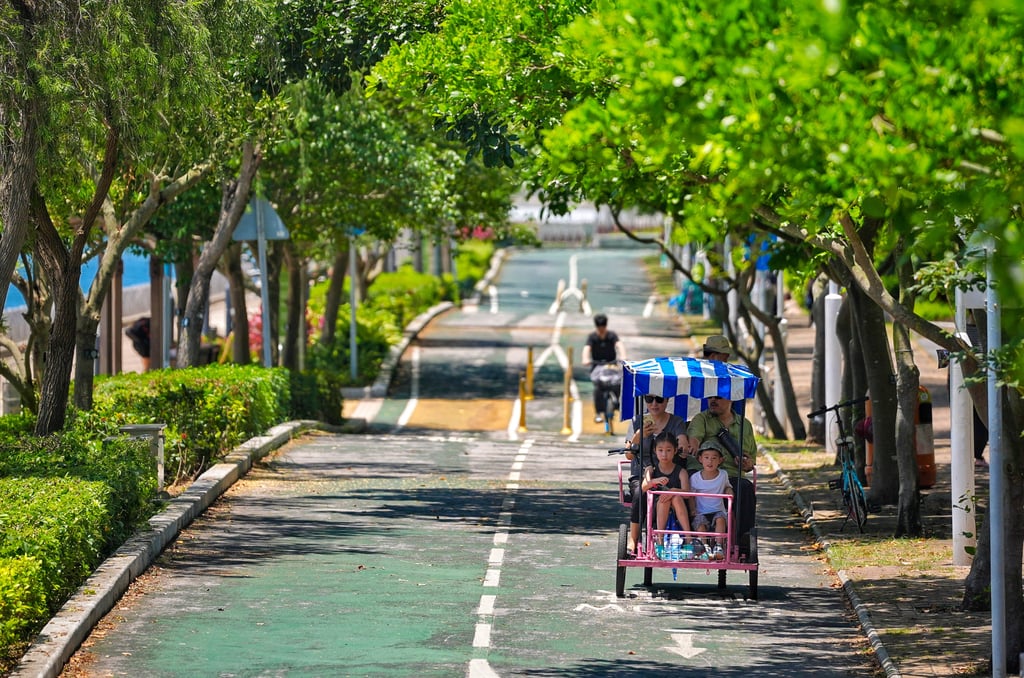
Taken together, these examples show how our urban environment can make family formation more manageable: enough space to grow, enough time to live together and enough places close to home to feel part of a community.
Fertility incentives, childcare support and other family policies remain important, but they address only part of the decision. Choosing whether to have a child is deeply personal. However, the conditions surrounding that decision are shaped collectively by the homes we build, the distances we create and the public spaces we provide.
Hong Kong has spent decades learning how to make a dense city efficient. The next challenge is to make that efficiency work for family life, too. The question goes beyond how many children Hong Kong will have to whether Hong Kong can become a city where starting a family feels possible.
KioskNews shows a cleaned-up reading view extracted from the publisher’s page — the original always lives on their site, not ours.