Narnia’s Most Debated Ending Isn’t the Problem Fans Think It Is


Michael John Petty is a Senior Author for Collider who spends his days writing, in fellowship with his local church, and enjoying each new day with his wonderful wife and precious daughters. At Collider, he writes features, reviews, recaps, interviews, and breaking news on select occasion. In addition to writing about stories, Michael has told a few of his own, from supernatural thrillers to historical fiction. His Western short story, The Devil's Left Hand, received the Spur Award for "Best Western Short Fiction" in 2025 from the Western Writers of America, of which he is a member. Michael currently resides in North Idaho with his growing family.
Sign in to your Collider account
Anyone who has thoroughly read through C.S. Lewis' The Chronicles of Narnia series will probably know the basics of the story and how religion played a big role in shaping it. They will also be aware that the final novel, The Last Battle, is missing one pivotal character: Susan Pevensie.
For years, many have criticized Lewis for his decision to leave the daughter of Eve out of Aslan's Country, a decision that the author must have known would rile folks up in the end. But while this creative choice was certainly intentional, it is by no means the "problem" that authors like Philip Pullman claim it to be. In fact, it proves that they, like Susan herself, entirely missed the point, and her absence is much more fitting when properly contextualized.
Why Susan Pevensie Does Not Return in 'The Last Battle'
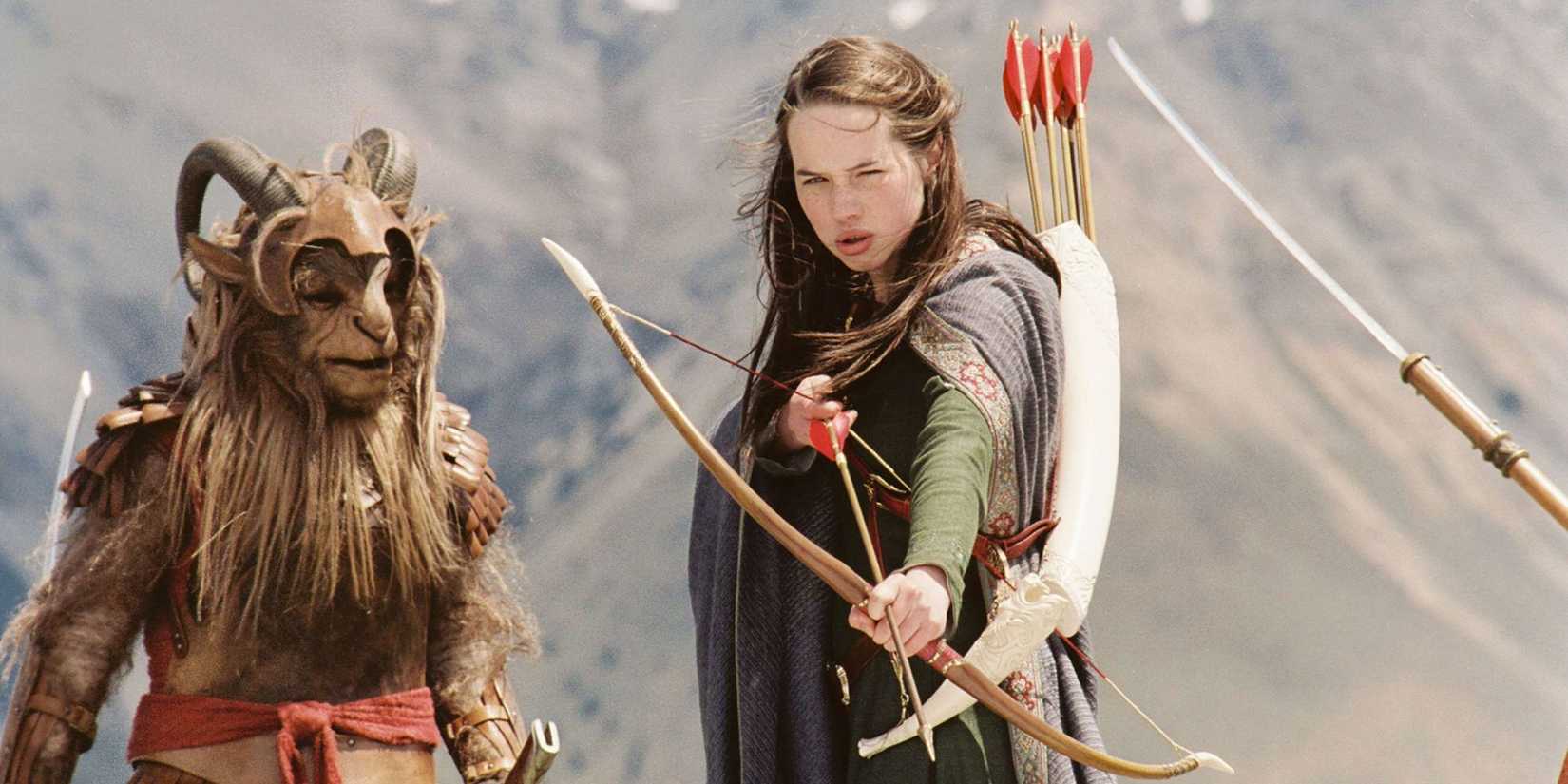
Near the end of the novel, the Earth-based "Friends of Narnia" — Peter, Edmund, and Lucy, their cousin Eustace, his friend Jill, their mentor Digory Kirke, and his childhood friend Polly Plummer — arrive to help King Tirian at the end of Narnian history. Peter banishes the demon Tash just before Aslan ushers all who were faithful to him into Aslan's Country. Not only do we discover that Susan is absent from the group, but we later learn that all but she were killed in a train accident in their world, including Mr. and Mrs. Pevensie. This is why Aslan allows them all to stay in his heavenly realm. Of course, this also means that Susan, who has since turned her back on Narnia, is now without her family in the "real world."
At the end of Prince Caspian, Aslan had told Peter and Susan that they would not return to the fantasy world. While Peter still clung to those years they served as Narnian royalty, Susan let them go entirely. In the twelfth chapter of The Last Battle, Eustace reveals that Susan now views Narnia as "funny games [they] used to play" during childhood. Jill further describes her priorities as "nothing nowadays except nylons and lipstick and invitations." Lastly, Polly adds that the former Queen of Narnia had "wasted all her school time wanting to be the age she is now," stating that she ought to truly grow up in a more authentic sense. Whatever your initial feelings on the matter, Lewis uses this revelation as a moment to pause and reflect on something he has actually been trying to say since the first Narnian chronicle.
Lewis famously dedicated The Lion, the Witch and the Wardrobe to his goddaughter, Lucy Barfield. Although he finished the book too late for her to enjoy it in childhood, he hoped that she would one day “be old enough to start reading fairy tales again.” It is with this idea in mind that we must reflect on Susan, who seemingly grew too “adult” for Narnia by maturing into a woman who could not leave the Shadowlands behind. While common critiques suggest that Lewis simply misunderstands Susan's mature desires, her decision is not (contrary to popular belief) about sex, nor is it an inherently misogynistic problem on the author's part. After all, Lucy, Jill, and Polly all remain faithful. Rather, the author juxtaposes the Friends' longing for "another country" (the spiritual) with Susan’s obsession with the tangibility of the present (the material). Instead of reflecting well on the lessons Aslan taught, she let them pass her by.
Susan Let Her Fears Overshadow Her Faith

Tragically, this is largely in step with Susan's priorities throughout the novels. In LWW, for instance, she refuses to entertain Lucy's experience even after Professor Kirke (a "grown-up") suggests she should. Indeed, upon arriving in Narnia, she more than once desires to go back, even wishing to abandon Mr. Tumnus to the White Witch. Susan didn't simply "mature" out of Narnia — it's all rooted in something deeper, and Prince Caspian gives us a clue as to what that is. Here, Susan is famously the last one to see Aslan, refusing again to believe Lucy; even worse, she makes a fuss when the others do. Looking back, it's hard to see all this as anything but foreshadowing for The Last Battle. While Lewis does show us a Susan who embraces her queenly role in A Horse and His Boy, she loses sight of who she was and who crowned her when back on Earth.
Susan always struggled with faith. In Prince Caspian, she confides to Lucy that she "really believed" all along that Aslan had been calling them — or, more accurately, as she admits, "I could have, if I let myself." As Aslan soon tells her, she allowed fear to cloud her faith, keeping her from trusting what she could not see. In the case of The Last Battle, we can't fully know why she chose to reject Narnia. Perhaps it was in fear of seemingly losing Aslan again like before. Of course, if this were the case, one would suspect that Peter, Digory, or Polly (all the eldest of the Friends) would have wrestled with these same fears. Instead, Lewis leans into Susan's pre-established dispositions, perhaps being more true to her character than readers would have preferred.
At the end of The Voyage of the Dawn Treader — in which Susan does not appear — Aslan reveals to Edmund, Lucy, and Eustace the entire point of their fantasy adventures: "...by knowing me here for a little, you may know me better there." This was Lewis' in-text revelation that Aslan was meant to be a "supposal" of how Jesus Christ might appear in another world. In a sense, Narnia was a "spiritual training ground" for the Pevensies, meant to teach them how to fully recognize Christ in their world. As the character who most struggles with the notion of faith (i.e., believing without always seeing), Susan became swept up in unbelief, and thus was unable to grasp the deeper truths of Narnia. For her, "growing up" wasn't really about having more "mature experiences," but a way to escape the pain of losing those years she spent elsewhere.
Collider Exclusive · 8 Questions · 2 Minutes What Fantasy World Do You Belong To? Middle-earth · Grand Line · The Continent · Camp Half-Blood
Pick your magic, your crew, where you want to wake up and who you would rather be fighting, and we will tell you which world you actually belong in. Four are open to you: an ancient kingdom living through its last good age, an endless sea full of pirates, a continent that pays people to kill monsters, and a summer camp where the Greek gods are extremely real and mostly a nuisance.
💍Middle-earth(Rings of Power)
👒Grand Line(One Piece)
🐺The Continent(The Witcher)
🔱Camp Half-Blood(Percy Jackson)
01
What kind of power do you want? Every one of these worlds runs on a completely different sort of magic.
02
Who is travelling with you? Nobody gets through any of these stories entirely on their own.
03
Where do you want to wake up tomorrow? The best fantasy is usually just somewhere you would genuinely like to live.
04
How are you making a living out there? Even in fantasy somebody has to pay for the horse.
05
There is something in the woods. What do you do about it? All four of these worlds keep something unpleasant out there in the dark.
06
Who is the villain of your story? The enemy tells you far more about a world than the hero ever does.
07
What do you actually believe in out there? Every world hands its heroes one rule and asks them to hold onto it.
08
A thousand years from now, how are you remembered? Eight questions in, this is the one that decides your world.
The Map Is Drawn Your World Is…
Four worlds and four completely different ideas of what a good life looks like. This is where you belong, what it would ask of you, and what you would get back in return.
Middle-earth
You belong somewhere old enough that the mountains have names and somebody can still tell you who gave them. Middle-earth is for people who think the right thing is worth doing even when it will not be finished in their lifetime.
- This is the only world on the list where doing good is understood as a very long defeat, fought anyway, by people who will never see how it ends.
- You are drawn to grandeur, to white cities and deep forges and the sense that almost everything you touch is older than your entire family line.
- The Rings of Power is set in the last good age before it all goes wrong, which gives every quiet scene in it a slightly unbearable weight.
- You would take the hard road, and you would take it on foot.
The Grand Line
You want the sea, a crew, and absolutely nobody telling you where you are allowed to go. The Grand Line is the world for people whose main ambition in life is finding out what is over there.
- One Piece has run for decades on one very simple engine, which is a group of people who each want something impossible and have decided to go and get it together.
- You collect people. Your ideal crew is a set of misfits who were each written off somewhere else before you turned up and offered them a better idea.
- The world is enormous and deliberately ridiculous, and the emotional gut punches land harder because of that rather than in spite of it.
- You would set sail knowing the map runs out, which is more or less the entire point of it.
The Continent
You would rather be feared and useful than liked and useless. The Continent is a world where the monsters are the straightforward part of the job and the people are where it all gets complicated.
- Witchers get paid to do what nobody else will and resented for existing at all, which is a trade most people would refuse and you would probably accept.
- You have no real illusions about which side is the good one, largely because on the Continent that question tends to have a disappointing answer.
- The best of these stories are not about the fighting. They are about somebody with a rigid code being repeatedly cornered into caring about people.
- You would take the coin, finish the job properly, and be out of town before the story got told wrong.
Camp Half-Blood
You want the myths to be real and loose in the actual world, and you want to find out at about thirteen that you were never anywhere near as ordinary as everybody kept telling you.
- Percy Jackson takes the oldest stories we have and drops them into car parks and diners, which makes the gods considerably funnier and a great deal worse.
- You would be the kid every school gave up on, who turns out to have been built for something nobody thought to test for.
- The series is genuinely about friendship rather than destiny, and it says so out loud every time a prophecy tries to get in the way.
- Camp Half-Blood is the real fantasy here: a place where the thing that made you difficult everywhere else is the thing that makes you belong.
The Chronicles of Narnia Is Not the End of Susan's Story
While Peter declares with sorrow that Susan is “no longer a friend of Narnia,” that does not mean she’s been rejected by Aslan as an outcast forever. The book leaves her fate uncertain, but Lewis always believed her story continued. In a 1957 letter collected in C.S. Lewis’ Letters to Children, the author states: “She is left alive in this world at the end, having by then turned into a rather silly, conceited young woman. But there's plenty of time for her to mend, and perhaps she will get to Aslan's Country in the end . . . in her own way.” Lewis would not have cared so little for Susan as to leave her in complete hopelessness. Perhaps, by removing her family from the picture, he was giving her the opportunity to finally reflect on her life and choose faith for herself, finding Aslan through her grief — something Lewis, who would later pen A Grief Observed, knew quite a bit about.
In a 1960 letter recorded in The Collected Letters of C.S. Lewis, the author admits that he couldn't write this story himself. “Not that I have no hope of Susan’s ever getting to Aslan’s Country," he explained, "but because I have a feeling that the story of her journey would be longer and more like a grown-up novel than I wanted to write.” Instead, he encouraged readers to write that story themselves. As Stuart Hunt of Into the Wardrobe points out, Lewis famously struggled with his faith. Though he was raised Anglican, he rejected religion entirely in his younger years before returning to Christianity in his early 30s (with the help of his friend J.R.R. Tolkien). Understanding this, it appears that the author's intent was never to push Susan aside, but to express a part of himself in her that simply could not be explored in these seven books — something many would relate to as they, too, grew up.
Susan Pevensie may be the most tragic character in The Chronicles of Narnia, but she is certainly not without hope. After all, as even Lewis himself once said, "When I became a man I put away childish things, including the fear of childishness and the desire to be very grown up." Of course, we can always fall back on Aslan's own words: "Once a king or queen in Narnia, always a king or queen."
KioskNews shows a cleaned-up reading view extracted from the publisher’s page — the original always lives on their site, not ours.