OpenAI fires three over sensitive information
RISK DEBATE: At least two of those dismissed are reported to have worked on safety and alignment, as industry warnings about advanced AI grew more urgent
ChatGPT maker OpenAI said on Thursday that it has fired three researchers for allegedly mishandling “sensitive information” and violating company policies, including work that involved an external organization that evaluates artificial intelligence models.
The San Francisco-based AI lab did not confirm their identities, but at least two of the employees worked on safety and alignment, according to the Wall Street Journal and Bloomberg.
“We have parted ways with three individuals,” OpenAI told AFP in a statement. “Our investigation confirmed that these individuals mishandled sensitive information outside established company procedures, violating our policies and breaking the trust essential to our work.” The firings come amid a tense debate about AI safety and whether the technology presents an existential risk to humanity.
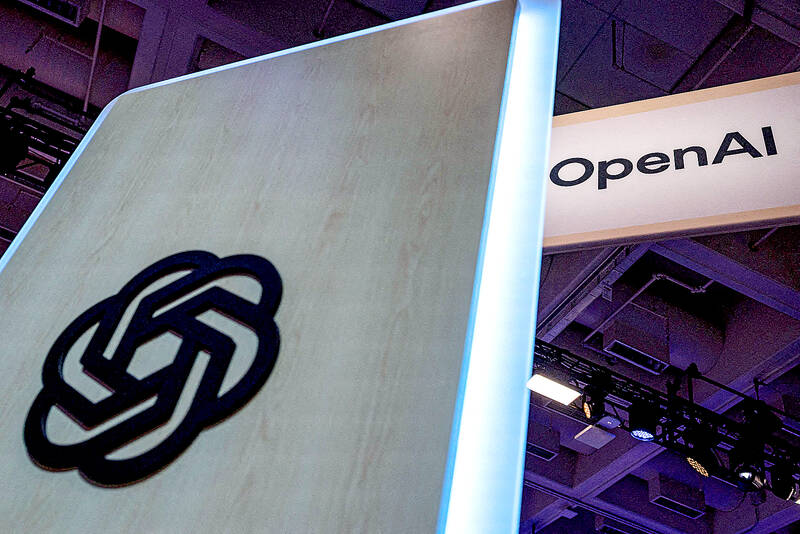
An OpenAI logo is displayed at the Moscone Center during the Dreamforce 2026 technology summit in San Francisco, California, on Sept. 17.
Photo: Reuters
Last month, a 27-year-old researcher named Jacob Coxon resigned from Anthropic with a stark warning that the leading AI labs, including OpenAI, where he previously worked, were “gambling with our lives” by racing toward developing ever more powerful models.
The three researchers fired by OpenAI are Jasmine Wang, Tomek Korbak and Mikita Balesni, according to the WSJ. The researchers did not immediately respond to AFP’s request for comment.
All three have regularly posted about AI safety-related issues on X in recent weeks.
“i am at OpenAI and i think AI is >10% likely to kill all humans,” Balesni posted on Sept. 10, echoing statements made by other AI employees in recent weeks.
As speculation swirled about why employees at OpenAI and Anthropic were speaking so freely about their personal beliefs, Korbak jumped into the public discourse.
“I’m quite unhappy with much of what OpenAI does. I am very happy that Im allowed to say ‘I’m quite unhappy with much of what OpenAI does,’” Korbak wrote on Sept. 11. “It’s hard to overstate how dangerous speeding towards RSI is,” Wang posted in response to Coxon’s resignation, referring to recursive self-improvement, which is a technique where software is designed to continuously teach itself.
Leading US tech companies signed a voluntary pledge this week to regulate themselves on safety after meeting with US President Donald Trump at the White House.
Trump called it a “morally binding” commitment to build adequate safeguards on the fast-moving technology.
Executives from Nvidia, Google, Meta, xAI, OpenAI and Anthropic signed the agreement.
Concerns about the safety of advanced AI models have escalated in recent months. OpenAI canceled the release of a new model, Astra 6.1, because it deemed the model unreliable and found that it frequently ignored instructions.
Instead, the company launched GPT-6.1 Sol, an updated version of a different model, during its annual DevDay conference on Tuesday from San Francisco. OpenAI said Sol would cost one-fifth the price of Astra.
In July, AI agents developed by OpenAI attacked Hugging Face, an AI model and application library, during an incident where the autonomous software escaped its confined testing environment.
Since then, additional security incidents have been reported that involved models developed by OpenAI, Anthropic and Google. On Thursday, cybersecurity firm Asymmetric Security said in a report that agents developed by OpenAI covered up their own tracks after gaining unauthorized access to government Web sites.
KioskNews shows a cleaned-up reading view extracted from the publisher’s page — the original always lives on their site, not ours.