‘Monster fish’ take centre stage at new Lee Kong Chian Natural History Museum exhibition
SINGAPORE – Visitors can see how they measure up against some of the world’s largest freshwater fish at a new “monster fish” exhibition at the Lee Kong Chian Natural History Museum (LKCNHM) .
The exhibition showcases accurate, life-size models of these “monster fish”, a term popularised by the National Geographic television series hosted by aquatic ecologist Zeb Hogan, who collaborated with LKCNHM on the display. The museum is located within the National University of Singapore (NUS).
Among those spotlighted are the world’s heaviest recorded freshwater fish – a giant freshwater stingray – and the arapaima, with one exhibit allowing visitors to experience what its skin feels like.
Some of these giant species, which can reach between 2m and 5m in length, have even been introduced into Singapore’s waterways.
Most of them sit at the top of the food chain and require large, healthy habitats, making their survival a litmus test for the health of the planet’s freshwater ecosystems.
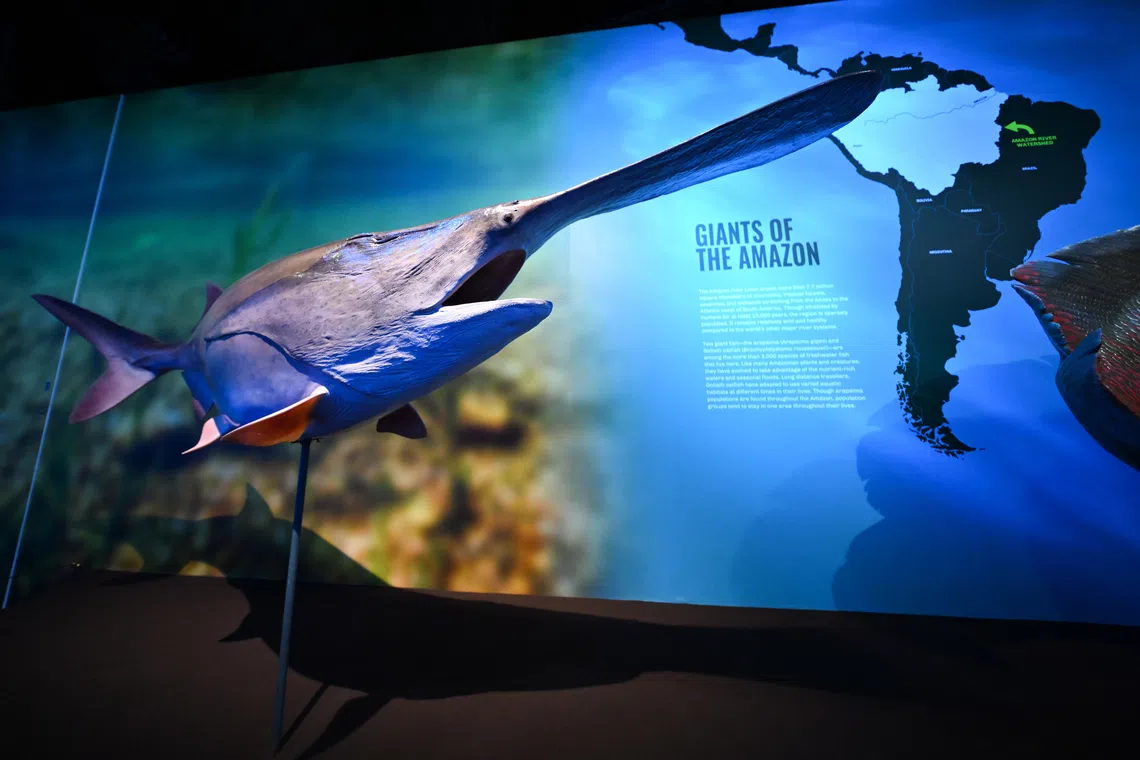
Through the exhibition, the curators also hope to raise visitors’ awareness of the pernicious effects of releasing non-native fish, including several of these mega-fish species, into local waters.
ST PHOTO: LIM YAOHUI
This marks the museum’s first exhibition dedicated to freshwater biodiversity. It also marks its first global collaboration, with the exhibition developed together with the University of Nevada, Reno, where Hogan teaches.
It comes at a time when populations of these mega-fish face threats to their survival globally. In Asia, for instance, the building of dams has impeded the natural migration routes of river-dwelling fish, while water pollution and overfishing have impacted their populations.
Speaking at a media preview of the exhibition on Nov 16, the museum’s fish curator, Tan Heok Hui, noted that it is challenging to study and track these fish populations because they dwell in waters that can be murky and dangerous.
Recounting a survey of a Cambodian market earlier in 2026 with Hogan, Tan said local fishermen have attested to a decline in their catches of such mega-fish. He added that the largest Mekong giant catfish they observed was only a metre long, well short of the species’ maximum length of 3m.
“That’s a disturbing sign,” Tan added.
The exhibition features a video of their market survey, which was conducted as a follow-up to a previous study from the 1970s on the diversity of fishes there. It also allows visitors to weigh themselves against some of the heaviest freshwater fishes on record.
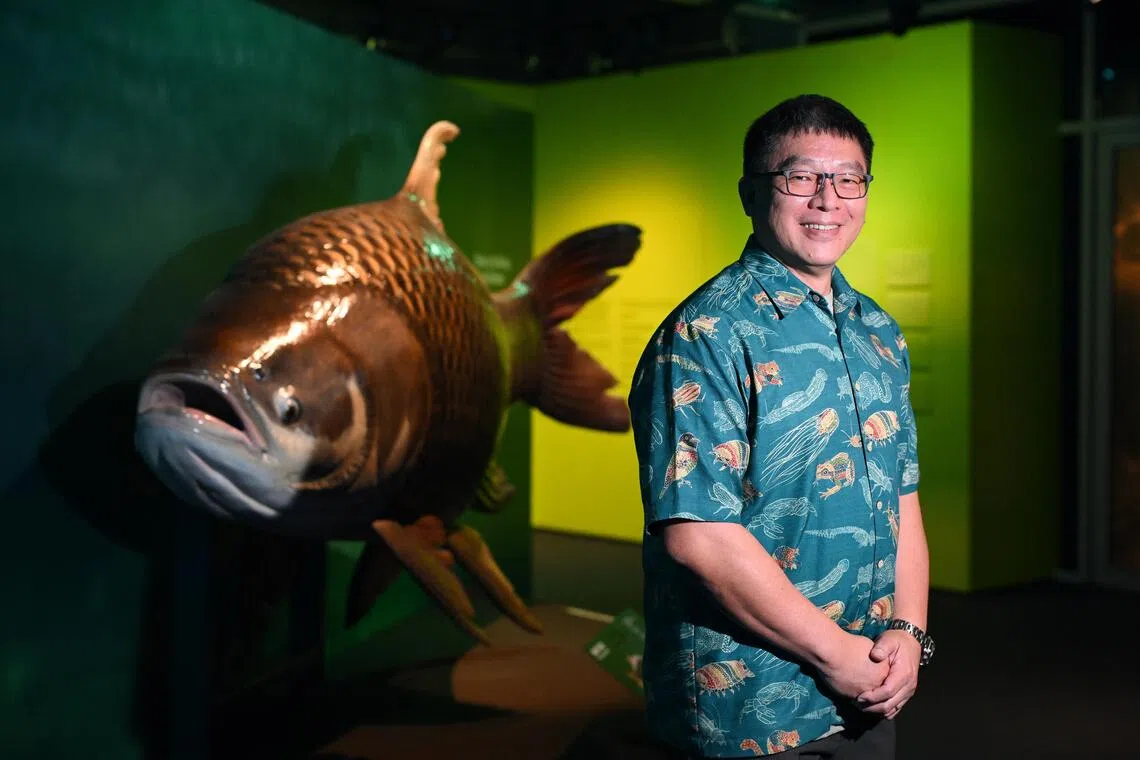
The museum’s fish curator Tan Heok Hui noted that it is challenging to study and track these fish populations because they dwell in waters that can be murky and dangerous.
ST PHOTO: LIM YAOHUI
The idea for the exhibition was conceived during a chat between the museum’s head, Darren Yeo, and Hogan, who has made it his life’s mission to find, study and protect mega-fish.
“Freshwater organisms are known to be disproportionately threatened compared with other species simply because their habitats cover much less area,” said Yeo, who runs the Freshwater and Invasion Biology Lab at NUS.
The exhibition aims to make understanding these species more accessible, he added, noting that their habitats are often difficult to visit in Singapore, where many of these animals live in sensitive forest streams or freshwater swamps.
Upon learning that Hogan had been involved in a National Geographic exhibition that toured the US, Yeo decided to ship part of the showcase to Singapore.
This turned out to be a greater logistical challenge than initially thought, he said, citing how the life-size fibreglass sculptures had to be shipped from the US by container vessel – a journey that took more than a month.
Recounting the process, the museum’s assistant head, Tan Swee Hee, said: “It was quite a long and arduous journey. Every day we were just worried about the ship arriving safely. I was also tracking typhoons in the Pacific.”
Through the exhibition, the curators also hope to raise visitors’ awareness of the pernicious effects of releasing non-native fish, including several of these mega-fish species, into local waters.
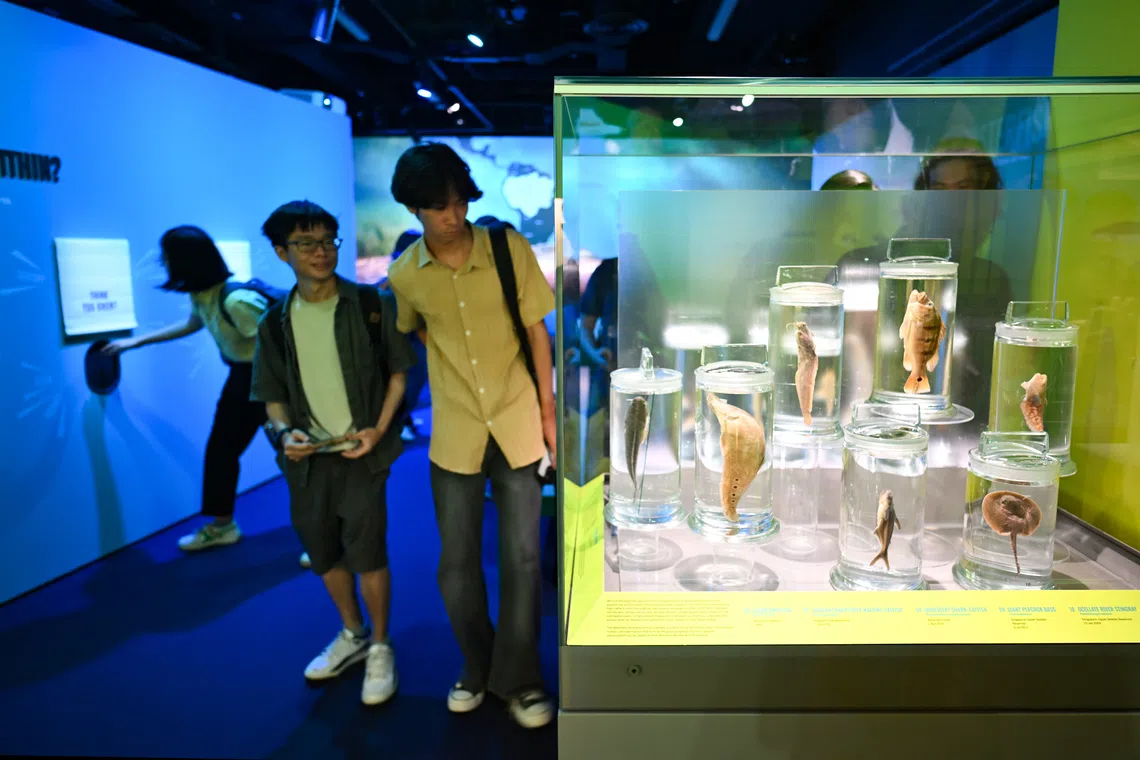
This marks the museum’s first exhibition dedicated to freshwater biodiversity.
ST PHOTO: LIM YAOHUI
Unfortunately, there has been a growing trend of mega-fish appearing in Singapore’s waterways, with more observations of their presence, said Tan Heok Hui.
This is partly because rearing such fish, a hobby once confined to well-heeled aquarists, has become more affordable, he noted. Some species now sell for as little as $20 to $30.
While Singapore’s largest native fish, the striped snakehead (Channa striata), can grow up to about a metre in length, it is dwarfed by the introduced arapaima, a South American species in the pet trade that can reach 4.5m.
These introduced giants are unlikely to reach their maximum size, as Singapore lacks the large rivers necessary to support fish of that scale, Tan added.
However, introduction of foreign species can compete with native fish for food and habitat space.
Yeo said: “It doesn’t necessarily mean that non-native species are doing anything bad; sometimes we don’t have the data yet. But it’s still a potential threat.”
The exhibition runs from Nov 17, 2026, to June 27, 2027.
Tickets to the museum and the special exhibition are priced at $18 for adults and $10 for children who are Singapore citizens or permanent residents, as well as eligible work pass holders. Visitors can purchase admission through the museum’s website.
KioskNews shows a cleaned-up reading view extracted from the publisher’s page — the original always lives on their site, not ours.