New MSF unit analyses data from police, CNB and other agencies to flag child abuse earlier
SINGAPORE – A new government unit has been set up to better detect and prevent child abuse by connecting the dots between information about families with child protection concerns held by law enforcement and other agencies.
In its first two months of operations, the SAFER (Sensemaking Alerts for Frontline Engagement and Response) Unit at the Ministry of Social and Family Development (MSF) has surfaced about 600 cases for further review.
It then flagged 70 cases to the ministry’s Protective Service (PSV), which manages high-risk abuse cases, and child protection case management agencies to step up support for the families involved.
Of the 70 cases, one case was previously unknown to MSF or other agencies, while most of the other cases were already known to the authorities over concerns such as abuse and neglect.
But new developments in these cases, such as a parent’s arrest for drug offences or police reports about family members, prompted a closer look at plans to keep the children safe.
An MSF spokesperson said it is focusing on children under seven for a start as young children are particularly vulnerable and less able to recognise, articulate or report harm.
The SAFER unit, officially launched on Sept 22, is one of the ministry’s initiatives to strengthen the child protection system in the wake of Megan Khung’s death.
Megan was four years old when she died in 2020 after being abused by her mother and her former boyfriend for over a year, in a case that drew public scrutiny and numerous questions in Parliament.
An independent review of her case found multiple breaches across agencies, including an officer from the Child Protective Service (CPS) – now known as the PSV – who failed to log a call by Megan’s pre-school seeking help and police officers not following processes.
None of the agencies were also able to piece together the various calls or information provided to form a fuller picture of the danger that Megan was in until it was too late.
SAFER is designed to address this gap.
For a start, the unit will include information from the Central Narcotics Bureau, the police and MSF agencies, such as case records from the National Anti-Violence and Sexual Harassment Helpline (NAVH) and pre-school data from the Early Childhood Development Agency, on families with children below seven where there are child protection concerns.
The unit is currently manned by a “handful” of staff with experience in managing abuse cases.
The MSF spokesperson said it would analyse data relevant to assessing a child’s safety and well-being such as pre-school attendance records, pre-school withdrawals, offences involving a child as a victim of harm, and drug and sexual offences.
Currently, SAFER uses a risk algorithm based on data analytics to combine information from available datasets, including any risk events or recent stressors, to assess the family’s potential needs and how they can be supported, the spokesperson added.
Any potential child protection concern is reviewed by trained professionals, who check against available case facts, consult existing case managers, and apply professional judgment before escalating the concern.
Social workers interviewed by The Straits Times say the new unit gives social service and child protection staff a better idea of what is happening in the family and the risk of harm to the child, so that they can reassess cases in the light of new developments.
Connecting these disparate pieces of information is key as the family may not reveal or may even lie about what is going on at home, they said.
For example, a parent may have been arrested for drug offences, but family members keep mum about this, though drug addiction poses safety concerns for a child.
One case SAFER flagged illustrates how the system works.
A family, which has more than three children, including two who were not attending pre-school regularly, had a history of neglect and had previously come under PSV’s watch. Neglect is when a parent fails to provide the child with the basic necessities or adequate supervision.
Both parents were arrested for drug offences, but did not disclose this to the staff from the family service centre (FSC) who visited the home in July.
The case worker also did not observe any drug-related concerns, or concerns over the children’s safety during their interactions. SAFER, however, was alerted to the parents’ arrest and this prompted PSV to reassess the case.
PSV is supporting the family and has put in place appropriate intervention and plans to keep the children, who are still cared for by family members, safe.
The MSF spokesperson said it hopes to expand SAFER to include information from more government agencies in time to come.
Addressing the media last week at the MSF building at Thompson Road ahead of the official launch of SAFER, Senior Minister of State for Social and Family Development Goh Pei Ming said: “The sooner concerns are identified and acted on, the better the chances of keeping our children safe and supporting families...
“With SAFER, while we cannot prevent every future instance of abuse, it will certainly reinforce our ability to identify high-risk cases and provide more timely support where needed.”
Goh stressed that SAFER supports, but does not replace the professional judgment exercised by child protection officers and social service professionals.
Upon receiving an alert from SAFER, PSV would do the necessary risk screening and information gathering, and assess which agency should manage the case within a target of three working days, the MSF spokesperson said.
If there are immediate safety concerns, the Domestic Violence Emergency Response Team would be sent promptly to see to the family.
The MSF said Megan’s case would have been identified for review about five months before her death in February 2020 under the SAFER model. SAFER would have been alerted when Megan was withdrawn from her pre-school in September 2019, and would have flagged her case for review.
Her pre-school would also have reported her injuries to the NAVH – which did not exist then – and SAFER would have been aware of the case under new protocols.
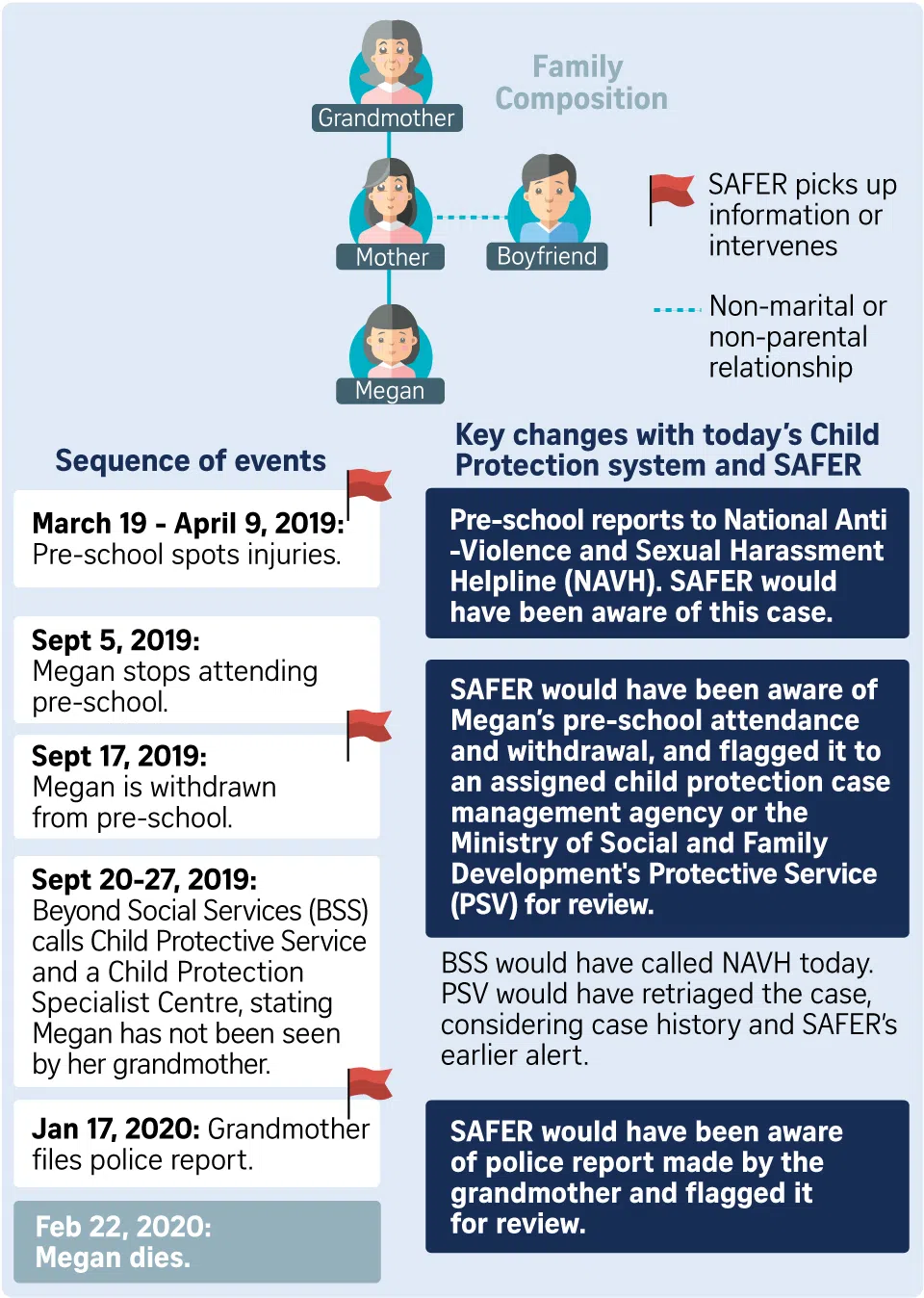
Since the independent review panel’s report on Megan’s case was released in October 2025, MSF has largely implemented the panel’s recommendations. MSF said that remaining measures requiring additional resources, such as the review of the funding structure for agencies that manage child protection cases, will be fully implemented in 2027.
Among the implemented recommendations is the formation of an independent panel of experts, called the Triage Assessment Panel. The panel will resolve disagreements between agencies over how best to protect a child, including when they differ over the level of risk the child faces.
Today, only agencies with relevant expertise are allowed to manage child abuse cases. These agencies are called child protection case management agencies, and there are 82 of them, including FSCs, child protection specialist centres and children’s homes.
A police spokesperson told ST that SAFER does not replace existing information-sharing protocols. For example, when the police receives information that a child may have been abused or needs protection, established protocols are already in place to notify MSF.
A SAFER alert, by itself, does not mean that child abuse has occurred or that protective intervention is required, said the spokesperson.
Officers have to assess and review the alerts before escalating the case for further action if there are child protection concerns.
The MSF spokesperson said that access to SAFER data is restricted to authorised personnel and it is governed by applicable laws, government data security policies and technical controls.
“This ensures that data is only accessed and used for authorised purposes, maintaining confidentiality and public trust.”
KioskNews shows a cleaned-up reading view extracted from the publisher’s page — the original always lives on their site, not ours.