Ten years after demonetisation, cash remains king despite India’s digital payments boom
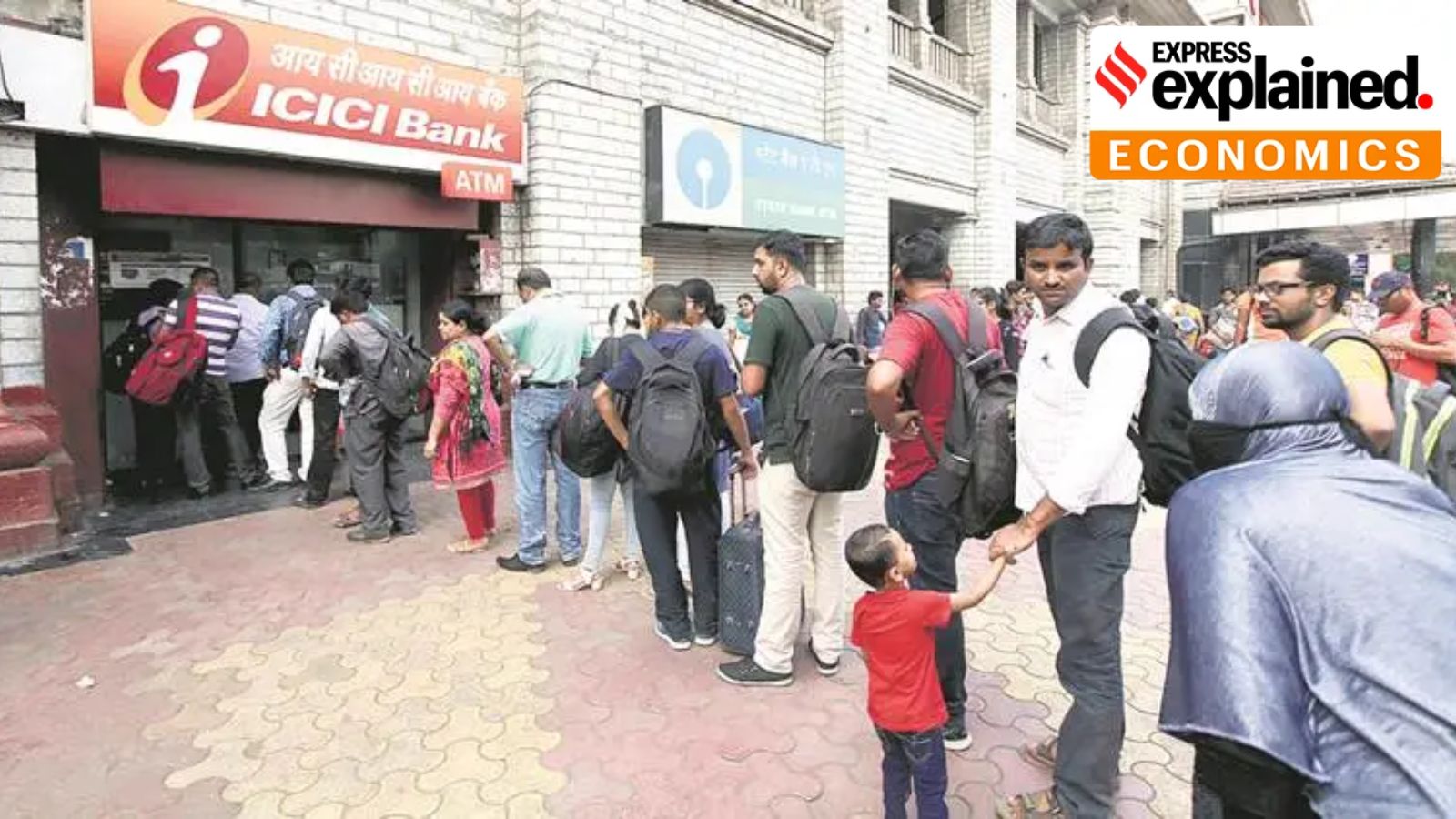
Ten years ago, on November 8, the Modi government announced the demonetisation of high-value currency notes of Rs 500 and Rs 1,000 in a dramatic bid to curb black money and push India towards a cashless economy. A decade later, however, cash remains king, with currency held by the public having more than doubled since demonetisation.
Currency with the public, which stood at Rs 17.97 lakh crore on November 4, 2016, plunged to Rs 7.8 lakh crore in January 2017 following the November 8 announcement. It has since surged to Rs 42.55 lakh crore as of October 15, 2026, according to Reserve Bank of India (RBI) data, an increase of nearly 137 per cent over its pre-demonetisation level.
Though digital payments have jumped manifold, high cash holdings raise questions about the lasting impact of demonetisation on India’s dependence on physical currency. While the economy has expanded considerably over the past decade, growing at 6-7 per cent annually in several years, the currency-to-GDP ratio has also returned to around its pre-demonetisation level. In other words, despite the massive push towards digital payments and formalisation, cash has not been driven out of the economy. Instead, its circulation has recovered alongside economic growth.
The big announcement
Prime Minister Narendra Modi announced demonetisation at 8 pm on November 8, 2016, in a televised address to the nation. The announcement rendered the then-existing Rs 500 and Rs 1,000 notes invalid as legal tender from midnight on November 8. These two denominations together accounted for approximately 86 per cent of the currency in circulation at the time, triggering an unprecedented cash crunch that disrupted shops, offices, businesses and households across the country.
The government had projected demonetisation as a decisive strike against black money, counterfeit currency and the financing of illegal activities. It was also expected to accelerate digital payments, encourage formalisation and reduce India’s dependence on cash. Ten years later, however, the more than doubling of currency with the public tells a different story: demonetisation may have temporarily drained cash from the system, but it did not fundamentally alter India’s appetite for physical currency.
What was the impact?
The sudden withdrawal of notes roiled the economy in November 2016, with demand falling, businesses facing a crisis and GDP growth declining by nearly 1.5 percentage points. Many small businesses were hit hard and shut down after the note ban created a liquidity shortage. The shock of suddenly invalidated high-denomination notes disrupted daily commerce, forced people to queue for hours at banks and ATMs, and pushed individuals and businesses to rethink how they managed cash.
In the years that followed, the printing of new Rs 500 and Rs 2,000 notes (the latter was subsequently withdrawn from circulation), increased cash holdings and a persistent preference for cash across large parts of the economy drove the stock of currency with the public to levels well above the pre-demonetisation norm.
Story continues below this ad
Cash holdings rose particularly sharply in 2020-21, primarily driven by a rush to hold cash as the government announced a stringent lockdown to tackle the spread of the Covid-19 pandemic. People began accumulating cash to meet their grocery needs, which were largely met by neighbourhood stores, and other essential expenses, including medical bills.
What’s currency with the public?
As per the RBI’s definition, currency with the public is calculated by deducting cash held by banks from total currency in circulation (CIC). CIC refers to currency notes and coins issued by the central bank within a country that are physically used to conduct transactions between consumers and businesses.
During the calendar year 2026 as of October 16, cash with the public increased by Rs 5.26 lakh crore, a rise of 14.1 per cent, according to RBI data.
How the currency to GDP ratio has changed
The rise in currency in circulation in absolute terms does not tell the full story, as GDP growth has remained strong and even touched 7.8 per cent in the first quarter of FY2026.
Story continues below this ad
Since demonetisation in 2016, currency in circulation has risen steadily every year, with the CIC to GDP ratio having surged to 14.4 per cent in 2020-21 from 8.7 per cent in 2016-17. The ratio remained at 12.1 per cent in FY26 as against 12.1 per cent in March 2016.
However, when compared with other countries, the ratio is over 16 per cent in Japan, 7.3 per cent in the US, where the dollar also circulates internationally, and 10.2 per cent in China.
A high CIC-to-GDP ratio indicates that people and businesses rely heavily on cash for transactions, while a lower ratio reflects a shift towards digital payments, banking channels and formal financial systems. On the other hand, a lower CIC-to-GDP ratio, driven by increased digitalisation and reduced reliance on cash, generally enables smoother monetary policy transmission and better inflation control, experts say.
India’s currency-in-circulation-to-GDP ratio is relatively high compared with those of the US and China, but lower than Japan’s. However, a high ratio, while indicating greater dependence on physical cash, does not necessarily mean an economy is less developed or less financially sophisticated.
Cash is still king despite digitisation
Story continues below this ad
Although the government and the RBI have pushed for a “less cash society”, promoted the digitisation of payments and imposed restrictions on the use of cash in various transactions, cash in the system has remained high. India’s total digital payments in FY2025–26 amounted to Rs 3,251.04 lakh crore, covering RTGS, retail bank transfers, card payments and prepaid payment instruments.
During FY2025–26, credit card, debit card and wallet transactions together accounted for approximately 151,611 lakh transactions, with a combined transaction value of Rs 30.31 lakh crore, RBI data shows. Credit cards dominated in terms of value, recording transactions worth Rs 23.62 lakh crore across 60,238 lakh transactions. Debit card transactions amounted to Rs 4.45 lakh crore, with a volume of 12,802 lakh transactions, while wallet transactions recorded the highest volume among the three instruments at 78,571 lakh transactions, amounting to Rs 2.23 lakh crore.
In FY2015–16, India recorded 10,038.67 million (approximately 1,003.87 crore) credit and debit card transactions, with a combined transaction value of Rs 29.39 lakh crore. Debit cards accounted for Rs 26.96 lakh crore, while credit cards contributed Rs 2.43 lakh crore.
The data highlight the growing role of electronic payment instruments in India’s financial ecosystem. Credit cards accounted for approximately 78 per cent of the combined transaction value of credit cards, debit cards and wallets during FY2025–26, reflecting their greater use for higher-value purchases. Debit cards contributed around 14.7 per cent of the value, while wallets accounted for the remaining 7.4 per cent. In terms of transaction volume, wallets dominated with a 51.8 per cent share, followed by credit cards at 39.7 per cent and debit cards at 8.4 per cent, reflecting their popularity for frequent, relatively low-value transactions.
Story continues below this ad
Overall, the figures underline the growing adoption of digital payment instruments and the evolving preferences of consumers towards convenient cashless transactions.
KioskNews shows a cleaned-up reading view extracted from the publisher’s page — the original always lives on their site, not ours.