Foreign exchange reserves drop, central bank reports
By Chen Cheng-hui / Staff reporter


The nation’s foreign exchange reserves decreased by US$1.159 billion to US$600.745 billion last month from the previous month, the central bank said in a statement yesterday.
The decline in foreign exchange reserves was mainly due to the strengthening US dollar and the central bank’s intervention in the foreign exchange market by selling US dollars and buying New Taiwan dollars to cap the local currency’s depreciation, it said.
It aligned with the situation in Japan in August, when the nation’s foreign exchange reserves fell below the US$1 trillion mark, down US$94.6 billion month-on-month to US$995 billion, as Japanese authorities intervened in the foreign exchange market to support the yen, the central bank said.
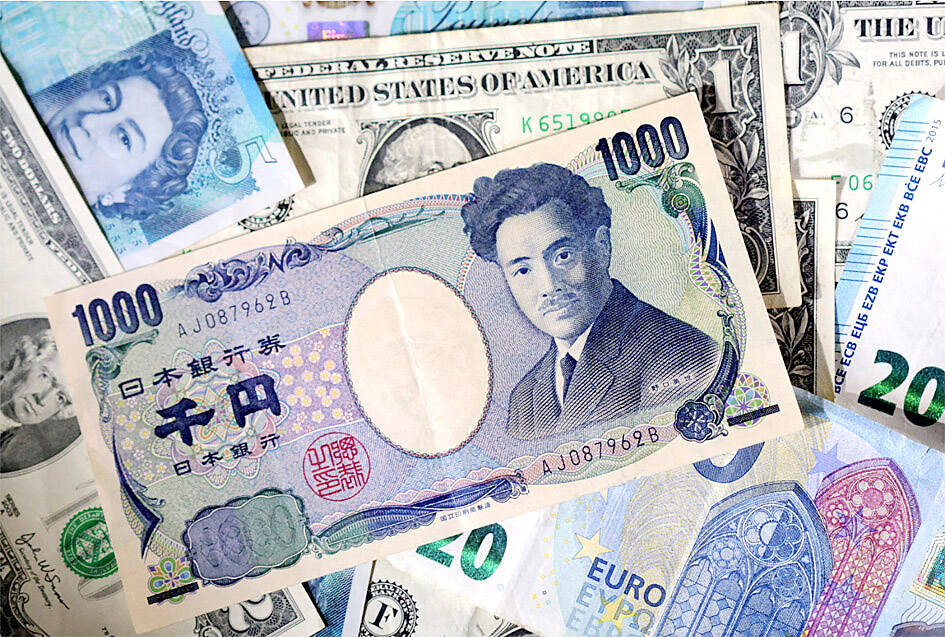
US dollar, euro, yen and British pound banknotes are pictured on May 4 last year.
Photo: Reuters
Last month, the US dollar index rose 2.03 percent, while other major non-greenback currencies except the yen declined, weighing on the central bank’s portfolio when the amount was converted into US dollars, an online report by the Chinese-language Liberty Times (the sister newspaper of the Taipei Times) yesterday quoted Department of Foreign Exchange Director-General Eugene Tsai (蔡?民) as saying.
The euro lost 2.23 percent, the British pound declined 2.34 percent, the Canadian dollar weakened 2.17 percent and the Australian dollar was down 2.76 percent, while the yen advanced 1.87 percent and the yuan appreciated 0.25 percent, central bank data showed.
The NT dollar fell 0.69 percent against the US dollar last month, as foreign investors posted net outflows of about US$2.3 billion, Tsai said.
Looking ahead, foreign fund flows and local exporters’ US dollar holdings, as well as overseas investments by Taiwanese individuals and businesses, all have an impact on the movements of the NT dollar, he said, adding that the central bank would act according to market conditions to avoid excessive fluctuations in the NT dollar.
As for the yen exchange rate, whether the Bank of Japan would raise rates further and if the Japanese authorities would intervene in the market again are key factors to the currency’s future movements, he said.
It also depends on global capital flows and overseas asset allocation by Japanese investors, he added.
Meanwhile, the market value of securities investments and NT dollar-denominated deposits held by foreign institutional investors rose to US$1.927 trillion last month, equivalent to 321 percent of foreign exchange reserves, compared with US$1.861 trillion and a ratio of 309 percent the previous month, central bank data showed.
A 3.92 percent rise in the TAIEX last month reflected the increase in these foreign holdings, the central bank said.
KioskNews shows a cleaned-up reading view extracted from the publisher’s page — the original always lives on their site, not ours.