Cabbies, PHV drivers can take up bus driver jobs by signing up for new training programme from Oct 1
SINGAPORE – Cabbies and private-hire drivers keen to make the transition into a career as bus drivers can sign up for a programme from Oct 1 that will help them adapt to a fast-changing transport sector being reshaped by technology.
The programme will be offered part-time or full-time, and last two to six months, including on-the job training and building related skills such as in the field of electric vehicle diagnostics or bus interchange operations.
Trainees will have the flexibility to juggle their work and personal or caregiving responsibilities while completing the course.
Speaking to the media during a visit to the Singapore Bus Academy at Ulu Pandan Bus Depot on Sept 28, Senior Minister of State for Transport Sun Xueling said while technology has made transport more accessible and convenient for commuters, it also impacts jobs.
“That is why we are preparing in advance. We want to make sure that as we transform the industry, we are also helping our workers at the same time,” she said.
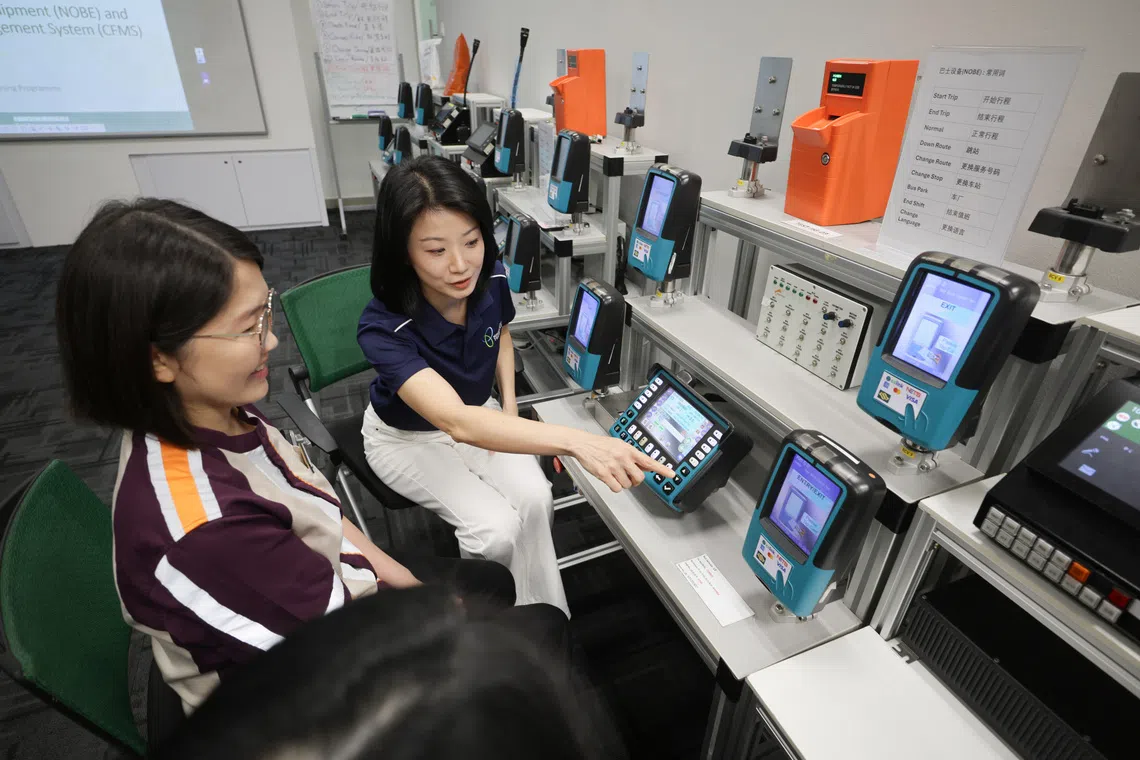
Kit Peng Lee (left) demonstrating the fare reversal for commuters that boarded the wrong bus to Sun Xueling Senior Minister of State for Transport on Sept 28.
ST PHOTO: GIN TAY
When asked if this programme was something that point-to-point drivers had asked for, Sun said many workers had concerns about autonomous vehicles (AVs) affecting their jobs.
The career conversion scheme is one of several options available, including one for those transitioning to careers as AV specialists.
The scheme, which was first announced in Parliament in July, is part of a driver support package that aims to help drivers anticipate technological advancements while being able to seize new job opportunities.
On Sept 28, the Ministry of Transport, the Skills and Workforce Development Agency, and the National Trades Union Congress (NTUC) said in a joint statement that the career conversion programme will last between two and six months.
Drivers who already possess a Class 4 licence to operate heavy vehicles will be allowed to undergo a shorter training period, it added.
Besides on-the-job training, individuals who take up the scheme will also pick up other skills relevant to their future careers, including electric vehicle diagnostics, as well as managing operations at bus interchanges.
Those interested in making the transition can apply directly with any of the four public bus operators – Go-Ahead Singapore, SBS Transit, SMRT Buses and Tower Transit Singapore.
The joint statement also said the programme complements current efforts to attract and retain local bus drivers, noting that those who choose to pivot their careers will be eligible for the increased starting salaries and higher sign-on bonuses that kick in from Jan 1, 2027, for new local bus drivers.
From that date, the Government will fund a $450 monthly salary increase for new Singaporean and permanent resident bus drivers, along with an additional $2,000 in sign-on bonuses.
In doing so, the average monthly pay for new public bus drivers will increase from about $3,600 currently to more than $4,000, after including overtime pay and allowances.
Existing bus drivers will receive a one-time pay bump instead.
Yeo Wan Ling, who is NTUC’s assistant secretary general, said the unions had worked closely with its tripartite partners to ensure the new career conversion pathway afforded point-to-point drivers flexibility.
“This gives interested drivers another option to broaden their skills and career possibilities, while retaining the flexibility that matters to them,” said the Labour MP, who represents Punggol GRC.
Yeo, who is also advisor to the National Private Hire Vehicles Association and the National Taxi Association, as well as the executive secretary of the National Transport Workers’ Union, added that discussions are ongoing with the bus operators to accommodate flexible work arrangements “so that drivers have the option of balancing bus driving and other work opportunities”.
Aqil Hamzah is a transport journalist at The Straits Times. He is also interested in issues related to crime and technology.
KioskNews shows a cleaned-up reading view extracted from the publisher’s page — the original always lives on their site, not ours.