Black Sea drone attacks enter NATO country's territorial waters for first time
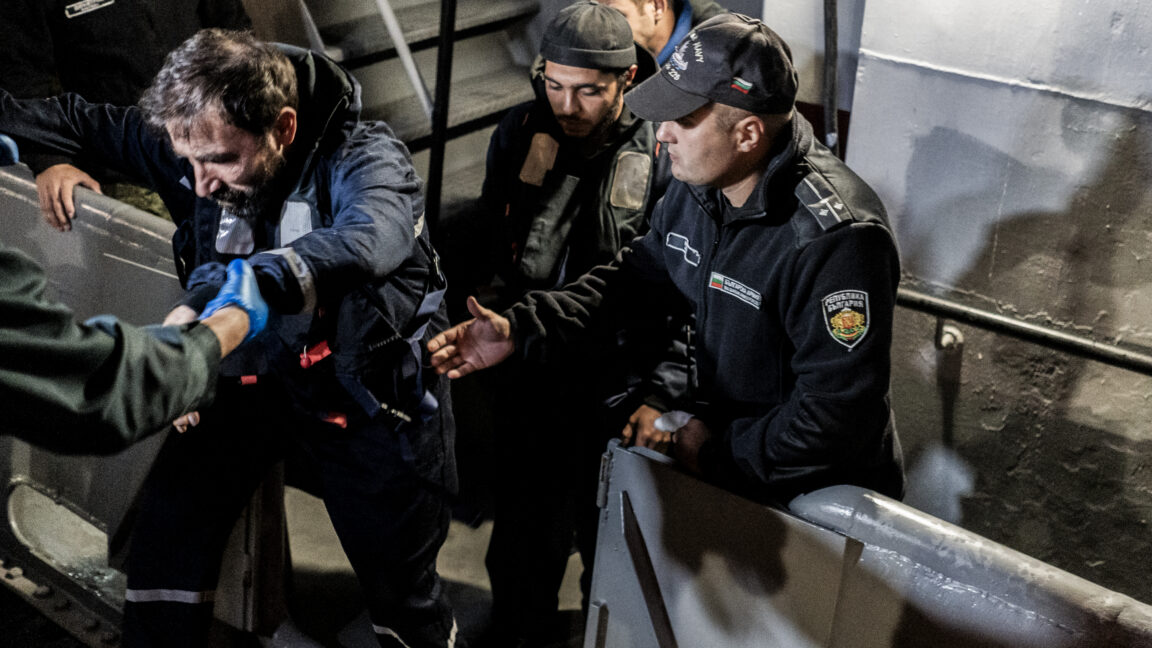
Russian drones are suspected of sinking a cargo ship and leaving chemical tankers ablaze near the Black Sea coasts of Bulgaria and Romania, respectively. The latest attacks mean that at least seven ships have been attacked in the exclusive economic zones of NATO member countries—and even within Romania’s territorial waters if Russian involvement is confirmed in the case of the chemical tankers.
Such attacks have spurred requests for NATO to redeploy counter-drone systems to provide more protection. In a social media post on October 15, NATO Secretary General Mark Rutte stated that NATO had increased “counter-drone capabilities” along the alliance’s eastern flank after meeting with the leaders of Bulgaria and Romania.
The latest attacks this week occurred within 24 hours between October 14 and October 15, when the two chemical tankers were set afire after Russian drones were detected in Romanian airspace, according to Deutsche Welle. Both ships were sitting at anchor near the mouth of the Sulina canal that connects the Black Sea to the Danube River, which has become a crucial shipping export route for Ukraine, Reuters reported.
The Comoros-flagged chemical tanker Yara J was struck within Romania’s territorial waters. All crew members were rescued and accounted for.
However, Romanian authorities are still searching for seven missing sailors after rescuing five people from the San Marino-flagged tanker Wine Trader, according to Reuters. This second tanker was struck while sitting just one mile outside Romanian territorial waters.
Reuters cited an anonymous NATO source as attributing the drone attacks to Russia.
A NATO statement also described a Marshall Islands-flagged bulk carrier named Sea Destiny as also having been targeted inside Romanian waters overnight, along with a Tanzanian-flagged tanker named Dania J coming under attack in the Danube port city of Izmail in Ukraine. But there were no immediate details about damage or casualties.
This comes just days after suspected Russian drone attacks sank a cargo ship and forced the evacuation of another vessel within two dozen miles of the coast of Bulgaria in the Black Sea on October 13. Those attacks occurred within Bulgaria’s exclusive economic zone.
One of the cargo ships that came under attack was the Ukrainian-operated coastal freighter Chelsea 3, registered under the flag of Malta. Bulgarian Prime Minister Rumen Radev told the Russian ambassador in Sofia that “it makes no sense for Ukraine to destroy its own ships in the Black Sea, and the results of these strikes favor Russia’s interests,” according to The Associated Press.
All 15 members of the Ukrainian-owned Chelsea 3 were safely evacuated by Bulgarian rescue operations after the ship was reportedly struck by three aerial drones.
But authorities were still searching for 11 missing crew members of the Guinea-Bissau-flagged cargo ship Dignity, which sank after coming under attack, The Associated Press reported. Five mariners were initially rescued from that ship.
Pattern of attacks and countermeasures
These incidents mark the latest in a growing series of unprecedented attacks on Black Sea shipping in the exclusive economic zones of NATO countries. One week earlier, aerial and sea drones sank the Togo-flagged cargo ship Alfa Watan and left the Palau-flagged cargo ship Able afire about 80 miles (128 kilometers) off the coast of Bulgaria on October 6.
The 18 crew members of the Able were rescued—two required hospitalization—but the 10-member crew of the Alfa Watan has been presumed dead after rescuers failed to find any survivors.
Such incidents first began when the Turkish-owned cargo ship Royad Mammadov came under drone attack and eventually sank near Romania’s Black Sea coast on October 5. All 11 crew members were rescued.
In response to the attacks, Bulgaria has stepped up cooperation with affected NATO member countries and the alliance as a whole. On October 14, Bulgarian Defense Minister Dimitar Stoyanov told the national parliament that the country would join NATO’s Drone Edge initiative that includes member countries committing a total of $40 billion toward developing more counter-drone capabilities over the next five years, according to independent news publication The Sofia Globe.
NATO officials began examining the possibility of moving existing anti-drone countermeasures to the region after receiving requests from Bulgaria, Romania, and Turkey, diplomats told Politico. The three countries are also cooperating on an initiative to safeguard freedom of navigation in the Black Sea, which Bulgaria Prime Minister Radev plans to present to the European Union this week.
Black Sea restrictions and warfare
Naval forces from NATO countries have avoided military exercises in the Black Sea since Russia launched its full-scale invasion of Ukraine in 2022, in accordance with the 1936 Montreux Convention that grants Turkey authority to restrict passage of ships through the straits leading into the Black Sea. This Turkish enforcement has also prevented Russia from reinforcing or rotating its Black Sea fleet during the war.
Despite lacking much of a conventional navy, Ukraine has managed to largely neutralize Russia’s warships and disrupt Russian-linked shipping and ports by using aerial and sea drones. But Russia has countered with its own drone attacks on Ukrainian ports and vessels, along with sometimes targeting ships from other countries in the region.
Since the fall of 2023, Ukrainian ships have typically stuck to sea lanes running through Romanian, Bulgarian, or Turkish territorial waters in the Black Sea, according to the Carnegie Endowment for International Peace. Such Black Sea shipping is especially crucial for Ukraine’s agricultural exports of grain, accounting for well over 90 percent.
The recent spate of probable Russian attacks in the Black Sea is now disrupting shipping carrying Ukraine’s latest harvest to the rest of Europe, with some cargo being rerouted overland or through the River Danube, Politico reported.
These unprecedented attacks in waters near NATO countries coincide with a growing wave of incidents attributed to Russian hybrid or gray-zone warfare tactics. Such incidents include an attempted explosive drone attack on Ukrainian cargo aircraft at Leipzig Airport in Germany and a Russian drone boat loaded with explosives found floating near a Romanian offshore gas platform in the Black Sea.
But since the start of the war, Turkey, Romania, and Bulgaria have continued upgrading their navies while forging closer cooperation on maritime security, according to Carnegie. The growing dangers for shipping in the Black Sea will likely accelerate this cooperative trend—and for the NATO alliance as a whole.
This article was updated on October 15 with news of the latest attacks on chemical tankers near and within Romania’s territorial waters, and NATO’s response.

Jeremy Hsu is a reporter exploring a wide range of topics across deep tech and AI. He has previously written for New Scientist, Scientific American, IEEE Spectrum, Wired, Undark Magazine and MIT Tech Review, among many other publications, about topics such as deepfakes, data centers, drones, battery tech, robotics, and GPS jamming. He also has a Master of Arts in Journalism from NYU, and a bachelor's degree from University of Pennsylvania in History and Sociology of Science, with a minor in English.
KioskNews shows a cleaned-up reading view extracted from the publisher’s page — the original always lives on their site, not ours.