Tiny, soft robot glows green as it stretches its limbs
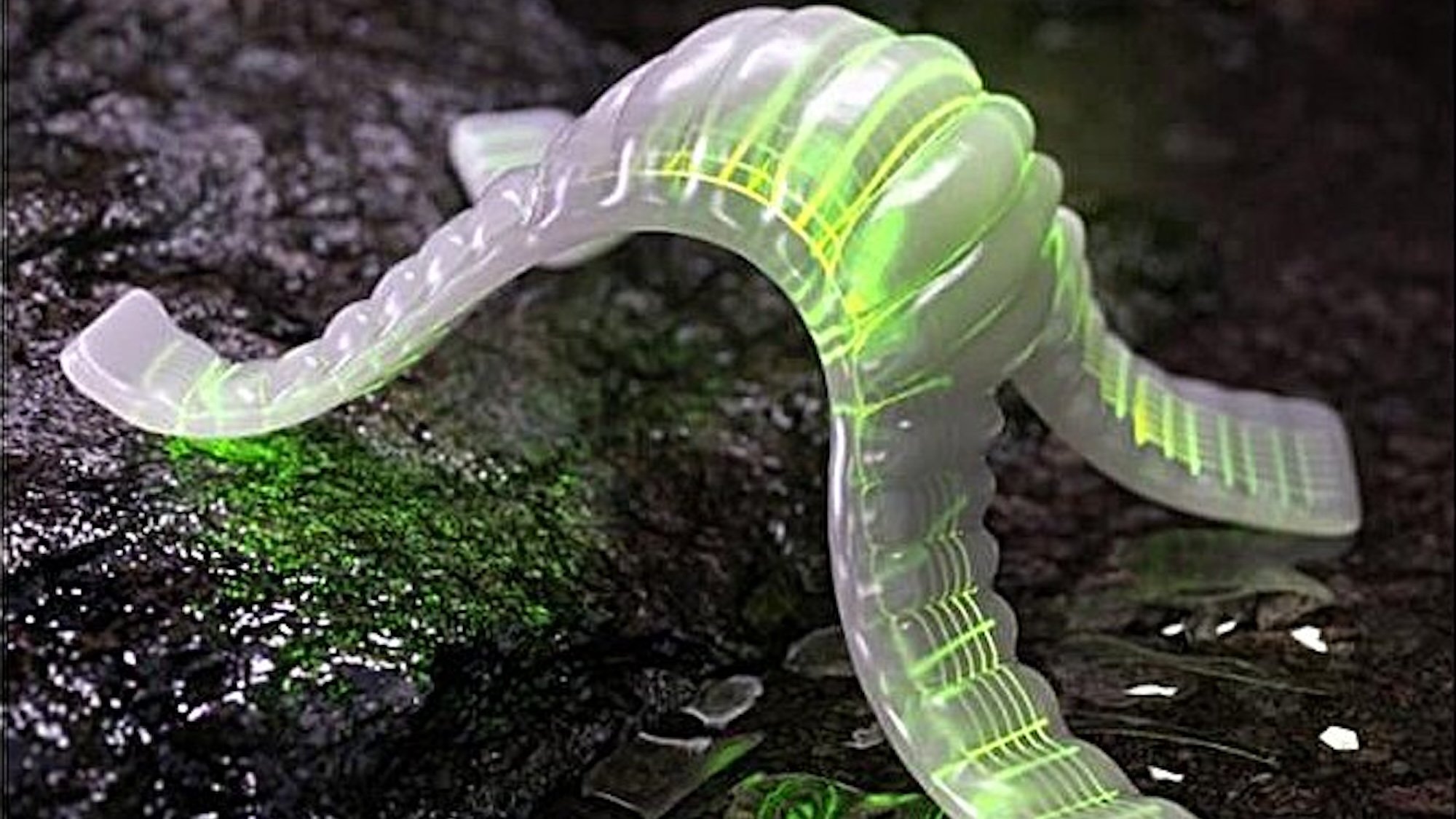
A tiny, four-limbed soft robot resembling the cross between an octopus and an earthworm does more than inch across difficult terrain. With a process known as mechanoluminescence, the device glows as it moves and stretches without the need for external batteries or electronics. It’s not flimsy, either. Writing in a study recently published in the journal Small Structures, the soft robot’s inventors explained their design maintains its illuminating abilities after more than 1,000 stretching cycles.
At South Korea’s Daegu Gyeongbuk Institute of Science and Technology (DGIST), engineer and study co-author Soon Moon Jeong believes the underlying dynamics at play are a promising new way to analyze and pinpoint deformations in a soft robot. It’s also potentially even more effective than existing softer options, since it doesn’t require additional components that might otherwise restrict the device’s movement.
Jeong’s team first designed a thin but resilient “tubular mechanoluminescent fiber” made from glowing particles of zinc sulfide and flexible polymers. They then filled elastic silicone tubes with the mixture, and wove them together into a mesh-like case for their pneumatic soft robot model. As the robot’s limbs stretch and contract, the zinc sulfide-infused polymer filling glows bright green specifically in the areas undergoing stress. Laboratory testing indicated their novel fibers withstood being pulled over twice their original length, and kept glowing after over 1,000 exercises.

Soft, glowing robot
Jeong said his team is now focusing on improving the robot’s light emissions and resiliency. If successful, their mechanoluminescent fibers may be used in wearable medical devices or even artificial skins.
“The woven fiber-network configuration provides qualitative visual indication of deformation over the robotic body, offering a simple strategy for realizing self-visualizing soft robotic systems,” wrote the study’s authors, adding that their invention showcases the potential foundations for “next-generation self-visualizing intelligent soft systems.”
KioskNews shows a cleaned-up reading view extracted from the publisher’s page — the original always lives on their site, not ours.