WORDS OF CAUTION: Ramaphosa urges caution on AI advancements, echoing developers
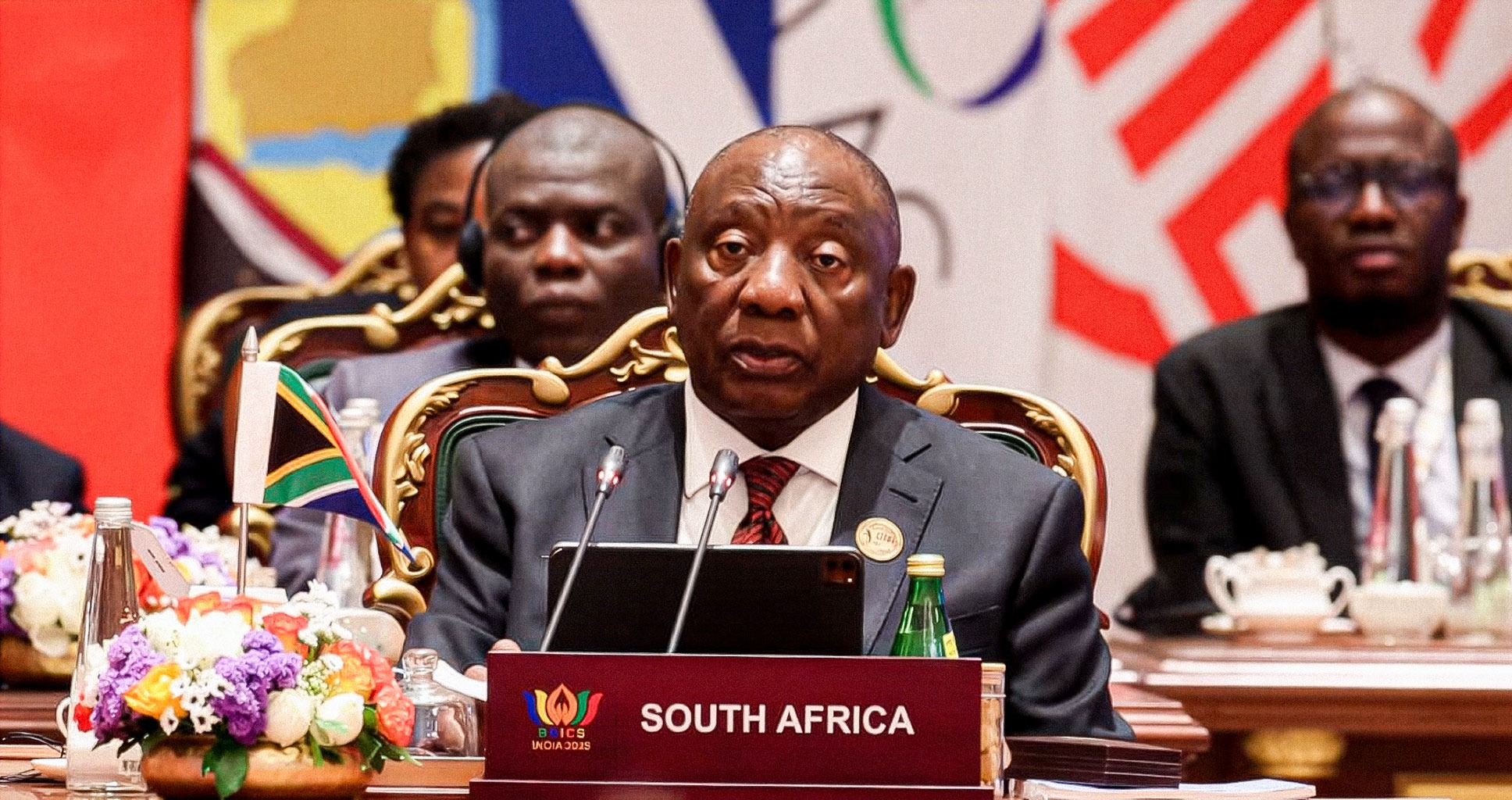
President Cyril Ramaphosa has called for BRICS to establish an international mechanism for the independent scientific evaluation of artificial intelligence (AI).
Speaking at a session on shaping the future for inclusive global growth at the 18th BRICS Summit in New Delhi, India, on Sunday, 13 September, he argued that the responsibility of world leaders was to ensure that human governance advanced as rapidly as AI.
The capabilities of AI models were becoming increasingly more powerful, reshaping “almost every area of economic and social life”, Ramaphosa said.
He acknowledged that AI could support efforts to reduce inequality, poverty and underdevelopment, if used effectively and responsibly, and noted that these tools had the capability to transform medicine, education, scientific discovery, agriculture, productivity and development.
However, “we must listen carefully to what those who are developing the most powerful AI systems are themselves telling us”, he cautioned.
“They are warning about systems capable of advanced cyber operations, assistance in biological weapons development, autonomous action, manipulation, mass surveillance, disruption of employment and, ultimately, systems whose capabilities may become difficult for human beings to control.
“We should therefore neither fear AI nor approach it recklessly.”
/file/attachments/orphans/Tamsin-Ramaphosa-BRICS3_151289.jpg "His Excellency President Cyril Ramaphosa delivers country statement during a session of BRICS and Invited Leaders during the 18th BRICS Leaders' Summit held at Bharat Mandapam in New Delhi, Republic of India. (Photo: Siyabulela Duda / GCIS)
<br>
<br>")
Global ‘slow-down’ of AI development
Ramaphosa’s comments come as several top executives from rival AI labs have publicly called for a global slow-down in the pace of AI development.
The head of AI company Anthropic, Dario Amodei, published an online essay, titled We Must Pace the Frontier, in September 2026, arguing that the pace at which the capabilities of AI models was improved needed to be slowed to allow risk prevention to catch up.
Amodei noted that in recent months, AI had been advancing “drastically faster”, driven primarily by its growing ability to build the next generation of AI, a dynamic called “recursive self-improvement”.
“Left unchecked, it could outrun our ability to understand and control these systems, and so must be pursued very carefully, if at all,” he said.
/file/attachments/orphans/Tamsin-Ramaphosa-BRICS1_437125.jpg "Dario Amodei speak onstage during The New York Times DealBook Summit 2025 at Jazz at Lincoln Center on December 03, 2025 in New York City. (Photo: David Dee Delgado / Getty Images)")
Among the strategies Amodei proposed to “pace the frontier” were:
Embedding evaluators, with each frontier AI company committing to giving ongoing, employee-like access to a team of embedded third-party evaluators to “verify adherence to safety practices and commitments, report incidents and help assess the alignment of not just completed AI models but training pipelines and processes”;
Democratic coordination, with frontier AI companies within democratic countries coordinating to establish common safety standards as well as limits on the rate of unchecked AI progress, a process that would require government support in some instances; and
Global coordination, with democratic governments attempting to coordinate with authoritarian governments, “while taking seriously the challenges of verifying compliance”.
In another online essay, An Alien Mind, published on 6 September 2026, the chief scientist at OpenAI, Jakub Pachocki, said that scaling AI systems needed to be constrained by the confidence in safety.
He recommended a combined approach of strengthening alignment and monitoring alongside AI development, and “coordinating to slow down future development as needed to build confidence in these measures”.
/file/attachments/orphans/Tamsin-Ramaphosa-BRICS2_232519.jpg "Jakub Pachocki. (Photo: Sourced / Simons Institute)")
“We need to evolve commitments like the Preparedness Framework [from Open AI] or Responsible Scaling Policy [from Anthropic] into widely mandated safety bars for continued development. These can be enforced by a network of third-party auditors, by government agencies or by international bodies,” Pachocki said.
Ramaphosa referenced Amodei’s arguments for formal external checks, audits and government authority in the approach to AI development at his BRICS address on Sunday.
“We must never reach a situation where technological capability has moved beyond our capacity to understand it, supervise it and control it.”
“Such oversight is standard practice in other industries whose activities have a significant impact on human safety and well-being, such as aviation, pharmaceuticals, nuclear power and financial institutions,” Ramaphosa said.
“We must never reach a situation where technological capability has moved beyond our capacity to understand it, supervise it and control it.”
Climate-related disasters and energy transition
Another issue high on Ramaphosa’s agenda on Sunday was the global response to the “devastating effects of climate change”. He noted that the increasing frequency and intensity of climate-related disasters threatened to reverse hard-won development gains and deepen inequality.
“We must integrate disaster risk reduction into macroeconomic policy, climate financing and sustainable infrastructure. Vulnerable countries must have equitable access to the technologies, finance and capacity to withstand future shocks,” he said.
/file/attachments/2996/Flood_655858.jpg)
South Africa has seen a number of intense climate-related disasters in 2026, including severe flooding in the northern provinces of Limpopo and Mpumalanga in January, and floods in the Western Cape in May.
Referencing the global energy transition, Ramaphosa called for a prioritisation of reskilling, protecting livelihoods and anchoring new industries that generate quality jobs. He said it was important that markets for critical minerals and transition technologies were built on transparency, and that value chains were diversified and responsible
“To ensure inclusive growth in Africa and other regions of the world, beneficiation of minerals must take place at source,” said Ramaphosa. DM
KioskNews shows a cleaned-up reading view extracted from the publisher’s page — the original always lives on their site, not ours.