Rs 25,000 vs Rs 40,000 EMI: How Much Difference Does Your Home Loan Tenure Make?

A home loan EMI of Rs 25,000 may appear easier on the monthly budget than one of Rs 40,000. But the difference between the two repayment amounts can have a significant impact on how long a borrower remains in debt and how much interest eventually goes to the bank.
For homebuyers, the decision is not simply about choosing an affordable EMI. It is also about understanding the long-term cost of borrowing.
Munish Jain, Chief Business Officer - Home Loans, Capri Loans, told NDTV that the impact of choosing a lower or higher EMI depends on the loan amount, interest rate and the borrower's cash-flow comfort. A higher EMI generally reduces the repayment tenure and overall interest burden, while a lower EMI offers greater monthly flexibility.
Also Read | Layoffs Are Rising In Tech, But These Skills Are Helping People Unlock Better Pay
Rs 25,000 Vs Rs 40,000 EMI: What The Numbers Show
Consider a home loan of Rs 40 lakh at an annual interest rate of 8.5 per cent.
At this interest rate, the monthly interest on a Rs 40 lakh loan itself is approximately Rs 28,333 in the initial month. An EMI of Rs 25,000 would not even cover the interest, meaning the outstanding loan would increase rather than decrease.
An EMI of Rs 40,000, however, can gradually repay the loan.
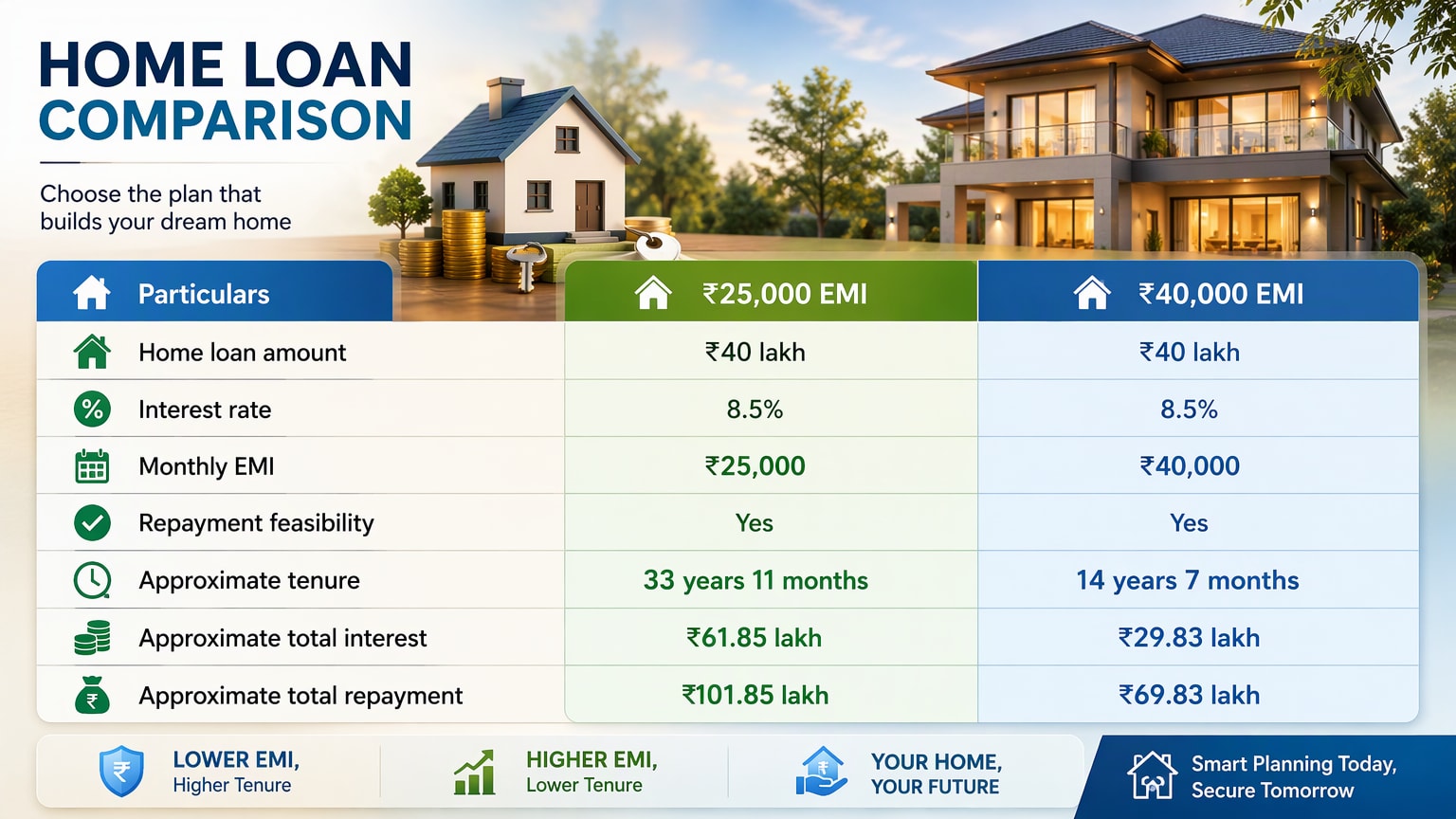
The comparison highlights why borrowers must assess the EMI against the outstanding principal and interest rate before finalising a repayment plan.
Why A Higher EMI Can Save Lakhs
A higher EMI reduces the outstanding principal faster. Since home loan interest is calculated on the outstanding balance, every additional rupee repaid towards the principal can reduce future interest costs.
This can make a considerable difference over a long repayment period.
However, Munish Jain of Capri Loans cautions that choosing the highest possible EMI is not necessarily the most sensible financial decision. Borrowers should consider income stability, existing financial commitments, emergency savings and long-term financial goals before committing to a repayment amount.
An aggressive EMI can leave households vulnerable if income falls or an unexpected expense arises.
Should Homebuyers Choose A Lower EMI?
A lower EMI can offer greater breathing room in the monthly budget. It may be particularly useful for young borrowers, households with multiple financial commitments or people whose income fluctuates. But affordability should not mean ignoring the long-term borrowing cost.
Jain recommends striking a balance between monthly affordability and repayment efficiency. Borrowers can begin with an EMI that fits comfortably within their budget and increase repayments as their income grows.
Salary increments, annual bonuses and other windfalls can also be used for partial loan prepayments. These payments can reduce the outstanding principal, shorten the repayment tenure and lower the overall interest burden.
The Smart Way To Repay A Home Loan
The objective should not be to finish a home loan at any cost. It should be to repay it without compromising financial stability.
A borrower who can comfortably afford a higher EMI may benefit from faster repayment and lower interest costs. Someone with limited monthly savings may be better off choosing a manageable EMI while making periodic prepayments.
As Munish Jain points out, maintaining financial flexibility is as important as reducing the overall borrowing cost.
Ultimately, the right home loan EMI is one that allows borrowers to meet their monthly obligations, build savings and steadily reduce their debt without putting their household finances under unnecessary pressure.
KioskNews shows a cleaned-up reading view extracted from the publisher’s page — the original always lives on their site, not ours.