Opinion: Blog: As Himalayas Change, Jim Corbett's Voice Echoes Louder Than Ever
'But how do we even know if all that Jim Corbett wrote about was even true?'
There was an audible gasp in the room.
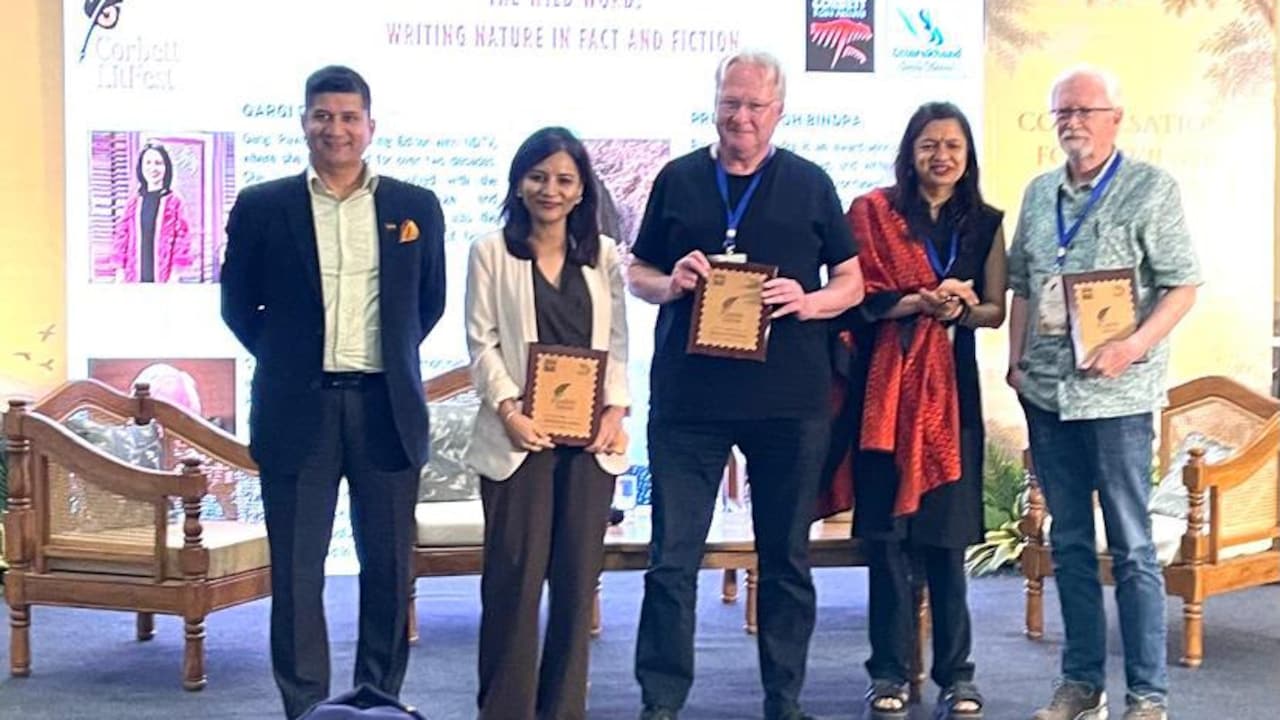
I was moderating a session on environment writing at the very first Corbett Literature Festival, being held right next to the Corbett National park, named after the celebrated hunter turned conservationist Jim Corbett.
The offending question, over the sanctity of Corbett's many tales, that have enthralled generations, was asked, in a light hearted manner, by Professor Richard Kerridge, himself a nature writer, who teaches creative writing at Bath Spa University.
Before I could react to the implications of the loaded statement he had just made, another panelist, prolific writer and celebrated author from the hills, Stephen Alter intervened.
'As someone who is from the region as well, I must step in here and defend Jim Corbett!' He said with some feeling, a smile on his face. 'How can you question our beloved hero? All his adventures, all his descriptions of chasing man-eating tigers and leopards in the Kumaon hills were all absolutely true!'
The hall, which was full of writers, environmentalists and wildlife enthusiasts laughed, and we continued our discussion, as Prerna Singh Bindra, the third panelist spoke about her favourite Jim Corbett book, and the fact that he his most popular book, The Man-eaters of Kumaon, was only published when he was in his 60s.
Ours was the last session of the three-day long inaugural Corbett Literature Festival.
Over the past three days, there has been a rich mix of conversations about books, the environment, the Himalayas, local cultures and communities, and even cuisine. Historian and food critic Pushpesh Pant had kept the audience entertained with a lively session on the region's food traditions.
The festival had also brought together celebrated photographers and filmmakers, who captivated audiences with films and photographic collections built over years of exploring the wilds of Corbett and the vast Himalayan landscapes. Their work offered glimpses of tigers and elephants, gharials basking by the river, the tall grasses of the grasslands and the Ramganga flowing through the forest.
My favourite screening was a short documentary made by the forest guards of Corbett. Using drones (and given the access they enjoy), they captured some spectacular images of the wild, offering a glimpse of the park that few get to see.
The visuals were spellbinding, but what made the screening particularly special was the opportunity it gave these often-unsung guardians of the forest to take centre stage and receive the applause they deserved, not just for their film, but also for the tireless work they do to protect a park that is loved by so many.
Renowned singer Jubin Nautiyal joined them on stage, alongside the forest guards and Divisional Forest Officers (DFOs), to felicitate and honour them.
As the audience applauded, it was a moment of recognition for the people who work, often away from the spotlight, to keep Corbett's wild heart beating.
The festival was organised in part by the Forest Department, with the dynamic Corbett Tiger Reserve Field Director Saket Badola closely involved in spearheading the effort, along with several corporates, and resorts in the area.
It was inaugurated by Forest Minister Subodh Uniyal, who spoke about the importance of communities in conservation. The Uttarakhand Tourism Development board also supported the festival, titled '3 days in the Wild' that brought together 30 speakers.
The involvement of resorts did not mean that tourism was spared from scrutiny. Several conversations tackled the issue of meaningful tourism and conservation.
Former park director Samir Sinha recounted an incident when he had entered a resort while tracking a tiger that was moving around habitation, and found a drain emptying dirty water straight into the Kosi river. The conversation pushed for responsible practices and finding the right balance when it comes to tourism.
And these are issues that need more attention, at a time when Uttarakhand is facing challenges in striking that balance between tourism, livelihoods and protecting the mountains and forests.
The Himalayas are currently witnessing an unprecedented expansion of tourism and infrastructure, often putting fragile ecosystems under immense pressure.
From unplanned construction and mounting waste to pressure on water resources, fragile mountain slopes and biodiversity, the environmental costs of this growth are becoming increasingly difficult to ignore.
This is why festivals and platforms like the Corbett Literature Festival matter.
After all, Jim Corbett was among the early voices in India to champion wildlife conservation and the protection of tigers, while also expressing a deep affection for, and concern about, the pahadi communities who lived alongside the forests he knew so well.
Wildlife historian Raza Kazmi shared a letter Corbett had written before leaving the country for Kenya.
"...I am glad I got that film when I did, for in a few years, ten at most, tigers will be extinct, except possibly in a few isolated pockets in Indian states..."
That prediction, however, did not come true. India's tigers survived, thanks in no small measure to decades of conservation efforts. But Corbett's words are a reminder of just how much we stand to lose when we fail to act in time.
Today, as we grapple with the pressures of tourism, development and climate change in our fragile Himalayan landscapes, his message remains as relevant as ever.
(Gargi Rawat is news anchor, consulting editor with NDTV and author of ‘Tiger Season')
KioskNews shows a cleaned-up reading view extracted from the publisher’s page — the original always lives on their site, not ours.