11 drills in 60 days: is India’s navy stretched too thin?
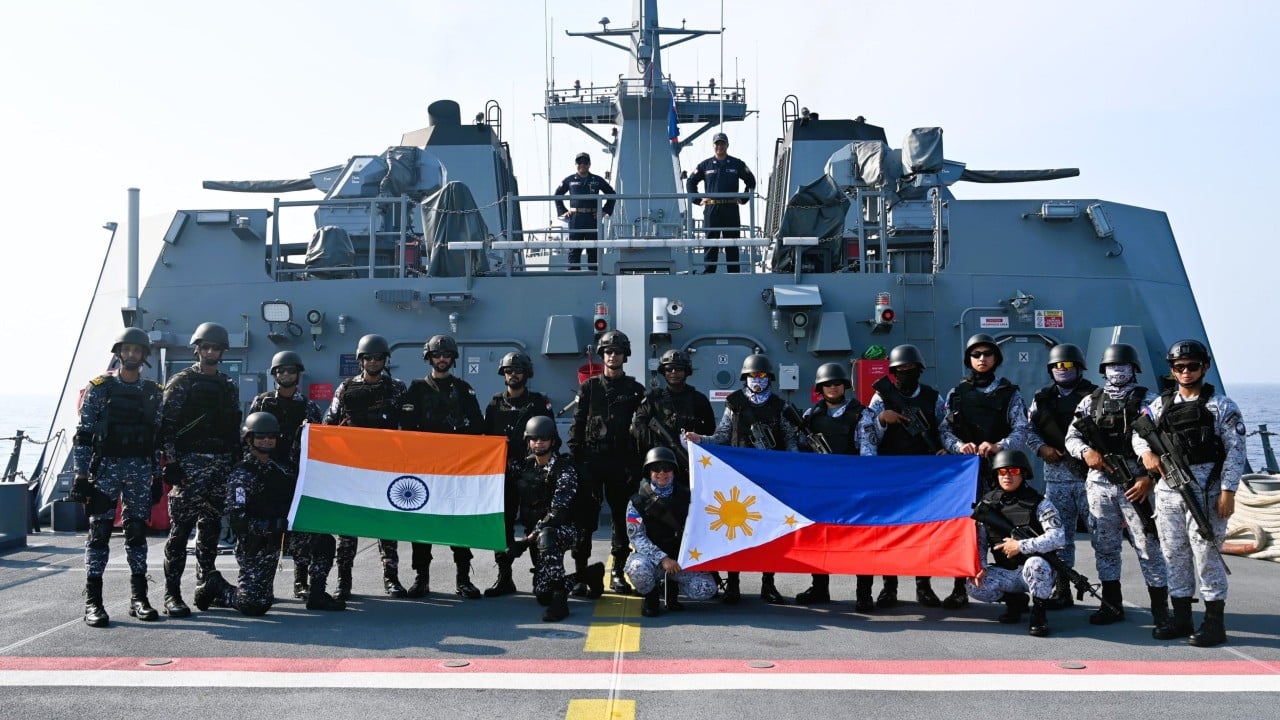
In the space of just two months, India’s navy has held joint exercises off the coasts of Britain, France, South Africa, Oman, the Philippines, South Korea, Japan and Russia’s far east.
Such a run of exercises signals a bid for a larger maritime role on the world stage, analysts say. Yet it also raises questions about whether a navy currently short on submarines and struggling to expand can support such global ambitions while also guarding India’s home waters.
Since mid-September, over a span of fewer than 60 days, Indian ships have taken part in:
-
Slinex with Sri Lanka off Visakhapatnam (September 17-21)
-
ADMM-Plus drills with multiple countries off Subic Bay (September 21-25)
-
Varuna with France at Toulon (September 22-28)
-
AIME with Asean member states at Subic Bay (September 28-October 2)
-
Konkan with the UK off Plymouth (October 8-15)
-
Indra with Russia at Vladivostok (October 13-18)
-
Simbex with Singapore in the Bay of Bengal (October 21-26)
-
IN-RoKN with South Korea at Busan (October 26-29)
-
Naseem Al Bahr with Oman off Muscat (November 8-12)
Why so many drills?
Indian officials cite the navy’s ability to operate concurrently across the Western Pacific, Mediterranean, North and South Atlantic and Indian Ocean as proof of its operational reach, logistics and endurance – and a reflection of both New Delhi’s policy of strategic autonomy and its global maritime vision and security doctrine, dubbed “Mahasagar”.
Analysts who spoke to This Week in Asia said the raft of recent drills helped India strengthen relationships and prove it could project maritime power beyond its immediate neighbourhood.
“Exercises and deployments are a tool of India’s multi-aligned foreign policy, for deepening relations with partners and adding nuance to its political-military signalling too,” said Antoine Levesques, a senior fellow for South and Central Asian defence at the International Institute for Strategic Studies.
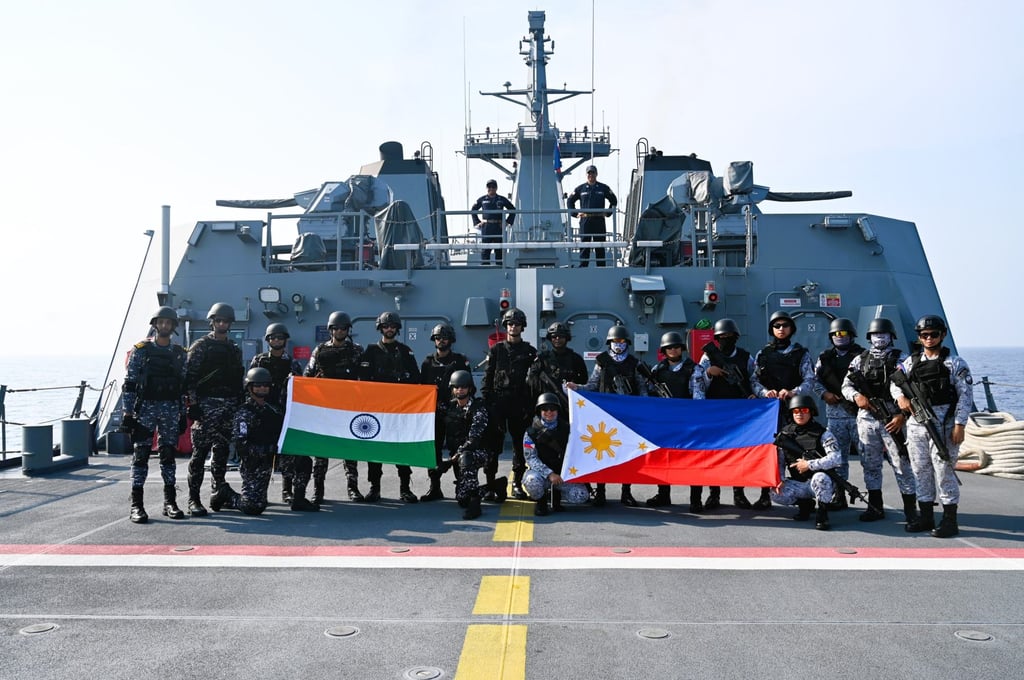
India’s participation in so many exercises could also be understood “as a form of diplomatic manoeuvring”, said Dongkeun Lee, a policy fellow at the Asia-Pacific Leadership Network specialising in maritime security.
“The Indian Navy not only participates in extra-regional exercises but also invites partner navies to the Indian Ocean region, showing that India’s partner countries are interested in Indian Ocean security and thereby contribute to the region’s balance of power,” he said.
“Demonstrating the Indian Navy’s capabilities overseas implies that [it] … could be deployed to other regions, coordinating with extra-regional partners in the event of a contingency against China.”
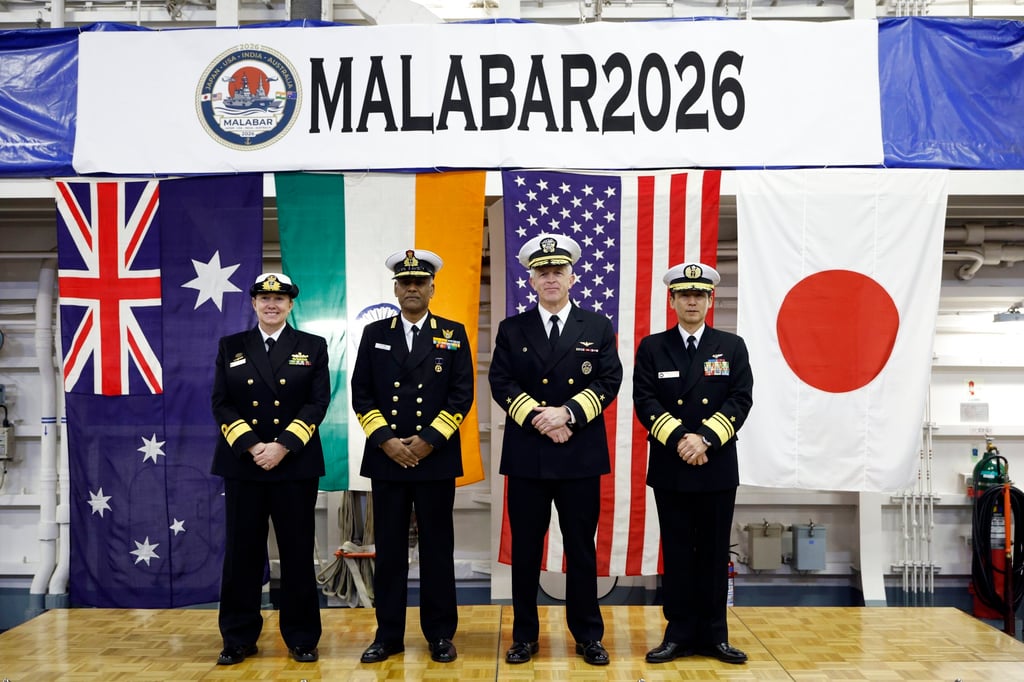
Walter Ladwig, a senior lecturer in international relations at King’s College London whose research focus includes South Asian security, agreed that experience gained from joint military exercises “would all be relevant in a scenario where the Indian Navy had to respond to Chinese naval activity in the Indian Ocean” – even if the countries taking part in such drills might not necessarily envisage fighting alongside one another in a conflict.
Retired Indian Navy captain Kamlesh K. Agnihotri, who now works as a senior fellow at the National Maritime Foundation in Delhi, told This Week in Asia that multinational drills such as Malabar and the biennial US-led Rim of the Pacific Exercise also had a deterrent effect.
“[They] send a clear strategic communication … that a coalition of like-minded nations and their forces will stand up to the coercive measures that are intended to alter the status quo and create a new normal by undermining the freedom of navigation and overflight,” he said.
With that in mind, India’s navy deploying for exercises far beyond the Indian Ocean region was about “much more than only diplomatic visibility”, Agnihotri added.
A changed world
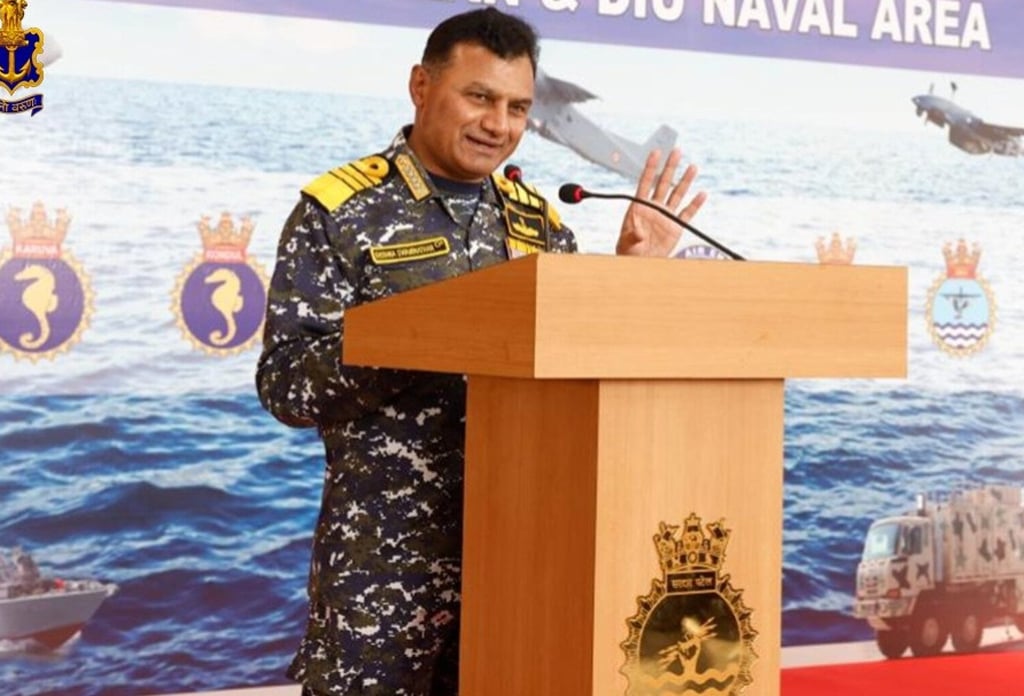
Speaking at this year’s Delhi Defence Dialogue on November 3, India’s navy chief Admiral Krishna Swaminathan stressed the need to develop a fighting force suited for “the 21st century operating environment”.
“The world has changed very vastly today from just a few years back,” he said. “Growing geopolitical tensions have inflamed a lot of old historical fault lines and today we find the use of force as an acceptable instrument of national policy. In fact, it’s not just an acceptable instrument, it is a preferred instrument.”
The world has changed very vastly today from just a few years back
The number of wars being fought globally had increased, Swaminathan noted, citing “about 65 state-based armed conflicts” last year alone – “perhaps the highest since records began being kept in 1946”.
Against such a backdrop, he said India was “quite cognisant of the capabilities of our adversaries”, adding that the country’s navy was keeping “a very good watch” on critical chokepoints such as the Strait of Malacca, in particular.
India currently operates two aircraft carriers, 13 destroyers, around 20 active frigates and over 20 smaller corvettes – plus dozens more auxiliary and support ships – crewed by more than 67,000 active personnel.
By 2035 it aims to have a 200-ship navy, with around 50 vessels and submarines on order – the vast majority of which are being built in Indian shipyards.
Analysts say submarine availability, ageing vessels and shipbuilding delays are some of the main obstacles hindering progress.
“The navy is not acquiring new boats fast enough to offset the old ones, let alone expand,” Ladwig said, adding that the size of India’s submarine fleet “needs to grow”.
Indeed, naval chief Swaminathan stressed at the defence dialogue in Delhi this month that India needed to speed up turning technological innovation into usable military capability, so it can “fight, sustain and adapt by itself without being constrained”.
Spread too thin?
As a “blue-water” navy, meaning one able to operate far from home, around two-thirds of India’s fleet is always kept available for sustained operations, according to Agnihotri, the naval veteran.
No more than three or four ships were ever deployed outside the Indian Ocean at any one time, he said – and only after the navy had calculated “the force level required for operations” at home.
“So if some serious crisis erupts near Indian waters, the available force level should be enough to handle that effectively,” Agnihotri said.
Lee said the types of ships deployed also mattered. Aircraft carriers and large destroyers were best suited to distant military operations, he said, while frigates and conventional non-nuclear submarines were better kept in reserve for a “serious crisis close to home”.
None of the recent exercises India took part in involved the two aircraft carriers it has in service, with the lion’s share of the Pacific engagements being handled by the INS Sahyadri, a Shivalik-class stealth frigate, and the INS Trishul of the Talwar-class being deployed to Europe. Around 10 vessels were reportedly deployed in total.
02:24
India launches its first home-grown aircraft carrier
Levesques said overseas deployments, including for joint exercises, did “exact a toll” on a navy’s ships and increased demand for maintenance and repairs, which is why most navies tended to group drills by region.
Many of India’s older ships and submarines are also of Russian origin, making the continued supply of Russian spares important – though the war in Ukraine does not appear to have disrupted deliveries, according to Levesques.
“Moreover, India’s steady induction of new naval platforms rests on ever greater proportions of indigenous content, increasing India’s overall ability to sustain its ambitions to exercise and deploy peacefully,” he said.
For Ladwig, “probably the most important constraint” on India’s ability to challenge Chinese naval operations in the Indian Ocean is its struggle to grow fast enough – “far more than a frigate spending a few weeks in Europe”.
“There are certainly capacity constraints in particular areas, most notably submarines, which have been a significant problem for some time,” he added.
KioskNews shows a cleaned-up reading view extracted from the publisher’s page — the original always lives on their site, not ours.