The GOP’s 2028 hopefuls navigate their party’s midterm wipeout: From the Politics Desk
Welcome to From the Politics Desk, a daily newsletter that brings you the NBC News Politics team’s latest reporting and analysis from the White House, Capitol Hill and the campaign trail.
In today’s edition, Kristen Welker dives into the early jockeying among the class of Republican White House contenders. Plus, Gary Grumbach explores why the Trump administration is moving on from its frequent voter fraud claims.
— Adam Wollner
The GOP’s 2028 hopefuls navigate their party’s midterm wipeout
Analysis by Kristen Welker
The dust has barely settled from the midterms, but there’s already been a lot of movement from potential Democratic presidential contenders ahead of what’s expected to be a sprawling contest reminiscent of the 20-plus person field from 2020.
While the positioning on the Republican side has so far been more subtle, it’s been equally notable.
In the weeks since the GOP suffered massive election losses, Vice President JD Vance has been trying to re-emphasize the “America” in “Make America Great Again.”
He’s distancing himself from the Iran war, sparring with a Republican governor on social media over immigration, and using a Fox News interview to invoke his call for “economic nationalism” and to “reindustrialize in the United States.”
Vance is not the only one emphasizing economic populism as the path forward for the bruised Republican Party. Sen. Josh Hawley, R-Mo., went from saying he has “no intention” of running for president in 2028 just two months ago to telling NBC News’ Allan Smith yesterday that he’s giving “serious thought” to what his political future might entail, not ruling out a White House bid.
Like Vance, Hawley emphasized how voters want to “get focused back on us, back on the blue-collar family that’s just trying to make it.” But unlike Vance, Hawley’s comments that “I’m not really a supporter of” the war with Iran are cleaner given his perch from outside the administration.
Even if the election results have diminished Trump’s political sway, he is still the primary force in Republican politics right now. And that’s why I’m paying close attention to how he talks about the race to be his successor.
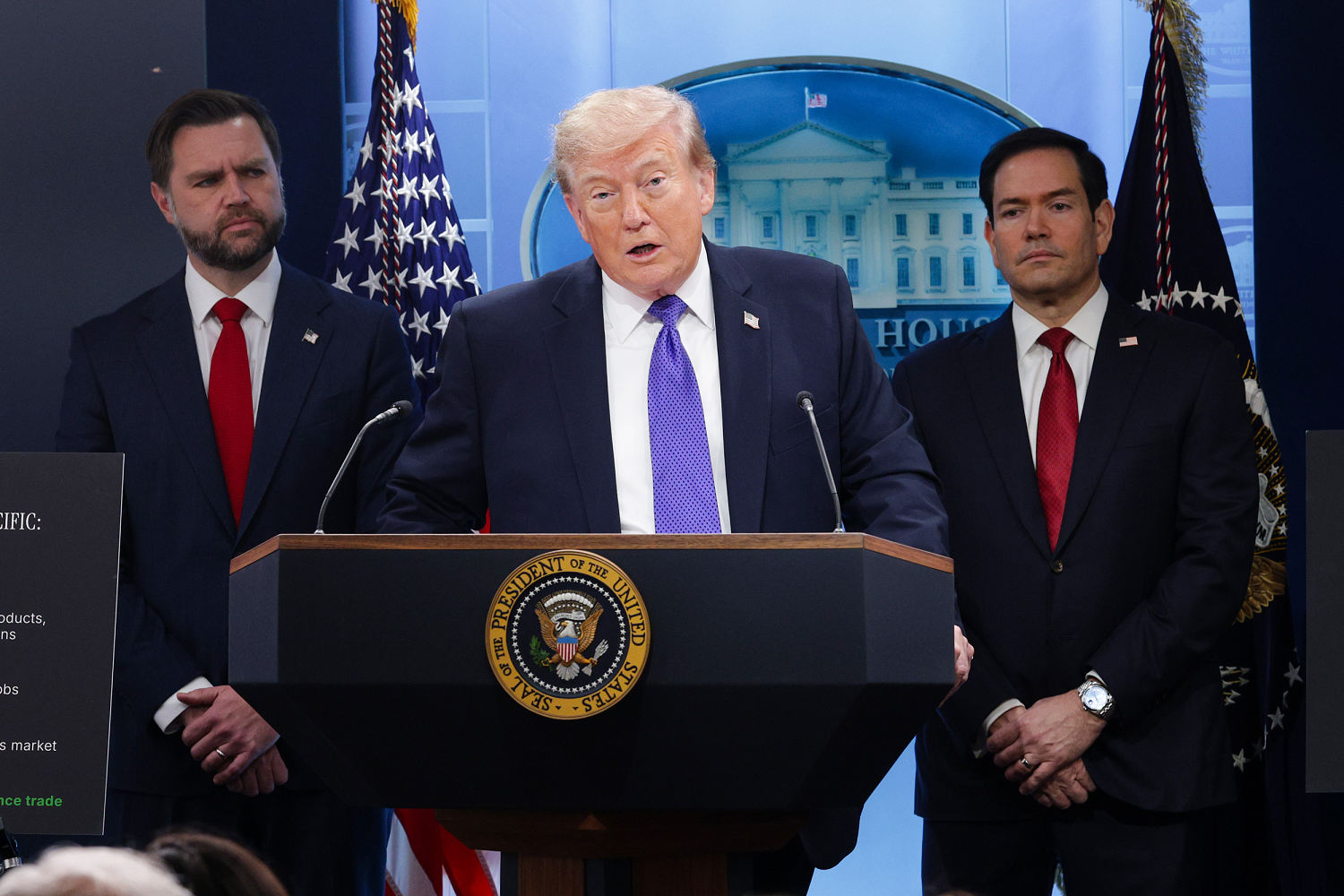
Vance and Secretary of State Marco Rubio flanked Trump in the White House briefing room today as he held a news conference after returning from his trip to China. In an interview yesterday with NBC News’ Gabe Gutierrez, Trump said of Vance and Rubio, “They’re both doing a great job.”
The topic of the Iran war came up again during the press briefing. Asked if the war was worth Republicans losing control of the Senate, Vance responded: “I think the president is the one who makes the decision. And the president has said he would do it again. And my view is that my goal is and my job is to support the president of the United States.”
And earlier, Trump was asked about Vance’s post-election social media post saying that the Iran war is the reason for the GOP’s losses. Trump said, “I thought the statement was fine, except I would have had one other thing, that if it were asked, I would have said — would you do it again? And absolutely. The answer is yes, because we cannot allow Iran to have a nuclear weapon.”
Outside of Washington, some of the tech billionaires who cozied up to Trump after he took office last year are now seeking some distance from the MAGA brand after the midterms. That includes Elon Musk, who gave hundreds of millions of dollars to help Republicans this election cycle and previously served as a Trump White House adviser. Trump told Gabe yesterday, “MAGA, to me, means something very specific, and when people veer from it, they don’t do very well.”
While it was technically in response to Musk, it’s a comment that could serve as a warning to those who believe their path to the presidency is by breaking from Trump’s vision for the GOP.
It’s against this backdrop that I’m looking forward to speaking with Sen. John Kennedy, R-La., who told me last month that he’s weighing his own presidential bid, on “Meet the Press” this Sunday.
And as Senate Democrats chart their path forward with their large new majority, I’ll also interview Sen. Chris Van Hollen, D-Md., who is challenging Sen. Chuck Schumer, D-N.Y., to be the leader of the chamber, and Sen.-elect Abdul El-Sayed, D-Mich. I hope you’ll join me.
DOJ’s focus on voter fraud fades post-midterms
By Gary Grumbach
Democrats flew election lawyers to key battleground states. Republicans recruited tens of thousands of volunteer poll watchers from coast to coast. The Justice Department implemented its largest election monitoring operation ever, after ramping up investigations of possible noncitizen voting. Department of Homeland Security officials threatened to hold up federal funding unless states complied with new election security measures.
But in the end, most of those resources weren’t needed. The 2026 midterm elections largely went off without a hitch.
It’s a stark departure from the doomsday election scenario that President Donald Trump and top members of his administration warned Americans about for nearly two years, as they raised fears of widespread noncitizen voting, including suggestions that Democrats might seek to rig the midterms.
But following Democrats’ decisive victory, the DOJ is dropping its appeals involving its litigation against states over potential voting concerns. Yesterday, the DOJ asked an appeals court to toss a civil suit it filed last month in Alaska that sought to block certification of the Senate election if GOP Sen. Dan Sullivan lost.
“Elections officials and civil society were as prepared as I’ve ever seen them, in 25 years of election work, to make sure that the process would be resistant and resilient to attempted disruption — and that preparation paid off,” said Justin Levitt, a professor at Loyola Marymount University who served as a White House policy adviser for democracy and voting under the Biden administration.
🗞️ Today's other top stories
- 📉 Market watch: The surging stock market of 2026 capsized today, wiping out gains for the year in the tech-heavy Nasdaq Composite and the Dow, while the broad S&P 500 entered correction territory, meaning it has declined 10% from its October peak. Read more →
- 🤖 New frontiers: Trump said he plans to restrict U.S. companies from building data centers overseas. Read more →
- ↘️ Expectation-setting: Sen. Bernie Moreno, the new chairman of the National Republican Senatorial Committee, said it will be “probably very” tough to regain control of the chamber in two years. Read more →
- 🔵 Near miss: Florida Democrats are lamenting their close losses in the state after a blue wave swept across much of the country. Read more →
- 🔎 Trump probes: Rep. Jamie Raskin, D-Md., the incoming chairman of the House Judiciary Committee, is focusing on the Trump administration’s use of the encrypted messaging app Signal, warning that there’s significant evidence officials “engaged in the widespread destruction, mutilation, and concealment of government records, seemingly with the express purpose of circumventing federal record preservation laws.” Read more →
- 🎤 On the hot seat: Michael LoSapio, Trump’s nominee to lead the Cybersecurity and Infrastructure Security Agency, refused to answer who won the 2020 presidential election or call the riot on Jan. 6, 2021, “an attack” during his confirmation hearing. Read more →
- 🎮 More of a Pac-Man crowd: While “Grand Theft Auto VI” may be taking the country by storm, you’d be hard pressed to find a senator who is spending their free time stealing cars and making minor renovations on their digital house in the fictional, Florida-esque state of Leonida. Read more →
That’s all From the Politics Desk for now. Today’s newsletter was compiled by Adam Wollner.
If you have feedback — likes or dislikes — email us at politicsnewsletter@nbcuni.com
And if you’re a fan, please share with everyone and anyone. They can sign up here.
KioskNews shows a cleaned-up reading view extracted from the publisher’s page — the original always lives on their site, not ours.